
 Worksheets
Presidency Review 2
Total questions: 15
Worksheet time: 8mins
What is the constitutional basis for the executive order power?
Ordinance power
Executive privilege
Whig theory
Stewardship theory
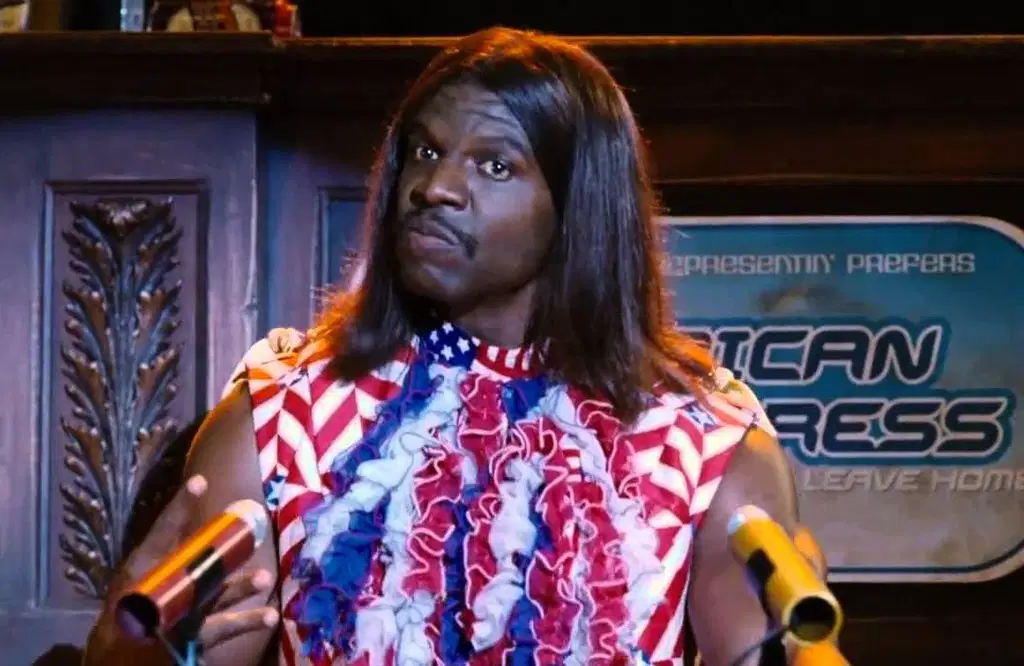
Who was the first president to claim executive privilege?
George Washington
Andrew Jackson
Theodore Roosevelt
Richard Nixon
Dwayne Camacho
Presidents acting on the basis of the _____________________ are the most likely to see executive power in narrow terms.
Whig theory
Stewardship theory
Imperial presidency
Unitary executive theory
Which of the following was not one of the "weak presidents"?
Lyndon B. Johnson
Jimmy Carter
Gerald Ford
Ronald Reagan
Which of the following did not limit presidential power vis-a-vis Congress?
National Labor Relations Board v. Canning
Train v. City of New York
War Powers Act
US v. Lopez
Impoundment Control Act of 1974
Unitary executive theory is a most prominent feature in which presidency?
George W. Bush
Ronald Reagan
George Washington
Theodore Roosevelt
Barack Obama

The scenario best highlights which of the following statements about court appointees?
Life tenure for appointed justices alongside the power of judicial review increases the stakes in the confirmation process for nominees to the Supreme Court.
Judicial appointees tend to make controversial statements on important policy issues during their confirmation hearings to get confirmed.
The merit system for hiring members of the bureaucracy extends to the vetting process for nominations to the Supreme Court.
Presidents usually request that the Senate be slow and deliberate with judicial appointments to check the power of the judicial branch.
Which of these presidential appointments would not require Senate confirmation?
Chief of Staff
Attorney General
Chair of the Council of Economic Advisers
Director of the Office of Management and Budget
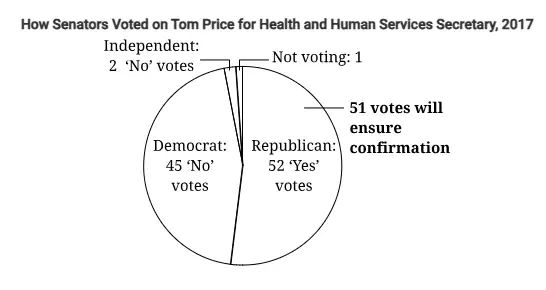
Which statement best explains the information in the graphic?
The secretary was confirmed by partisan vote.
Confirmation was blocked by one party.
Independents swayed the vote for the majority.
Attempts at compromise were unsuccessful.

Based on the passage, which of the following constitutional provisions would the author most likely identify as a solution to the problem of the imperial presidency?
Congress exercising the power to regulate commerce.
Congress insisting that it declare war prior to the use of international force.
The president making stronger use of bureaucratic discretion.
Congress creating term limits for all members of government.

Which of the following best reflects the author's concern about an "imperial" presidency?
The Senate ratifying treaties without executive approval.
The president issuing an increasing number of executive agreements.
Congress declaring war independent of the president.
The president appointing a new secretary of education.
A newly elected president faces a Senate controlled by the opposition party. Which of the following presidential appointments is the most likely to encounter difficulty with confirmation by the Senate.
Secretary of Defense
Supreme Court Justice
Chairman of the Federal Reserve
White House Counsel

Which of these scenarios illustrates how social media has changed the way presidents relate to the public?
A
B
C
D

In the Federalist 70, Alexander Hamilton states that "energy in the executive is a leading character in the definition of good government." In this statement, Hamilton is arguing in favor of the need for which option?
A
B
C
D

Which of the following best explains a reason that a president might use a signing statement to express displeasure with a bill as opposed to issuing a veto?
The president may have objections to provisions of a bill but does not want to risk Congress overriding a veto.
Congress has severely curtailed the power of the president to withhold funds for bills that have been adopted.
The Supreme Court is hesitant to acknowledge the president's power to veto legislation.
The president wants to ensure executive agencies do not spend the money appropriated by Congress.

