
 Worksheets
Units 8, 6, & 7 Potpourri Exam
Total questions: 53
Worksheet time: 53mins
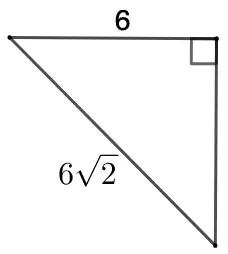
1. Consider the triangle shown. Explain how you know the given triangle is a 45°, 45°, 90° triangle.
The triangle has two equal sides and one right angle.
The triangle has three equal sides.
The hypotenuse is equal to the leg times the square root of 2 (about 1.41)
The triangle has one right angle and two different angles.

Consider the triangle shown. Find the missing length.
6
5
7
8

Consider the triangle shown. Which of the following explains how you know the given triangle is a 45°, 45°, 90° triangle?
The triangle has two equal sides, and thus two equal angles.
The triangle has three equal sides.
The triangle has two right angles.
The triangle has one angle greater than 90°.

Consider the triangle shown. b. Find the length of the hypotenuse.
3√2
2√2
4
5
The hypotenuse of a 45°, 45°, 90° triangle has a length of 20 centimeters. Find the length of a leg of the triangle.
10√2 or 20/√2
10
20
5√2
The hypotenuse of a 45°, 45°, 90° triangle has a length of 68 centimeters. Find the length of a leg of the triangle.
34√2 or 68/√2
34
68
68√2

Find the value of x.
17√2
17
34
Not enough information.

Find the value of x.
22
22√2
11√2 or 22/√2
11
Which is equivalent to: √48?
4√3
2√12
3√6
9√3
Which is equivalent to 32/√2?
16√2
8√2
32√2
4√2

11. △CAR is shown. a. Find m∠C.
m∠C = 66
m∠C = 45°
m∠C = 90°
m∠C = 30°

Find CA.
CA = 24√2
CA = 30
CA = 20
CA = 15
In △HOG, m∠H = 60°, m∠O = 90°, and m∠G = 30°. Find GHOH .
GHOH=3
GHOH=1
GHOH=21
GHOH=2
In a 30°, 60°, 90° right triangle TOP, side TO is opposite the 30° angle and side OP is the hypotenuse. How many times greater is OP than TO?
OP is 2 times greater than TO
OP is 1.5 times greater than TO
OP is 3 times greater than TO
OP is 4 times greater than TO
In right triangle LET, the ratio LEET=21 . What is the measure of ∠L if LE is the hypotenuse of the triangle?
∠L = 60°
∠L = 45°
∠L = 30°
∠L = 90°

△ABC is shown (not drawn to scale). Which of the following statements is true?
△ABC is a 30°, 60°, 90° triangle.
△ABC is a 45°, 45°, 90° triangle.
△ABC is a equilateral triangle.
The side lengths given for △ABC do not make a right triangle.
Is the following statement always, sometimes, or never true?
"Two triangles with different side lengths are similar figures"
Always
Sometimes
Never
Are the following statements always, sometimes, or never true? b. Two triangles with different side lengths are congruent figures.
Always
Sometimes
Never
Is the following statements always, sometimes, or never true?
"Two circles with different radii are similar figures"
Always
Sometimes
Never

The image of a basketball (shown to the left) was scaled to produce the image in Figure 2 (to the right). This scaling represents:
an enlargement
a reduction

If triangle ABC is dilated about point A with a scale factor of 21 , what is the slope of line segment B'C'?
The slope of line segment B'C' is the same as the slope of BC, which is −32 .
The slope of line segment B'C' is undefined.
The slope of line segment B'C' is 0.
The slope of line segment B'C' is 1.

If triangle ABC is dilated about point B with a scale factor of 2, what is the slope of line segment A'B'?
0
-2/3
3/-2
undefined
Lindsey was dilating a rectangle by a scale factor of 2. In the original rectangle, the sum of the 4 angles was 360°. She predicted that the sum of the 4 angles would be twice as large or 720°. Is Lindsey’s prediction correct?
Yes, the sum of the angles will be 720°.
No, the sum of the angles will remain 360°.
Yes, because the scale factor affects the angles.
No, the sum becomes 180 because the figure becomes a triangle.

Write the equation of the circle shown.
(x−3)2+(y+2)2=25
(x+3)2+(y−2)2=16
(x+3)2+(y+2)2=25
(x+3)2+(y+2)2=16

Write the equation of the circle shown.
(x−3)2+(y+2)2=20
(x+3)2+(y−2)2=16
(x−3)2+(y+4)2=20
(x+3)2+(y+2)2=16
Write an equation of a circle that is centered at the origin and has a diameter of 18.
x2+y2=81
x2+y2=36
x2+y2=18
x2+y2=9
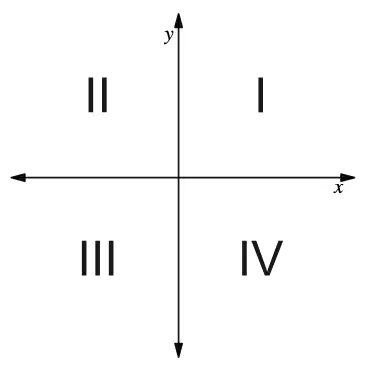
Consider the circle given by (x−3)2+(y+4)2=16 . In which quadrant is the center of the circle?
Quadrant I
Quadrant II
Quadrant III
Quadrant IV
Consider the circle given by (x−3)2+(y+4)2=16 . What is the radius of the circle?
2
3
4
5
Is (-1, -4) a point inside, on, or outside the circle given by (x+3)2+(y−1)2=25 ?
Inside the circle
On the circle
Outside the circle
Is (0, 0) a point inside, on, or outside the circle given by (x−2)2+(y−3)2=16 ?
Inside the circle
On the circle
Outside the circle
A circle has an area of 84 square inches. Find the radius of the circle, to the nearest hundredth.
4.61 inches
5.17 inches
5.18 inches
5.19 inches
A circle has an area of 100 square centimeters. Find the radius of the circle, to the nearest hundredth.
5.64 cm
5.65 cm
5.66 cm
5.67 cm
A circle has a circumference of 44 mm. Find the radius of the circle, to the nearest hundredth.
6.99 mm
7.00 mm
7.01 mm
7.02 mm
A circle has a circumference of 18 inches. Find the radius of the circle, to the nearest hundredth.
2.87 inches
2.86 inches
2.85 inches
2.84 inches
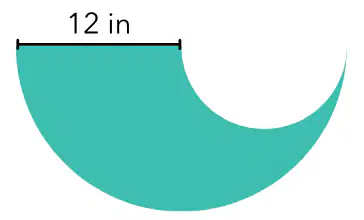
A semicircle is cut out of a larger semicircle with a radius of 12 in. The resulting shape is shown. Find the area of the shape.
113.04 in²
169.65 in²
339.12 in²
452.16 in²

A semicircle is added to the side of a quarter circle, as shown in the image. The radius of the quarter circle is 50 cm. Find the area of the shape.
7850 cm²
3925.76 cm²
2945.24 cm²
3140.92 cm²

The shape shown is made up of three semicircles, centered at A, B, and C, respectively. If B is the midpoint of AC and AC = 12 m, find the area of the shape.
72π m²
54π m²
36π m²
18π m²
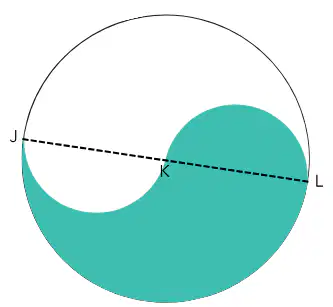
JL is a diameter of the circle centered at K. JK and LK are diameters of the semicircles shown in the figure. The length of JL is 36 inches. What is the area of the shaded region?
324π square inches
162π square inches
648π square inches
81π square inches
The circumference of a circle is 22π cm. Find the area of the circle.
121π cm²
44π cm²
77π cm²
154π cm²
The circumference of a circle is 30π cm. Find the area of the circle.
225π cm²
150π cm²
75π cm²
100π cm²


Determine whether the triangles are similar by AA~, SSS~, SAS~, or not similar.
AA
SSS
SAS
Not similar

Determine whether the triangles are similar by AA~, SSS~, SAS~, or not similar.
AA
SSS
SAS
no similar

Determine whether the triangles are similar by AA~, SSS~, SAS~, or not similar.
SSS
AA
SAS
not similar
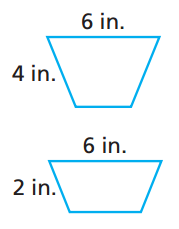

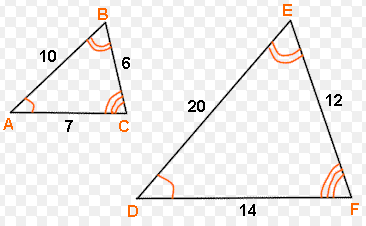
What is the Scale Factor from ΔDEF (original) to ΔABC (new)?
1/2
7/3
2
10/3

What is the Scale Factor from ABCD (original) to MNOP (new)?
2/3
3/2
2
3

Find x.
10
103
102
20

Find a.
12
24
243
16

