
 Worksheets
Thursday 4/17 Group D
Total questions: 6
Worksheet time: 8mins
What event marked the beginning of the Civil War?
Confederate troops fired on Fort Sumter
Union forces surrendered at Fort Sumter
Four more states joined the Confederacy
The signing of the Emancipation Proclamation
How long did it take for Union forces to surrender after the attack on Fort Sumter?
Less than 34 hours
48 hours
72 hours
One week
Which state was NOT mentioned as joining the Confederacy after the battle at Fort Sumter?
California
Texas
South Carolina
Virginia
Where did the first battle of the Civil War take place?
Fort Sumter
Gettysburg
Antietam
Bull Run
How many states joined the Confederacy after the fighting at Fort Sumter?
Four
Two
Six
Eight
Why did Southerners support states’ rights?
The population of the South believed that each state was its own country.
Southerners did not want the federal government to abolish slavery because it was not in their interests.
The southern states wanted to own the rights to all railroad tracks in their state.
Many Southerners disagreed on the issue of women’s suffrage.
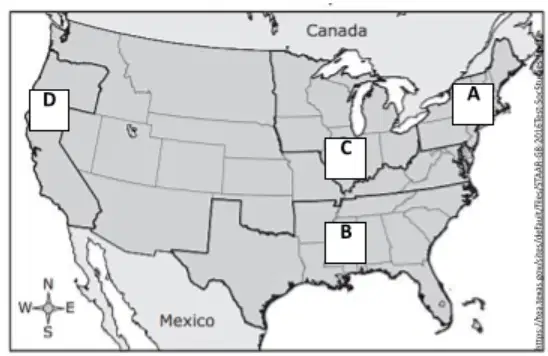
Which region’s primary economic activity in the 1860s was the cultivation of cotton?
A
B
C
D
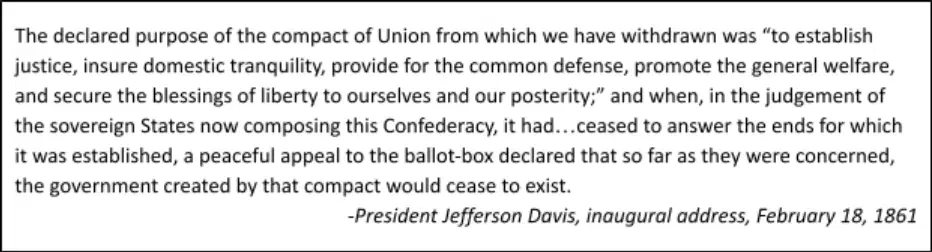
How did President Abraham Lincoln react to the idea expressed in Jefferson Davis’s inaugural address?
Lincoln stated that the argument by the South to leave the Union was unjustified.
Lincoln called on the U.S. Supreme Court to make a ruling on the legality of secession.
Lincoln believed the reasoning to leave the Union was protected by the Constitution.
Lincoln prepared to amend the Constitution in order to appease the Southern states.
What was one effect of the Fugitive Slave Act of 1850?
The Republican Party lost influence in the federal legislature.
The Missouri Compromise was deemed unconstitutional by federal courts.
Tensions among the populations of northern and southern states increased.
Immigrants were forced to relocate from eastern cities to western territories.
Match the following.
Ruled slaves were property and not citizens
Dred Scott v. Sandford
North and South agreed; California became a free state; strict
fugitive slave law was passed
Compromise of 1850
Geography caused country to develop economic differences
Sectionalism
Attempted to solve the issue of slavery through popular sovereignty; violence erupted as a result of the law
Kansas-Nebraska Act

