
NEW
Font size
 Worksheets
Gravity and Orbitals
Total questions: 14
Worksheet time: 15mins
Define the term 'Orbit'.
The path of a celestial body or an artificial satellite as it revolves around another body
A type of star
A phase of the moon
A type of galaxy
An ellipse is defined as:
A circle
A set of points equidistant from a single point
A set of points such that the sum of the distances from two fixed points is constant
A parabola
The term 'Semi-major Axis' is defined as:
The longest diameter of an ellipse
The shortest diameter of an ellipse
The distance from the center to the edge of a circle
The radius of a sphere
The term 'Orbital Period' is defined as:
The time taken for a planet to complete one orbit around the sun.
The distance between a planet and the sun.
The speed at which a planet orbits the sun.
The gravitational force between a planet and the sun.
Gravitational Force is defined as:
The force that attracts any two objects with mass.
The force that repels objects with mass.
The energy stored in an object due to its position.
The force that acts only on objects in motion.
Define the term 'Perihelion'.
The point in the orbit of a planet where it is closest to the Sun
The point in the orbit of a planet where it is farthest from the Sun
The point in the orbit of a planet where it is closest to the Moon
The point in the orbit of a planet where it is farthest from the Moon
Define the term 'Aphelion'.
The point in the orbit of a planet where it is closest to the Sun.
The point in the orbit of a planet where it is farthest from the Sun.
The point in the orbit of a planet where it is neither closest nor farthest from the Sun.
The point in the orbit of a planet where it is closest to another planet.
What is the shape of the orbits in Kepler's First Law?
Elliptical
Circular
Parabolic
Hyperbolic
According to Kepler's Second Law, when do planets move faster?
When they are closer to the sun (perihelion).
When they are farther from the sun (aphelion).
When they are at the same distance from the sun.
When they are moving in a circular orbit.
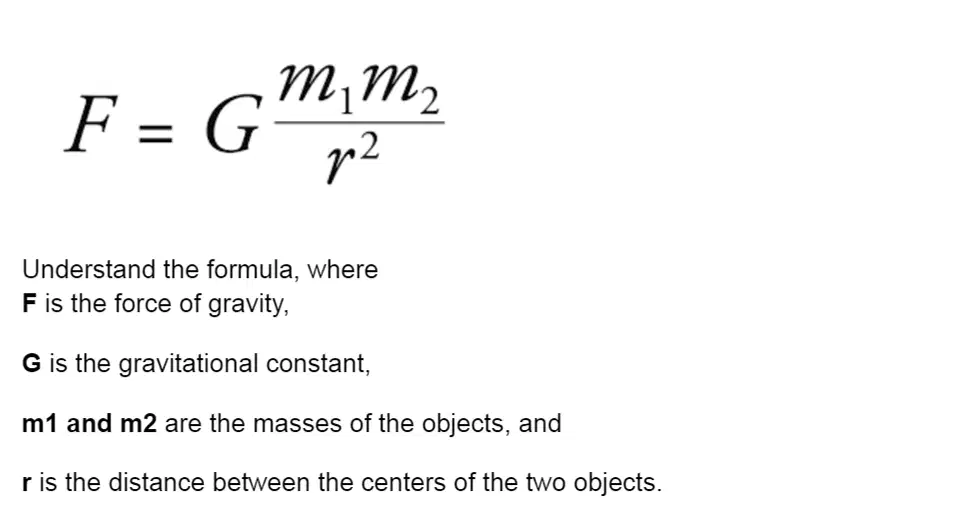
What does the formula F=G(m1∗m2)/r2 represent?
Newton's Law of Universal Gravitation
Einstein's Theory of Relativity
Coulomb's Law
Pythagorean Theorem
Gravity affects the orbits of planets around the sun by:
providing a force that keeps them in orbit
pushing them away from the sun
having no effect on their motion
causing them to move in a straight line
Gravitational Force Conceptual: If the distance between two objects in space is halved, how does the gravitational force between them change?
Increase
It remains the same
Decrease
Gravity and inertia work together to keep a planet in orbit around the sun by:
providing a balance between the sun's gravitational pull and the planet's forward motion
allowing the planet to move in a straight line away from the sun
causing the planet to stop moving
making the planet move in a random path
During which part of Earth's orbit is it moving the fastest, and why?
During perihelion, because it is closest to the Sun and gravitational pull is strongest.
During aphelion, because it is farthest from the Sun and gravitational pull is weakest.
During the equinoxes, because the Earth's tilt is neutral.
During the solstices, because the Earth's tilt is at its maximum.

