
 Worksheets
Ôn Math 6th
Total questions: 106
Worksheet time: 18mins
Integers is Whole numbers that can be
positive
negative
zero
Positive only
negative only
Decimals is Numbers with a whole part and fractional part.
Place Value is The value of each digit that appears in a number.
Ordering is Changing a number to the closest desired place value.
Ordering is
The value of each digit that appears in a number.
Numbers with a whole part and fractional part.
A method of arranging numbers.
The value of each digit that appears in a number
Rounding is
The value of each digit that appears in a number
A method of arranging numbers.
Changing a number to the closest desired place value.
What is a digit?


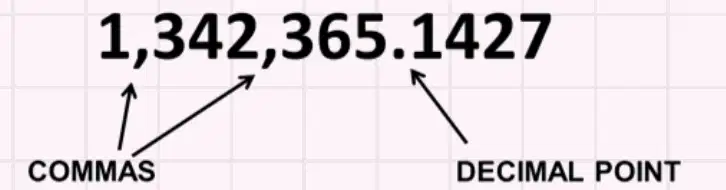
Integers are to the right of the decimal point
Decimal places are to the right of the decimal point
You must use the word ‘and’ to separate the digits on either side of the decimal point,
You must add “ths” to your words.
for example:
1.25 =
(a)
You must use the word ‘and’ to separate the digits on either side of the decimal point,
You must add “ths” to your words.
for example:
2.004 =
(a)
You can also write and say each digit separately after the decimal point. For example:
1.25 =
(a)
You can also write and say each digit separately after the decimal point. For example:
2.004 =
(a)
Ascend means 'to go up'. Numbers that are in ascending order start small and end big.
Descend means 'to go down'. Numbers that are in descending order start big and end small.
(a) means 'to go up'. Numbers that are in ascending order start small and end big.
(a) means 'to go down'. Numbers that are in descending order start big and end small
Ascending Order means Arrange these numbers from largest to smallest
Descending Order: 0.0067, 0.007, 0.00618, 0.00701, 0.006
0.00701
0.007
0.0067
0.00618
0.006
0.00701
0.00618
0.006
0.00701
0.0067
0.006
0.00618
0.0067
0.007
0.00701
Rounding to 3DP : 45.3467
(a)
Rounding to 2 DP : 45.3467
(a)
Rounding to 1 DP: 45.3467
(a)
Round the number to the nearest ten:
1,253
(a)
Round the number to the nearest ten:
455
(a)
Round the number to the nearest ten:
3,699
(a)
Round the number to the nearest hundred:
726,553
(a)
Round the number to the nearest hundred:
1,698
(a)
Round the number to the nearest hundred:
49
(a)
Round the number to 3 decimals:
4.6799
(a)
Round the number to 3 decimals:
292.3984
(a)
Round the number to 3 decimals:
9.999
(a)
Round the number to 1DP : 8.789
(a)
Round the number to 2DP : 3.987
(a)
Round the number to 3 DP : 32.45678
(a)
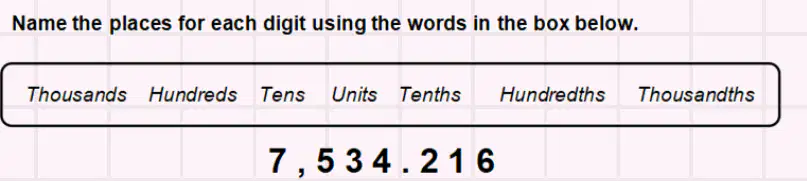
choose correct answer
7: Thousands
1: Hundred
6: Thousandths
4: Units
2: Tenths
Significant Figures Rules:
Rule 1: Non-zero digits (#1-9) are (a)
Significant Figures Rules:
Rule 1: Non-zero digits (#1-9) are (a)
Significant Figures Rules:
Rule 2: zero in between two non-zero digits are (a)
Significant Figures Rules:
Rule 3: Leading zeros are (a)
Significant Figures Rules:
Rule 4: Trailing zeros are (a)
How many SF in each of the following numbers?
9,999,990
7 SF
6 SF
5 SF
1 SF
How many SF in each of the following numbers?
0.00000009
7 SF
6 SF
5 SF
1 SF
How many SF in each of the following numbers?
1,000,001
7 SF
6 SF
5 SF
1 SF
How many SF in each of the following numbers?
986,001
3 SF
6 SF
4 SF
3 SF
How many SF in each of the following numbers?
0.42
7 SF
6 SF
2 SF
3 SF
How many SF in each of the following numbers?
7.00008
7 SF
6 SF
2 SF
3 SF
How many SF in each of the following numbers?
53
7 SF
6 SF
2 SF
3 SF
How many SF in each of the following numbers?
1234,567
4 SF
7 SF
2 SF
3 SF
(a) is when we use an estimated value to write an approximate answer
(a) is replacing a value with an approximate value that is quicker and easier to do calculations with.
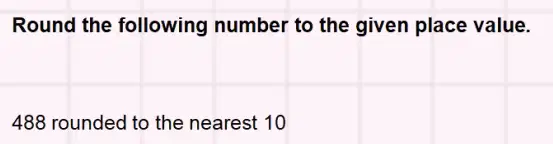
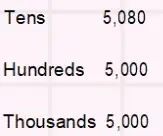
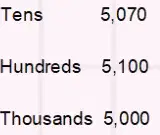
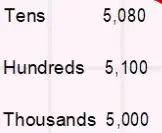
590
490
480
500

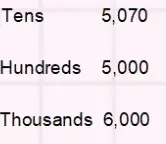

898,000
897,000
897,500
897,400
ROUND 18,891 TO THE NEAREST THOUSAND
18,000
18,900
19,000
20,000
round 8,914 to the nearest hundred
8,910
8,900
9,000
8,800

(a)
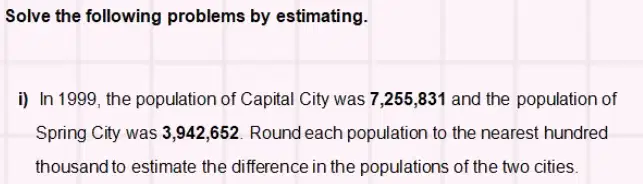
3,400,000
3,500,000
3,313,000
3,300,000

2,400km
2,200 km
2,300 km
2,500 km
A number rounded to the nearest hundred is 9,200
Determine the largest possible number.
9,250
9,249
9,151
9,248
There are 7,453 pine trees currently in the park, Park workers will plant 9,932 more pine trees today. How many pine trees will be in the park when the workers are finished? Estimate your answer to the nearest thousand.
(a)
(a) means If you divide one number by another, without leaving a remainder
(a) is A number that can be divided by 2 without leaving a remainder.
The (a) is the amount "left over" after dividing.
A number is divisible by 2 if the last digit is ................
even
odd
zero
A number is divisible by three if the sum of the digits is divisible by (a)
A number is divisible by 4 if the sum of the digits is divisible by (a)
A number is divisible by 5 if the last digit is a ....... or...............
2
0
3
5
A number is divisible by 6 when it is divisible by ..... AND .....
2 and 3
2 and 4
2 and 5
A number is divisible by 9 if the (a) is divisible by 9
A number is divisible by 10 if it (a) in a ZERO.
A number is divisible by 2 if the last digit is (a)
A number is divisible by 5 if the last digit is a (a)
A number is divisible by 4 if the (a) are divisible by 4
199 is (a) by 2 because the last digit is odd
65 is not divisible by 6 as the last digit is not divisible by (a) .
432 is divisible by two because the (a)
561 divisible by 3?
yes
no
10,890 is divisible by 9 ?
yes
no
There are 10 laps in a relay race. Each member of a relay team must run the same whole number of laps. Using divisibility rules, find all the possible numbers of team members.
1
2
5
10
4
Jane’s little brother is playing with Lego pieces. He wants to put all 39 of his blocks into stacks with the same number of blocks in each stack. How many stacks could Jane’s brother make?
1
3
13
39
23
Last year a drinks company produced the same number of cans of each flavour. If the company produced 7,194 cans in total last year, how many different flavours did the company make?
(a)
An (a) (indices) is the amount of times the base number is multiplied by itself.
If a number is (a) , this means we have multiplied that number by its self twice.
If a number is (a) , this means we have multiplied that number by its self 3 times.
(a) - a number that is multiplied by itself to get to an answer.
(a) - a number that is multiplied by itself three times (cubed) get to an answer
(a) are an easy way of writing repeated multiplications of the same number.
The Laws of Indices:
Law 1: When the index of a base number is (a) , the answer is always the base number itself.
The Laws of Indices:
Law 2: When the index of a base number is (a) , the answer is always one.
The Laws of Indices:
Law 3: When the index has a (a) , such as 102 , we multiply by 10.
The Laws of Indices:
Law 4: When multiplying two of the same number with different indices together we (a) the indices.
The Laws of Indices:
Law 5: When dividing two of the same number with different indices we (a) the indices.
The Laws of Indices:
Law 6: When multiplying an index inside a bracket with an index outside a bracket we (a) the indices together.
Write each product as a single power.
2 5 x 2 5
2 10
2 25
4 5
4 10
Write each product as a single power.
6 8 : 6 2
6 6
6 4
6 16
6 10
Roots are the opposite of indices.
select correct sentences
12 squared is 144
11 squared is 121
The square root of 144 is 12
The square root of 121 is 11
The square root of 64 is (a)
The square root of 729 is (a)
The square root of 169 is (a)
The cube root of 216 is
(a)
The cube root of 512 is (a)
A number multiplied by itself to get answer is called a (a)

(a)

√16 = 4

