
 Worksheets
Funda2 U4 Lesson 4
Total questions: 28
Worksheet time: 2hrs 54mins

Look at the noun in the first sentence. Add the pronoun that refers to, or goes with, the noun.
Otto Frank, Anne's father, had and office. The family hid above (a) .
say:
Otto Frank, Anne's father, had and office. The family hid above it.
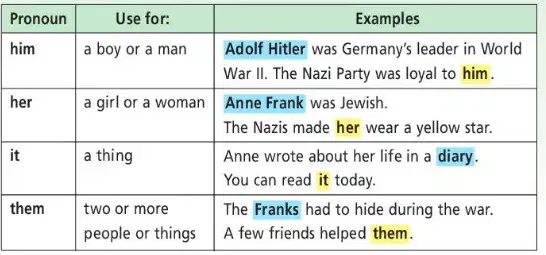
Look at the noun in the first sentence. Add the pronoun that refers to, or goes with, the noun.
A boy named Peter also hid there. Anne became good friends with (a) .
say:
A boy named Peter also hid there. Anne became good friends with him.

Look at the noun in the first sentence. Add the pronoun that refers to, or goes with, the noun.
One horrible morning, the Nazis found the family. The soldiers took (a) to prison camps.
say:
One horrible morning, the Nazis found the family. The soldiers took them to prison camps.
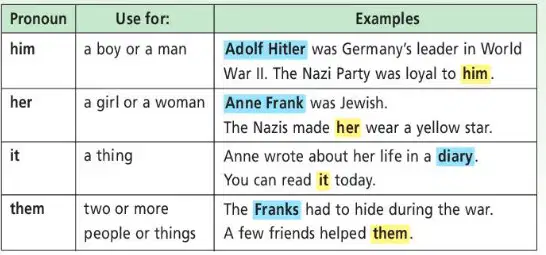
Look at the noun in the first sentence. Add the pronoun that refers to, or goes with, the noun.
Anne left her diary in the hiding place. A friend found (a) .
say:
Anne left her diary in the hiding place. A friend found it.
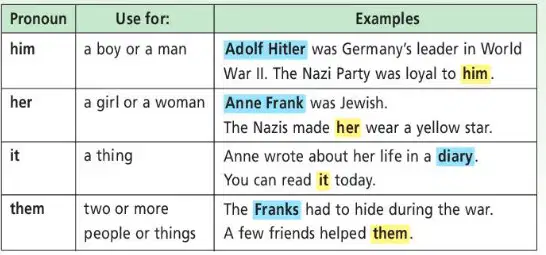
Look at the noun in the first sentence. Add the pronoun that refers to, or goes with, the noun.
Anne died in the prison camps. After the war, Mr. Frank published her diary. He wanted people to remember (a) .
say:
Anne died in the prison camps. After the war, Mr. Frank published her diary. He wanted people to remember her.

Look at the noun in the first sentence. Add the pronoun that refers to, or goes with, the noun.
You can read Anne's diary in many languages. Many people have read (a) .
say:
You can read Anne's diary in many languages. Many people have read it.
Look at the noun in the first sentence. Add the pronoun that refers to, or goes with, the noun.
Nelson Mandela, a leader in South Africa, said the story encouraged (a) .
say:
Nelson Mandela, a leader in South Africa, said the story encouraged him.
Look at the noun in the first sentence. Add the pronoun that refers to, or goes with, the noun.
Several writers have been interested in Ann. They wrote books about (a) .
say:
Several writers have been interested in Ann. They wrote books about her.
Look at the noun in the first sentence. Add the pronoun that refers to, or goes with, the noun.
Many people feel Anne's diary helped (a) to understand what happened in World War II
say:
Many people feel Anne's diary helped them to understand what happened in World War II

During the war, things changed for (a) .
Dad planted a garden. I helped (a) take care of it.
Mom asked (a) to put up some special curtains.
We called (a) "blackout curtains."
At night, airplanes couldn't see (a) or our lights through the curtains.
I wanted new shoes. Dad said, "We can't buy shoes for (a) now. "
There wasn't much rubber. Factories used (a) for the war.
We missed my sister. We talked about (a) a lot.
She wrote some letters just to (a) .
I still have all of (a) .

