
 Worksheets
Geometry EOC Review: Day 1
Total questions: 27
Worksheet time: 2hrs 6mins
Rewrite the following definition as a biconditional statement. Definition: The midpoint of a segment is the point that divides the segment into two congruent segments.
If a point is not the midpoint of a segment, then the point doesn’t divide the segment into two congruent segments.
A point is the midpoint of a segment if and only if the point divides the segment into two congruent segments.
If a point divides the segment into two congruent segments, then the point is the midpoint.
A point divides the segment into two congruent segments if and only if the point is the midpoint.
What is the inverse of the statement, “If a parallelogram has a right angle, then the parallelogram is a rectangle”?
If a parallelogram is a rectangle, then the parallelogram has a right angle.
If a parallelogram is not a rectangle, then the parallelogram does not have right angle.
If a parallelogram does not have a right angle, then the parallelogram is not a rectangle.
If a parallelogram has a right angle, then the parallelogram is not a rectangle.
What is the converse of the statement, “If two angles are congruent, then they have the same measure”?
If two angles are not congruent, then they have the same measure.
If two angles are not congruent, then they don’t have the same measure.
If two angles have the same measure, then they are congruent.
If two angles don’t have the same measure, then they are not congruent.
The Triangle Midsegment Theorem states: "If a segment joins the midpoints of two sides of a triangle, then it is parallel to the third side and half its length." Which of the following represents the converse of this theorem?
If a segment is parallel to the third side of a triangle and is half its length, then it joins the midpoints of two sides.
If a segment joins two midpoints of a triangle, then it is not parallel to the third side.
If a segment is parallel to one side of a triangle, then it divides the other two sides into equal parts.
If a segment is half the length of one side of a triangle, then it must be a midsegment.
Which situation would provide a counterexample to this statement? "Alternate interior angles are never supplementary."
A line that is parallel to two parallel lines.
A transversal that forms 45° angle with two parallel lines.
A transversal that is perpendicular two parallel lines.
A line that has a slope that is the reciprocal of the slopes of two parallel lines.
Which of the options best describes a counterexample to the assertion below? "If one pair of opposite sides of a quadrilateral is congruent, then the quadrilateral is a parallelogram."
Isosceles trapezoid
Rectangle
Rhombus
Square
A student claims: "If two sides of a triangle are the same length, then the third side must be shorter than either of those sides." Which of the following triangles provides a counterexample to the student’s claim? Select all that apply.
A triangle with side lengths 2 cm, 3 cm, and 3 cm.
A triangle with side lengths 5 cm, 4 cm, and 5 cm.
A triangle with side lengths 6 cm, 6 cm, and 6 cm.
A triangle with side lengths 10 cm, 7 cm, and 10 cm.
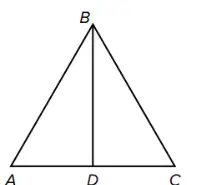
Given AD≅CD , which statement is sufficient to prove that △ABD≅△CBD ?
A. ∠ABD≅∠CBD
B. AD≅BD
C. ∠BAD≅∠CDB
D. ∠ADB≅∠CDB
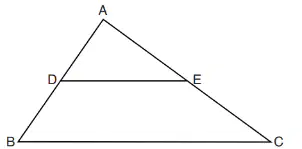
In the diagram below of ΔABC, D and E are the midpoints of AB and AC, respectively, and DE is drawn. Which methods could be used to prove ΔABC ~ ΔADE?
I. AA similarity
II. SSS similarity
III. SAS similarity
I only
I and II
II and III
I, II, and III
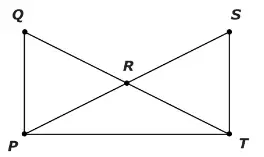
In the figure, ∠QPT and ∠STP are right angles. Sides PQ and TS are congruent. Which statement is always true?
RS ≅ PQ
RS ≅ RQ
RS ≅ ST
PS ≅ PT
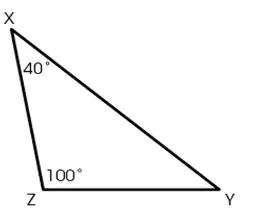
Triangle XYZ is shown. Which triangle must be similar to triangle XYZ?
triangle with two angles that measure 40°.
triangle with angles that measure 40° and 60°.
scalene triangle with only one angle that measures 100°.
isosceles triangle with only one angle that measures 40°
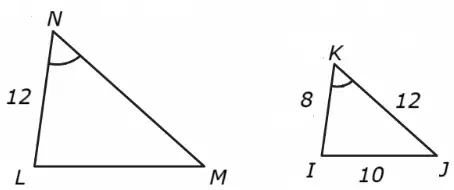
Given ΔLNM and ΔIKJ. Which additional piece of information would prove that ΔLNM~ΔIKJ?
NM = 18
LM = 18
NM = 15
LM = 10
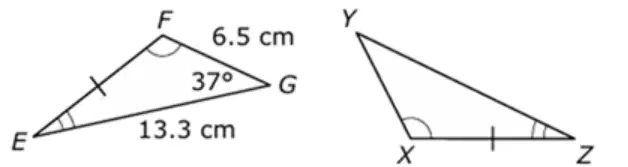
Based on the diagram, which of the following must be true?
∠E ≅ ∠Y
∠G ≅ ∠Z
EF ≅ YX
FG ≅ XY

Which statement and reason complete the proof?
A. BD≅BD , Reflexive Property.
B. AD≅DC , Definition of midpoint.
C. ∠ADB≅∠CDB , All right angles are congruent.
D. ∠A≅∠C , Base angles of an isosceles triangle are congruent.
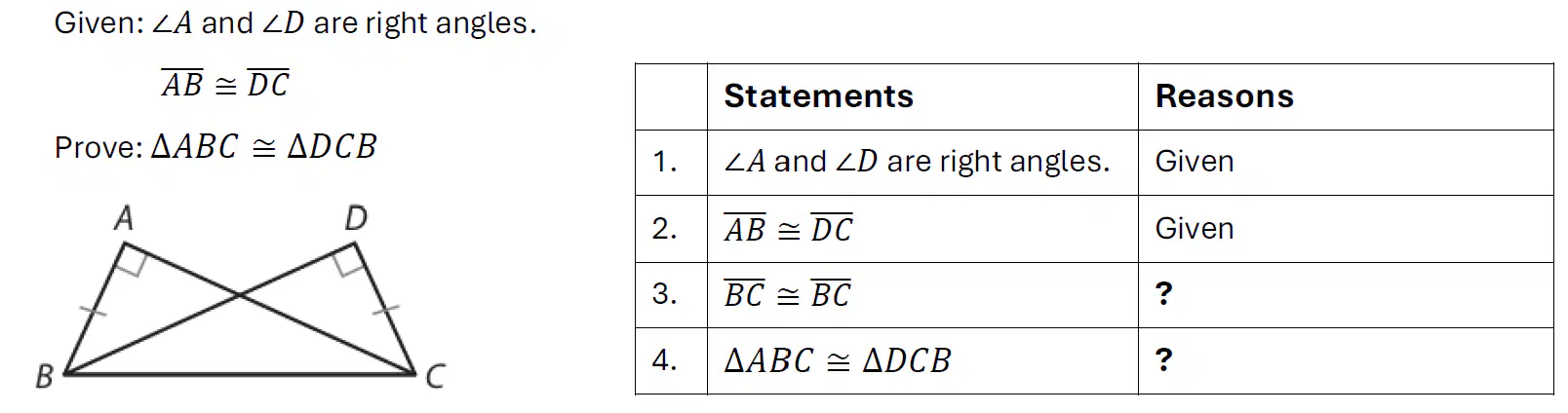
What could be reasons 4 and 5 to complete the proof?
Reason 4: Symmetric Property of Congruence, Reason 5: Side-Angle-Side Congruence Theorem
Reason 4: Reflexive Property of Congruence, Reason 5: Hypotenuse-Leg Congruence Theorem
Reason 4: Reflexive Property of Congruence, Reason 5: Side-Side-Side Congruence Theorem
Reason 4: Symmetric Property of Congruence, Reason 5: Angle-Side-Angle Congruence Theorem

Find the measure of the indicated angles. m∠1 = _______
41°
30°
50°
60°
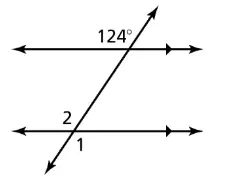
Find the measure of the indicated angles. m∠1 = _______
124°
90°
60°
45°
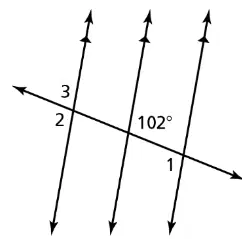
Find the measure of the indicated angles. m∠1 = _______
102°
90°
75°
60°
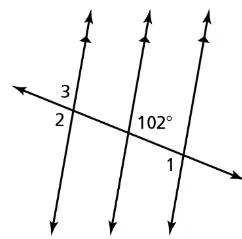
Find the measure of the indicated angles. m∠2 = _______
78°
60°
102°
90°
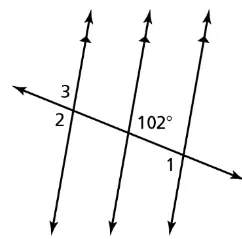
Find the measure of the indicated angles. m∠3 = _______
78°
60°
45°
90°
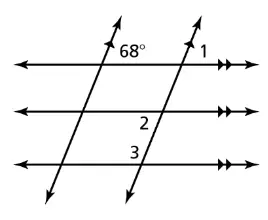
Find the measure of the indicated angles. m∠1 = _______
68°
45°
90°
120°
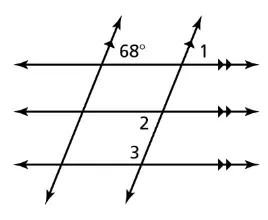
Find the measure of the indicated angles. m∠2 = _______
112°
90°
45°
68°
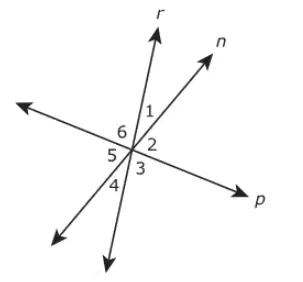
The figure shows coplanar lines, r, n, and p, intersecting to form angles numbered 1, 2, 3, 4, 5, and 6. Based on the figure, which individual statement would provide enough information to conclude that line r is perpendicular to line p?
A. m∠2=90°
B. m∠6=90
C. m∠3=m∠6
E. m∠3+m∠4=90°
D. m∠4+m∠5=90°
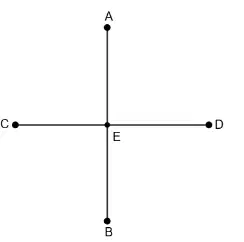
In the diagram below CD is the perpendicular bisector of AB. Select all the true statements.
E is the midpoint of CD.
E is the midpoint of AB.
Point D is equidistant from Points A and B.
Point B is equidistant from Points C and D.
Point C is equidistant from Points A and B.
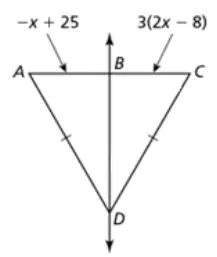
In the figure below BD is the perpendicular bisector of AC. Find the value of x.
x = 11
x = 10
x = 7
x = 13
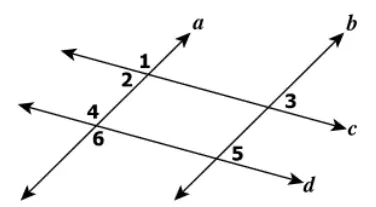
Lines a and b intersect lines c and d. Which of the following statements could be used to prove that a parallel b and c parallel d?
∠1≅∠6 , ∠3≅∠5
∠1≅∠6 , \angle 4 and \angle 5 are supplementary
∠1≅∠4 , \angle 1 and \angle 2 are supplementary
\angle 1 and \angle 3 are supplementary, \angle 1 and \angle 6 are supplementary
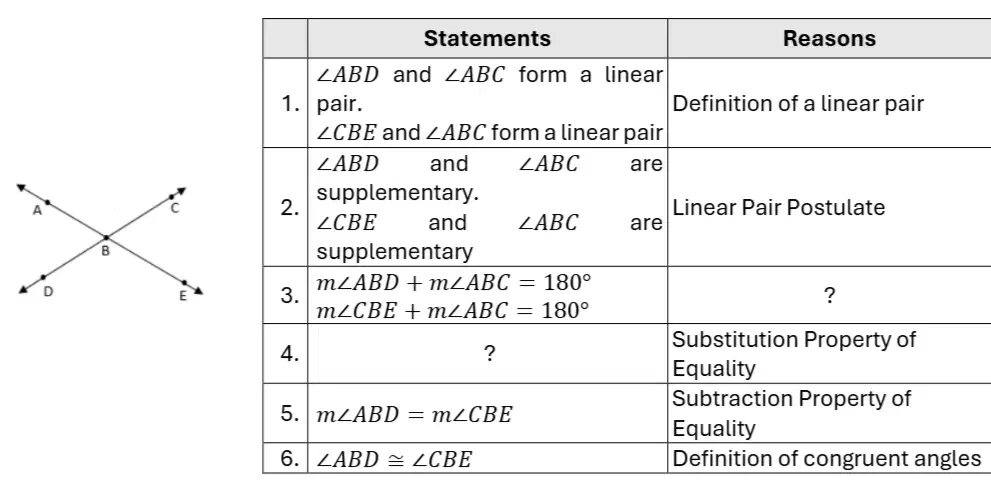
Select the statement and reason that are missing from the proof below showing that vertical angles formed by intersecting lines are congruent.
Reason 3: Definition of Complementary Angles Statement 4: m∠ABD + m∠ABC = m∠DBE + m∠EBC
Reason 3: Definition of Supplementary Angles Statement 4: m∠ABD + m∠ABC = m∠CBE + m∠EBC
Reason 3: Definition of Complementary Angles Statement 4: m∠ABD + m∠ABC = m∠CBE + m∠ABC
Reason 3: Definition of Supplementary Angles Statement 4: m∠ABD + m∠ABC = m∠CBE + m∠ABC

