
Font size
 Worksheets
Electric flux
Total questions: 81
Worksheet time: 1hrs 5mins
Which of the following is NOT an example of electric potential energy?
An incandescent light bulb is turned off.
A cell phone that is turned off.
A television that is turned on.
Solar cells at night.
Which of the following describes electric potential?
The capacity for doing work which arises from position or configuration.
The amount of work needed to move a unit charge.
Electric potential difference per unit charge.
Charge per unit distance.
Which is the standard (SI) unit for electric potential?
Volt
Joule
Coulomb
Ampere
Which of the following describes electric potential energy?
The capacity for doing work which arises from position or configuration.
The amount of work needed to move a unit charge.
Electric potential per unit charge.
Charge per unit distance.
While touching the Van de Graaff generator, why does your hair fly up as the generator starts charging?
Because the opposite charge is transferred to the hair.
Because the charge of the generator is transferred to the hair.
Because the charge of the hair is transferred to the generator.
Because the opposite charge of the hair is transferred to the generator.
Which of the following is the other term for electric potential?
capacitance
current
resistance
voltage
Which is the standard (SI) unit for electric potential energy?
Ampere
Coulomb
Joule
Volt
Which is the standard (SI) unit for electric potential difference?
Ampere
Coulomb
Joule
Volt
The quantity electric potential is defined as the amount of ____________________.
force per unit charge
electric potential energy
force acting upon a charge
potential energy per unit charge
TRUE or FALSE. The electric flux of a Gaussian surface is equal to zero if it does not enclose a charged particle.
TRUE
FALSE
TRUE or FALSE. The electric flux flowing from inside to outside is negative.
TRUE
FALSE
TRUE or FALSE. Gauss’s law relates the electric field of a surface to the net charge enclosed within that surface.
TRUE
FALSE
the intersection of field lines is due to
attraction
repulsion
it is not possible
both attraction and repulsion
fringing of field lines is due to
Uniform electric field
Non uniform electric field
Uniform charges on plates
Non uniform charges on plates
Electric flux is maximum at angle
45
90
180
0
When is the flux on a surface zero?
When it is perpendicular to an electric field
When it is at an angle to an electric field
When it is parallel to an electric field
It is never zero in an electric field
When a piece of paper is held with one face perpendicular to a uniform electric field the flux through it is 25 N×m2/C. When the paper is turned 25° with respect to the field the flux through it is:
0 N×m2/C
11 N×m2/C
12 N×m2/C
23 N×m2/C
A spherical conductor is given a positive charge. Under electrostatic conditions, which of the following is TRUE of the electric field just beneath the surface of the sphere?
The electric field is directed away from the center of the sphere.
The electric field in infinitely large.
The electric field is zero.
The electric field depends on the radius of the sphere.
The electric field is directed tangential to the surface of the sphere.
A conducting sphere has a charge +Q and a radius R. Which graph below describes the electric field as a function of distance r from the center of the sphere?


A solid non-conducting sphere has a radius R and a charge of +Q uniformly distributed throughout its volume. Which graph below describes the electric field as a function of distance r from the center of the sphere?
A charge is sitting outside a closed surface. The net flux is
double because it passes through two surfaces
half because it passes through two surfaces
squared because it passes through two surfaces
zero because it passes through two surfaces

SEE IMAGE
A
B
C
D
E

SEE IMAGE
A
B
C
D
E
Electric current is defined as the total _____ passing through a given area divided by the ______ interval. Its unit in the SI is the _______. (Use commas to give your answer).
(a)
Linear charge density
λ=Lq is used for example in:plates or surfaces
wires
spheres
“The total electric flux through any closed surface is equal to the total (net) electric charge enclosed by the surface, divided by e0”
Faraday's Law
Coulomb's Law
Gauss's Law
Volta'sLaw
Since the electric field and the area are vectors, they have:
magnitude
direction
quantity
arrows
Electric potential energy is measured in units of:
(a)
A positive test charge placed near a negative charge would have________ potential energy.
high
zero
low

What does this image represent?
(a)
Who is attributed with the idea "An electric field is measurable effect generated by any charged object".
Faraday
Coulomb
Volta
Ampere
What are the factors that affect Electric Flux? (check all that apply)
Area
Electric Force
Electric Field
Charge
Radius
What is the equation for Gauss Law that includes electric flux? (if you want to use
Φ , use an "s" to represent this. If you want to use ϵ0 , use "e")
(a)
What is the relationship between Electric Flux and the charge enclosed?
As the charge enclosed decreases, the flux increases.
As the charge enclosed increases, the flux increases.
There is no relationship.
Flux is a constant, it never changes.
Electric flux is...
the measure of electric force through a given surface.
the measure of magnetic field through a given surface.
the measure of electric field through space.
the measure of electric field through a given surface.
What is the general equation for Electric Field?
E=q0F
E=F×q0
E=λds
A charge is sitting outside a closed surface. The net flux is
double because it passes through two surfaces
half because it passes through two surfaces
squared because it passes through two surfaces
zero because it passes through two surfaces
When is the flux on a surface zero?
When it is perpendicular to an electric field
When it is at an angle to an electric field
When it is parallel to an electric field
It is never zero in an electric field
When a piece of paper is held with one face perpendicular to a uniform electric field the flux through it is 25 N×m2/C. When the paper is turned 25° with respect to the field the flux through it is:
0 N×m2/C
11 N×m2/C
12 N×m2/C
23 N×m2/C
A spherical conductor is given a positive charge. Under electrostatic conditions, which of the following is TRUE of the electric field just beneath the surface of the sphere?
The electric field is directed away from the center of the sphere.
The electric field in infinitely large.
The electric field is zero.
The electric field depends on the radius of the sphere.
The electric field is directed tangential to the surface of the sphere.
A conducting sphere has a charge +Q and a radius R. Which graph below describes the electric field as a function of distance r from the center of the sphere?
A solid non-conducting sphere has a radius R and a charge of +Q uniformly distributed throughout its volume. Which graph below describes the electric field as a function of distance r from the center of the sphere?

a.
b.
c.
d.
e.

positive (net outward flux)
negative (net outward flux).
positive (net inward flux)
negative (net inward flux)
zero

The electric flux through the planar surface above ( positive unit normal to left ) is:
Positive
Negative
Zero

a.
b.
c.
d.
e.

a.
b.
c.
d.
e.
(True/False) An electric flux can be calculated in open and closed surfaces.
(a)
When is the Electric Flux zero? (Check all that apply).
If inside the box there are equal magnitude charges with an opposite sign.
If one charge magnitude is greater than the other.
If there are no charges inside the box.
If the charges are outside the box.
The electric field lines passing through a surface area are called:
Electric Field
Electric Flux
Electric Charge
Electric Lines
(True/False) The direction of the flow of the electric field can be determined by the sign of the charge.
(a)
Which among the statement is TRUE?
A flux flowing from inside to outside is negative
A flux flowing from inside to outside is positive.
A flux flowing from outside to inside is positive.
A flux flowing from inside to outside can be negative or positive
The formula to solve the electric flux is:
Electric flux is equal to Electric Field over Area of the surface subtracted to cosine theta.
Electric flux is equal to cosine theta over Electric field multiplied by Area of the surface
Electric flux is equal to Area of the surface multiplied by cosine theta over Electric field.
Electric flux is equal to Electric field multiplied by Area of the surface times cosine theta.
Flux will be minimum when the electric field lines to the vector area are
parallel
perpendicular
at angle
at distance
System International unit of electric flux is
Nm2C−1
Nm2C
Nm1C−1
m2C−1
If the electric field lines are parallel to the vector area, the electric flux will be
minimum
maximum
zero
constant
Which among of the choices is/are not FALSE about electric flux
Which among of the choices is/are not FALSE about electric flux
Electric flux is the amount of charge in a certain surface.
Electric flux is the direction of the electric field in a certain charge.
All of the above
When is the flux on a surface zero?
When it is perpendicular to an electric field
When it is perpendicular to an electric field
When it is at an angle to an electric field
It is never zero in an electric field
Which quantity and unit are correctly paired?
electric field strength and N/C
electrostatic force and electron
electricity and Coulombs
electricity and Coulombs
The area vector for a flat surface
is parallel to the surface and has a magnitude equal to the length of a side of the surface.
is parallel to the surface and has a magnitude equal to the area of the surface.
is perpendicular to the surface and has a magnitude equal to the length of a side of the surface.
is perpendicular to the surface and has a magnitude equal to the area of the surface.
The electric flux Φ through a surface
is the amount of electric field piercing the surface.
does not depend on the area involved.
is the electric field multiplied by the area.
is the line integral of the electric field around the edge of the surface

Figure shows a closed surface which intersects a conducting sphere. If a positive charge is placed at the point P, the flux of the electric field through the closed surface:
will remain zero
will become positive
will become negative
will become undefined.
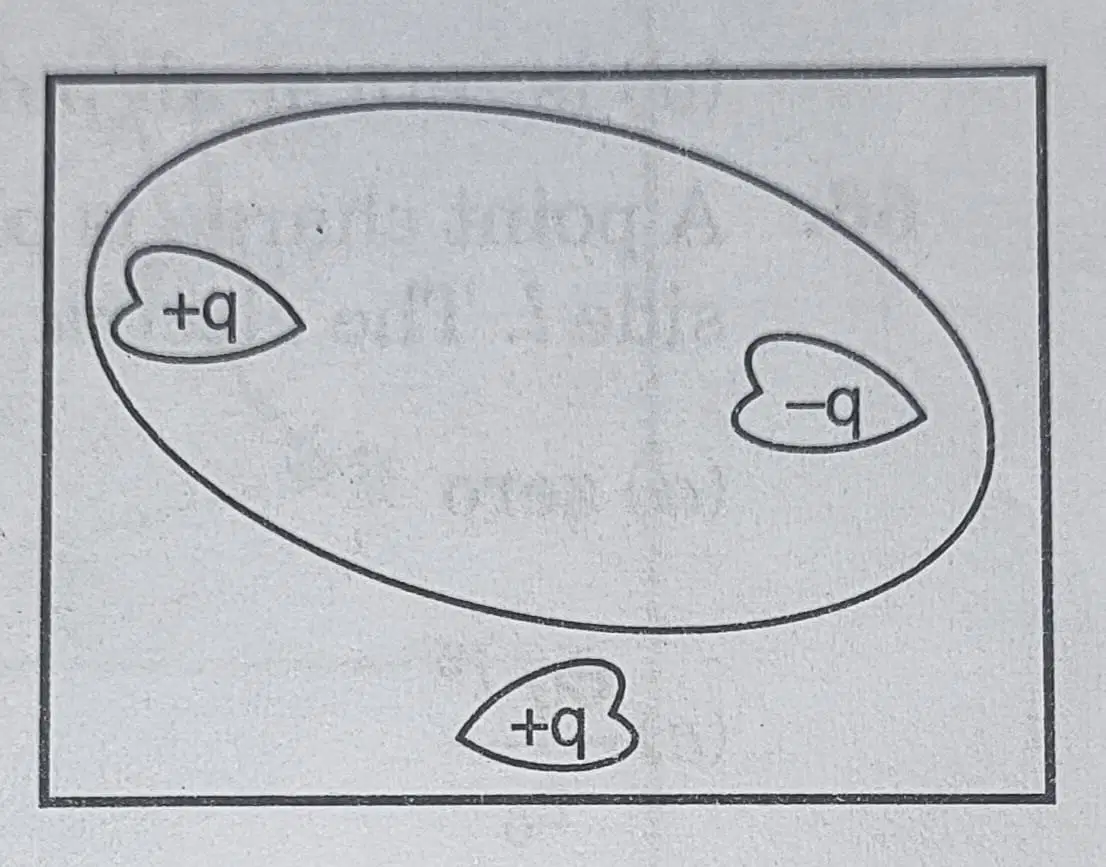
Given below (figure) is a distribution of charges. The flux due to these charges through the surface S is:
ϵ03q
ϵ02q
ϵ0q
Zero
A point charge +q is placed at the mid-point of a cube of side L. The electric flux emerging from the cube is:
ϵ0q
6L2ϵ0q
ϵ06qL2
Zero
According to Gauss’s theorem, the total outward normal induction (in c.g.s. electrostatic system) over a closed surface is equal to:
the positive charge enclosed within the surface
4π times the net charge outside the surface
4π times the total charge enclosed within the surface
the charge density on the surface.
A hollow cylinder of radius R and length l is filled with charges uniformly. Electric flux linked with the two faces of the cylinder will be proportional to:
R
1/R
1/R2
there will be no flux
A circular disc of radius R is held parallel to a uniform field of strength E. Net electric flux linked with the disc is:
zero
E×πr2
E×2πr
E×4πr2
A square sheet of side ‘a’ is held perpendicular to a uniform field of strength E. The electric flux linked with the surface is:
zero
Ea
Ea2
4Ea
Electric flux linked with a given plane surface is maximum if the angle between the electric lines of force and the normal to the surface is:
0°
45°
90°
135°
A surface is held perpendicular to the direction of lines of force of electric field. Electric flux linked with it is:
zero
infinite
minimum
maximum

