
 Worksheets
GMAS Review Questions Quizizz 2
Total questions: 30
Worksheet time: 2hrs 0mins
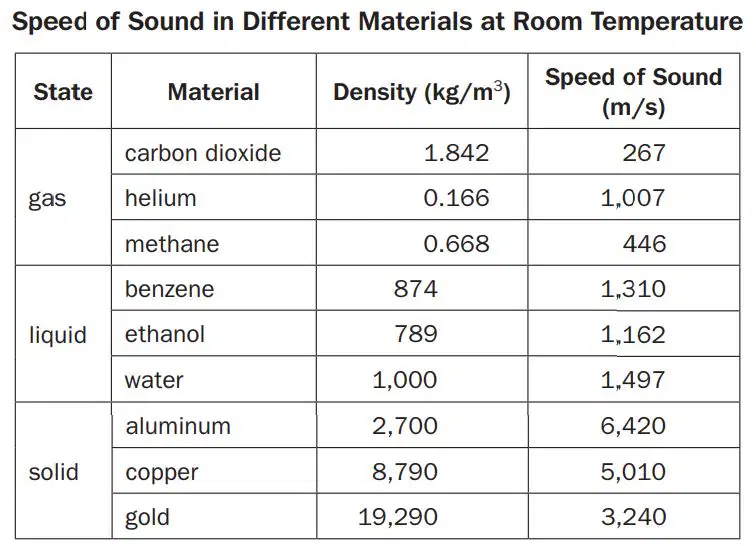
A student questioned how the properties of different materials affect the speed of sound waves traveling through them. The student found the following data in a chemistry handbook for the speed of sound in gases, liquids, and solids.
The student analyzed the data to make predictions about the speed of sound on materials with various densities and states of matter. Which prediction can be made based on the data shown in the table?
The speed of sound generally increases as it moves from gases to liquids to solids.
The speed of sound generally increases as it moves from liquids to gases to solids.
The speed of sound generally increases as it moves from solids to gases to liquids.
A student questioned how the properties of different materials affect the speed of sound waves traveling through them. The student found the following data in a chemistry handbook for the speed of sound in gases, liquids, and solids.
The student analyzed the data to make predictions about the speed of sound on materials with various densities and states of matter. Which prediction can be made based on the data shown in the table?
As the density of liquids and solids increases, the speed of sound generally increases.
As the density of gases and liquids increases, the speed of sound generally decreases.
As the density of solids and gases increases, the speed of sound generally decreases.
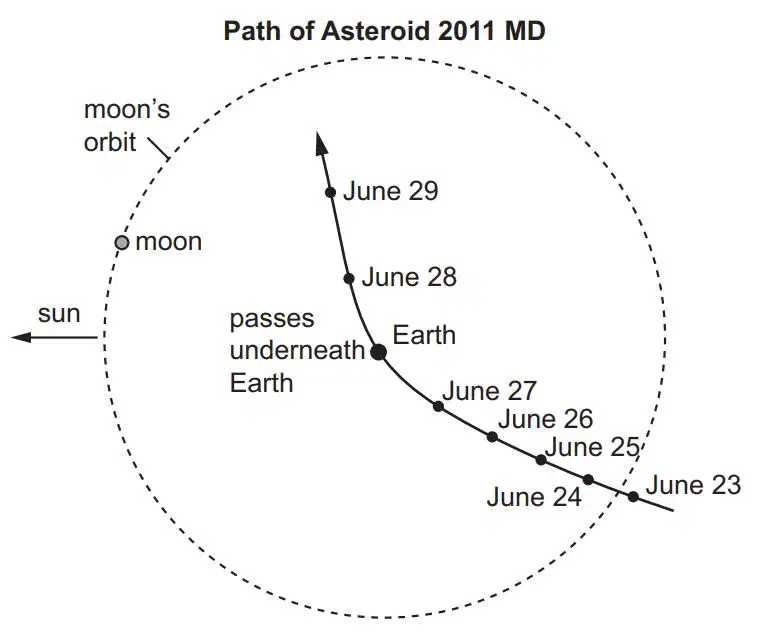
A space agency tracked the path of an asteroid named 2011 MD, which passed within 12,300 kilometers of Earth’s surface. The path of the asteroid is projected onto the plane of the moon’s orbit around Earth in the diagram.
Space scientists claimed that Earth’s strong gravitational field was responsible for the path of asteroid 2011 MD. Which argument BEST supports this claim?
The velocity of the asteroid changed as evidenced by the changing direction of the asteroid.
The velocity of the asteroid changed as evidenced by the straight line path after it passes Earth.
The position of the asteroid bends slightly away from Earth as evidenced by the different locations relative to Earth.
The position of the asteroid bends slightly toward the sun as evidenced by the different locations relative to the sun.
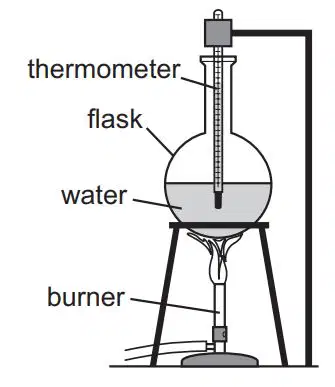
A student is planning an investigation in which different modes of heat transfer will be used to heat a thermometer. The diagram shows the setup used to conduct the first part of the investigation.
In this setup, the thermometer is being heated by conduction and convection. How should the student change the setup to heat the thermometer by using only radiation?


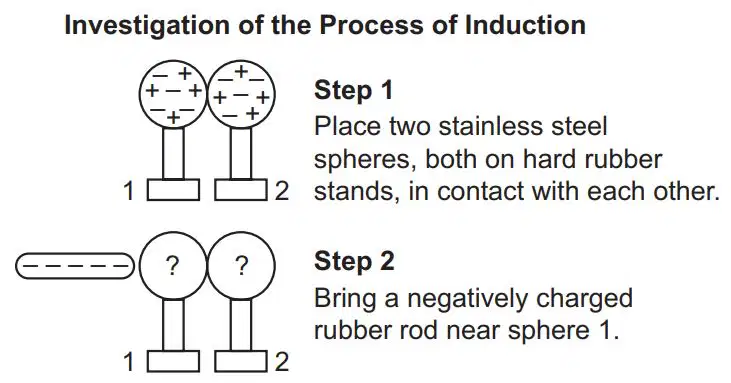
A student is investigating how a negatively charged rubber rod affects how charges are distributed on two stainless steel spheres that are touching each other. A diagram that shows two steps of the investigation is shown.
Which diagram for step 2 correctly predicts the distribution of charges on the stainless steel spheres?


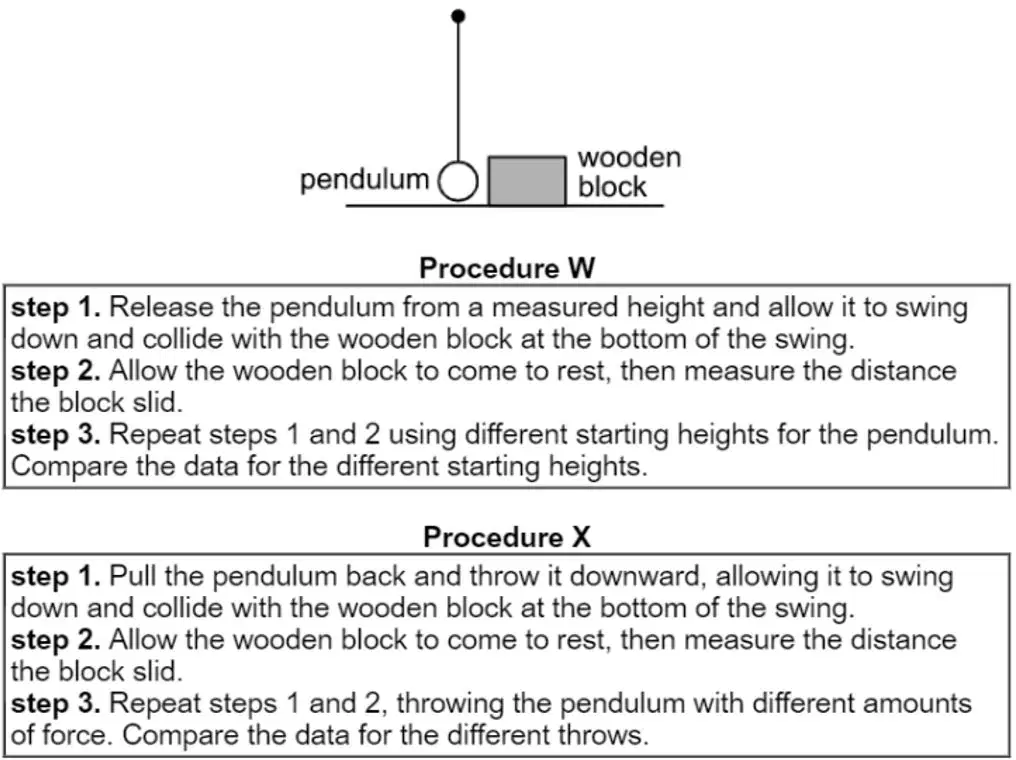
A student wishes to use the pendulum and wooden block shown to investigate the relationship between kinetic energy and potential energy.
The boxes show two possible procedures the student can use in the investigation.
Which procedure will BEST allow the student to complete measurements for the investigation and why?
Procedure W should be used. In this procedure, the moving pendulum will demonstrate transforming potential energy into kinetic energy.
Procedure X should be used. In this procedure, the moving pendulum will demonstrate transforming potential energy into kinetic energy.
Procedure W should be used. In this procedure, the moving pendulum will demonstrate transforming kinetic energy into potential energy.
Procedure X should be used. In this procedure, the moving pendulum will demonstrate transforming kinetic energy into potential energy.
A student wants to investigate how to apply an electric charge to a conducting metal sphere by using and electrically charged rod made of insulating material.
Which of the following images correctly illustrates distribution of electric charge onto the conducting metal sphere after the positively charged rod is touched to the sphere and then removed?


A student reads that a number of electrical devices utilize electromagnets. Some of these devices require strong magnetic fields. The student decides to investigate how to increase the strength of a basic electromagnet.
How can the student test whether the magnetic field produced by an electromagnet is increasing in strength?
A stronger magnet will require less wire for the coils.
A stronger magnet will have more widely spaced coils.
A stronger magnet will have a reduced measurable current.
A stronger magnet will attract a greater number of metallic items.
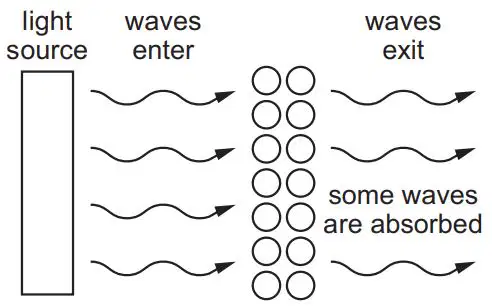
The model shows how light waves are transmitted through a transparent substance.
How would the model be different for a sound wave that is being transmitted through the same substance?
The wavy arrows representing sound waves would have a smaller wavelength.
The wavy arrows representing sound waves would go in the opposite direction.
The atoms in the model would move parallel to the direction of the incoming wave.
The atoms in the model would move perpendicular to the direction of the incoming wave.
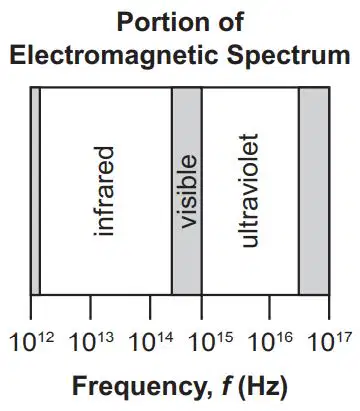
The diagram shows three types of electromagnetic radiation and their range of frequencies.
Which explanation correctly uses the data in the diagram to show how infrared radiation and ultraviolet radiation are related in terms of energy?
Ultraviolet radiation has less energy than infrared radiation because energy is inversely proportional to frequency and the frequency of ultraviolet radiation is higher.
Ultraviolet radiation has more energy than infrared radiation because energy is inversely proportional to frequency and the frequency of ultraviolet radiation is lower.
Ultraviolet radiation has less energy than infrared radiation because energy is proportional to frequency and the frequency of ultraviolet radiation is lower.
Ultraviolet radiation has more energy than infrared radiation because energy is proportional to frequency and the frequency of ultraviolet radiation is higher.
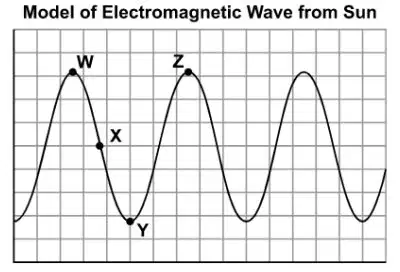
A student drew the diagram shown to model an electromagnetic wave from the sun.
Scientists have shown that ultraviolet light from the sun that has a wavelength of 315 to 400 nanometers can damage the eye's retina.
Which of the following is the BEST question for the student to ask to determine whether the electromagnetic wave modeled will cause damage to the retina?
What is the vertical distance between point W and point Y on the model?
What is the vertical distance between point X and point Y on the model?
What is the horizontal distance between point W and point Z on the model?
What is the horizontal distance between point Y and point Z on the model?
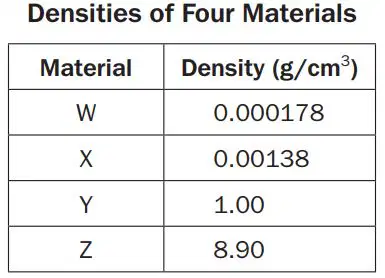
The densities of four different materials at the same temperature are shown in the table.
Based on the densities shown in the table, in which material will a sound wave MOST LIKELY travel at the GREATEST speed?
Material W
Material X
Material Y
Material Z

A student is making models of incoming sound waves' interactions with a surface. Which correctly identifies each model?
The model on the left demonstrates absorption, the center model demonstrates reflection, and the model on the right demonstrates refraction.
The model on the left demonstrates diffraction, the center model demonstrates refraction, and the model on the right demonstrates reflection.
The model on the left demonstrates refraction, the center model demonstrates absorption, and the model on the right demonstrates diffraction.
The model on the left demonstrates reflection, the center model demonstrates diffraction, and the model on the right demonstrates absorption.
A student is making models of incoming sound waves' interactions with a surface. Which shows an echo?
The model on the left shows an echo.
The center model shows an echo.
The model on the right shows an echo.
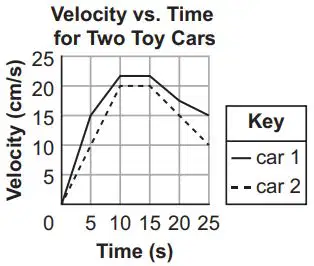
Two toy cars move in the same direction with velocities that are shown in the graph.
Based on the information in the graph, which statement describes the motion of the two toy cars?
Car 1 is traveling faster than car 2.
Car 2 is traveling farther than car 1.
Car 1 has constant velocity between 0 and 10 seconds.
Car 2 is changing direction between 10 and 15 seconds
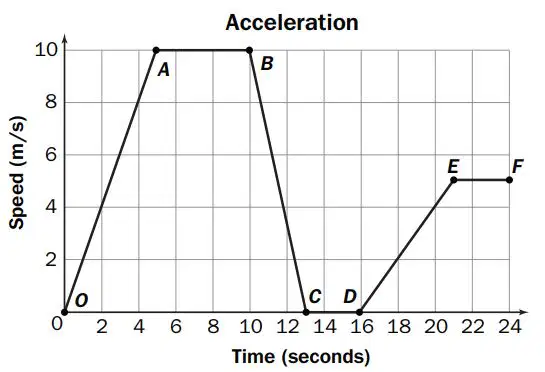
Students are exploring the relationship between velocity and acceleration. This graph shows the acceleration of a remote-controlled toy car.
Which statement is TRUE based on the graph?
Segment BC and segment EF show constant speed.
Segment OA and segment BC show constant speed
Segment AB and segment CD show positive acceleration.
Segment OA and segment DE show positive acceleration.
A magnet is moved toward a paper clip, as shown in the drawing. Students want to investigate how the strength of the force between the paper clip and a magnet changes under different conditions.
Which TWO factors should the students vary to BEST investigate the strength of the force between the paper clip and a magnet?
Attach the spring scale to the table.
Move the magnet farther away from the paper clip.
Replace the bar magnet with a horseshoe magnet.
Increase the length of the string attaching the spring scale to the wall.
Increase the length of the string attaching the spring scale to the paper clip.
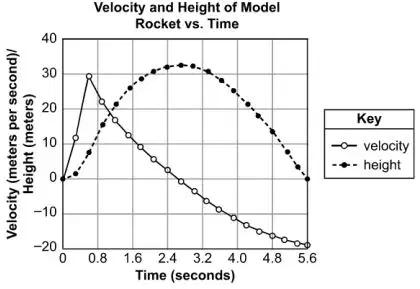
A hobbyist launched a flying model rocket and recorded the motion data shown in the graph. The model rocket is launched at time 0 and lands back on the ground after 5.6 seconds.
Which TWO choices correctly describes the direction of the rocket's acceleration during the flight?
From time 0 to 2.7 seconds, the rocket's acceleration is upward.
From time 0 to 0.6 seconds, the rocket's acceleration is upward.
From time 0 to 0.6 seconds, the rocket's acceleration is downward.
From time 0.6 to 5.6 seconds, the rocket's acceleration is downward.
A hobbyist launched a flying model rocket and recorded the motion data shown in the graph. The model rocket is launched at time 0 and lands back on the ground after 5.6 seconds.
Which TWO choices correctly describes the direction of the rocket's motion during the flight?
From time 0 to 2.7 seconds, the rocket was traveling upward.
From time 0 to 5.6 seconds, the rocket was traveling upward.
From time 2.7 to 5.6 seconds, the rocket was traveling downward.
From time 0.6 to 5.6 seconds, the rocket was traveling downward.
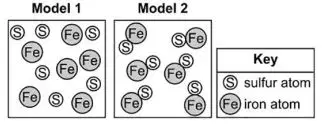
Iron can be found as a gray powder, and sulfur can be found as a yellow powder. The diagram shows atomic models of the two substances made of iron (Fe) and sulfur (S).
Classify the models of the substances.
Model 1 is a pure substance and Model 2 is a homogeneous mixture.
Model 1 is a homogeneous mixture and Model 2 is a heterogeneous mixture.
Model 1 is a heterogeneous mixture and Model 2 is a pure substance.
Iron can be found as a gray powder, and sulfur can be found as a yellow powder. The diagram shows atomic models of the two substances made of iron (Fe) and sulfur (S).
Describe the appearance of the substances.
Model 1 appears uniform in color and Model 2 has gray and yellow particles visible.
Model 1 has gray and yellow particles visible and Model 2 appears uniform in color.
Both models appear uniform in color.
Both models have gray and yellow particles visible.
What is the main difference between an electromagnet and a permanent magnet?
An electromagnet can be turned on and off, while a permanent magnet cannot.
A permanent magnet can be turned on and off, while an electromagnet cannot.
Electromagnets do not have magnetic poles, while permanent magnets do.
Permanent magnets can only attract materials, while electromagnets can attract and repel.
A student is studying the effects of different materials on the reflection of light waves. Which material is most likely to cause a significant reflection?
A matte, white surface
A transparent, clear surface
A smooth, shiny surface
A rough, dark surface
In an experiment, a student measures the speed of sound in different media. Which medium will likely show the slowest speed of sound?
Water
Air
Steel
Glass
A student is investigating the relationship between wavelength and frequency of electromagnetic waves. Which statement is TRUE?
As wavelength increases, frequency increases.
Wavelength and frequency both decrease together.
As wavelength increases, frequency decreases.
Wavelength and frequency are independent of each other.
Which of the following materials is most likely to absorb sound waves effectively?
A thick, carpeted surface
A polished, wooden surface
A transparent, glass surface
A smooth, metallic surface
A student is investigating the relationship between mass and gravitational force. Which statement is TRUE?
Gravitational force remains constant regardless of mass.
As mass increases, gravitational force increases.
Gravitational force is independent of mass.
As mass increases, gravitational force decreases.
Amy runs 2 miles south, then turns around and runs 3 miles north. What is Amy's displacement?
5 miles
1 mile North
2 miles South
3 miles

Scott travels north 5 miles and then goes west 3 miles before coming straight back south 2 miles. What is his distance?
10 miles
7 miles
8 miles
6 miles

The graph shows an object that is ______.
In motion
At rest
Accelerating
Decelerating

