
NEW
Font size
 Worksheets
ESS2.4 Plate Movements TCAP Review
Total questions: 15
Worksheet time: 8mins
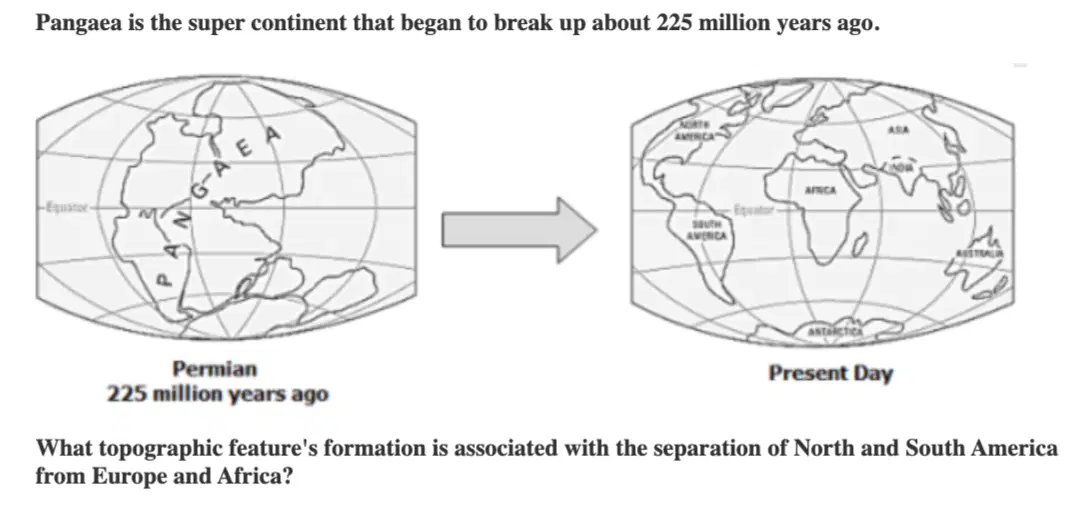
What topographic feature's formation is associated with the separation of North and South America from Europe and Africa?
deep-sea trench
continental mountain range
mid-ocean ridge
plateau
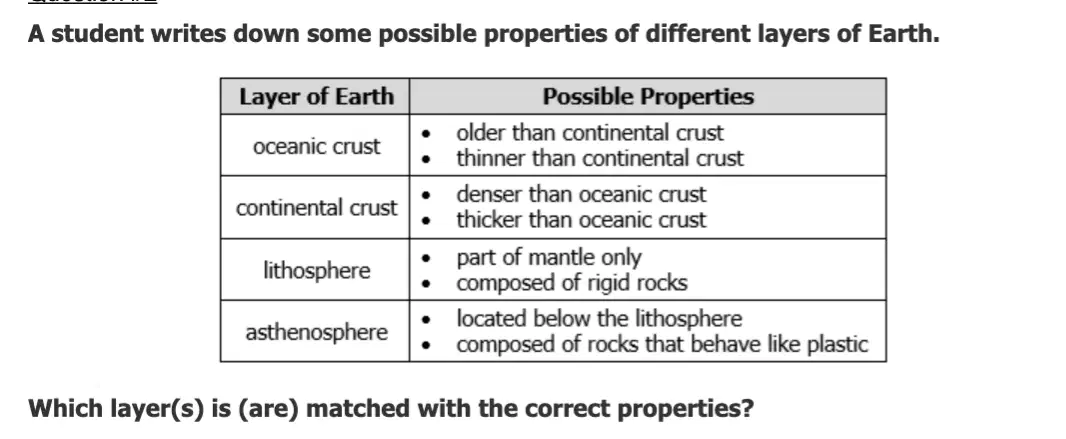
A student writes down some possible properties of different layers of Earth. Which layer(s) is (are) matched with the correct properties?
Asthenosphere only
Continental crust only
Asthenosphere and lithosphere
Continental crust and oceanic crust
Geologists have discovered that the sea floor of the Atlantic Ocean is growing wider at a rate of about 2 to 3 cm per year. Which type of tectonic force is responsible for this expansion?
Two oceanic plates are being forced apart allowing magma to pass between the plates.
Two continental plates are being forced apart creating a rift valley.
An oceanic plate is colliding with a continental plate, and the continental plate sinks toward the mantle.
A continental plate is colliding with an oceanic plate, and the oceanic plate sinks toward the mantle.
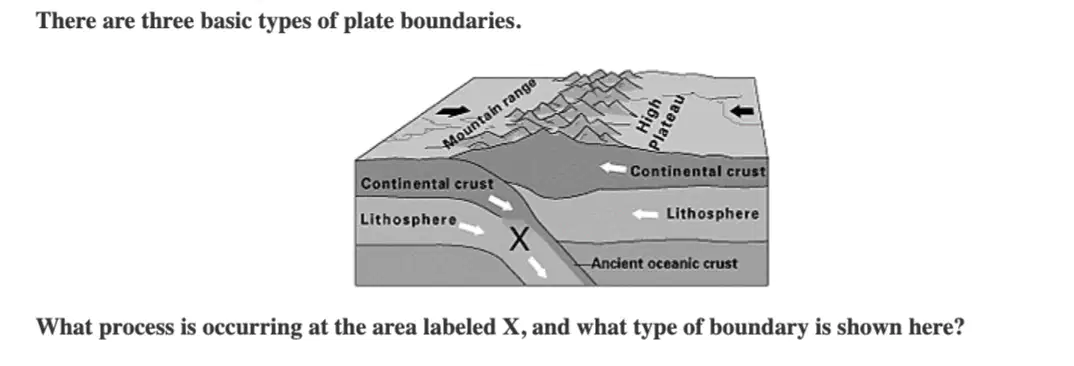
There are three basic types of plate boundaries. What process is occurring at the area labeled X, and what type of boundary is shown here?
This is convection at a convergent boundary.
This is convection at a divergent boundary.
This is subduction at a convergent boundary.
This is subduction at a divergent boundary.
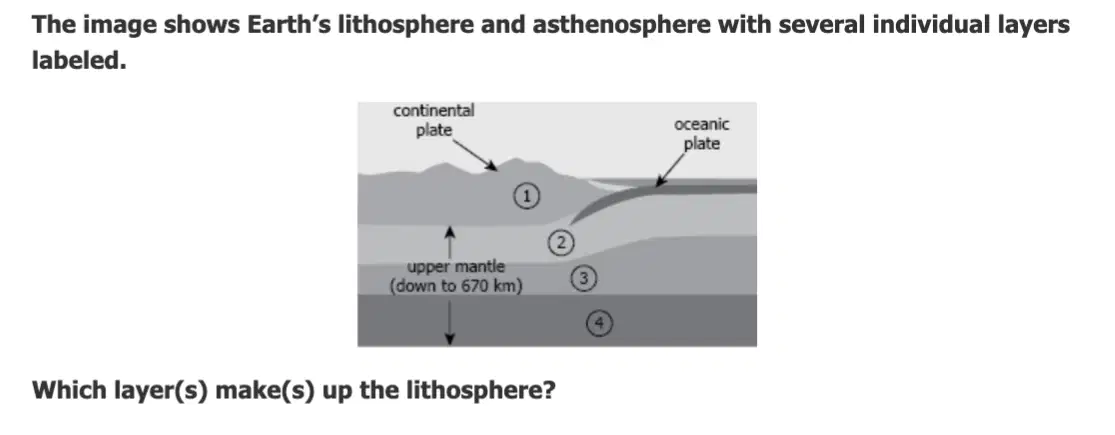
The image shows Earth’s lithosphere and asthenosphere with several individual layers labeled. Which layer(s) make(s) up the lithosphere?
layer 1 only
layer 3 only
layers 1 and 2
layers 3 and 4
How does faulting and folding on Earth’s surface most likely occur?
Movement of the asthenosphere causes the movement of the lithosphere.
Movement of the lithosphere causes the movement of the asthenosphere.
Movement of the mantle causes the movement of the outer core.
Movement of the inner core causes the movement of the outer core.
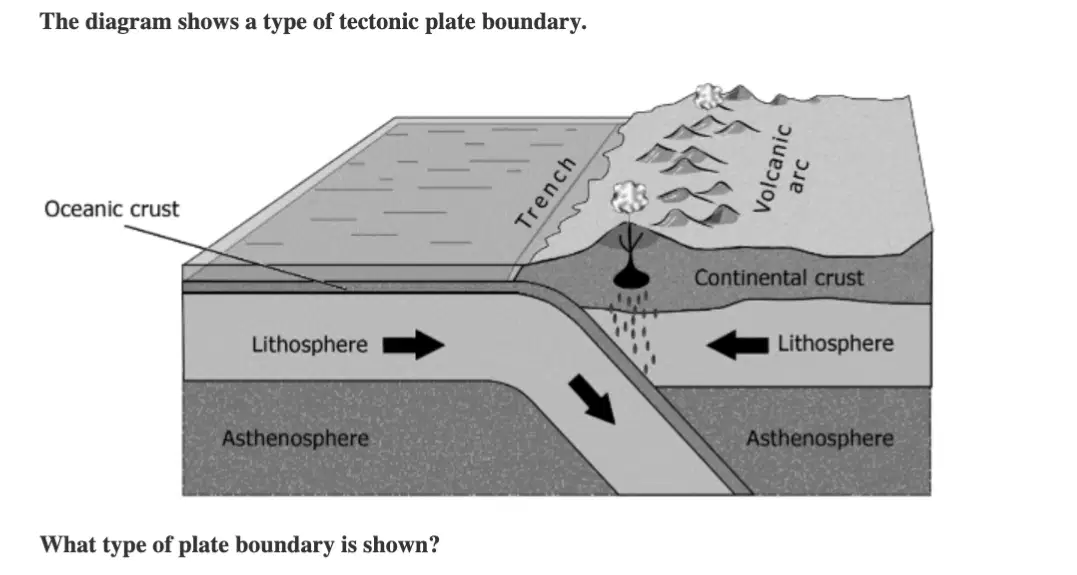
What type of plate boundary is shown?
oceanic-oceanic divergent plate boundary
oceanic-continental convergent plate boundary
continental-continental divergent plate boundary
continental-continental convergent plate boundary
Which layer of Earth causes the movements of tectonic plates?
crust
inner core
mantle
outer core
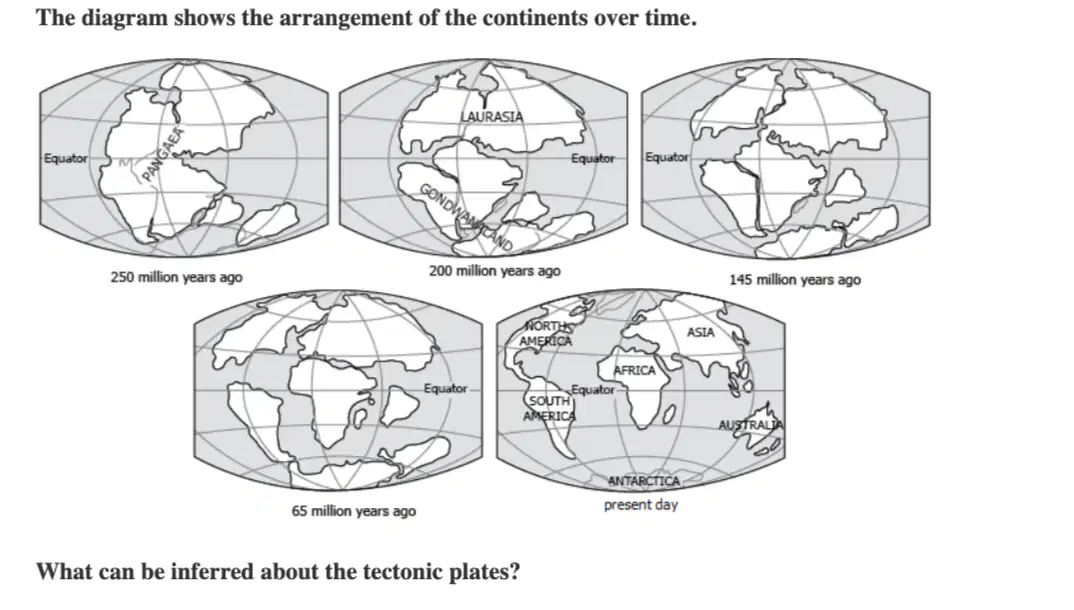
What can be inferred about the tectonic plates?
All plates moved in one direction, creating new oceans.
Some plates moved at a fast rate, and the rest remained in the same place.
Some plates moved to reshape the continents, and the rest remained in the same place.
Plates collided and spread apart, changing the shape of the continents.
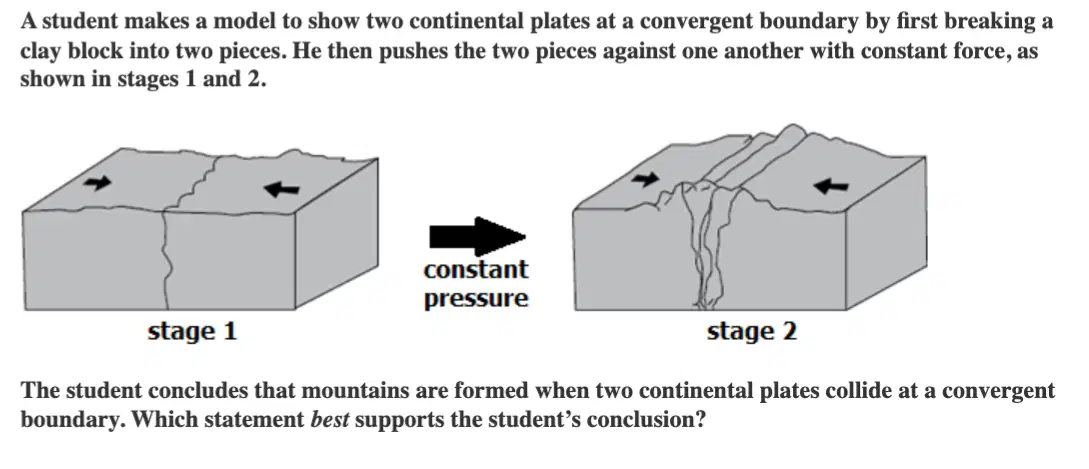
A student makes a model to show two continental plates at a convergent boundary by first breaking a clay block into two pieces. He then pushes the two pieces against one another with constant force, as shown in stages 1 and 2. The student concludes that mountains are formed when two continental plates collide at a convergent boundary. Which statement best supports the student’s conclusion?
Both halves of the block are equal in dimensions.
The texture of the block resembles continental crust.
The fault line in stage 1 is vertical, and this is descriptive of all continental boundaries.
Both stages 1 and 2 have the same densities, and one plate cannot sink under the other.
The theory of plate tectonics states that Earth’s plates are always in motion. What geological evidence supports this statement?
Continental and oceanic plates differ in densities.
Seismic activity occurs along plate boundaries.
Less dense plates always subduct beneath the more dense plates.
The sizes and shapes of continents remain the same over time.
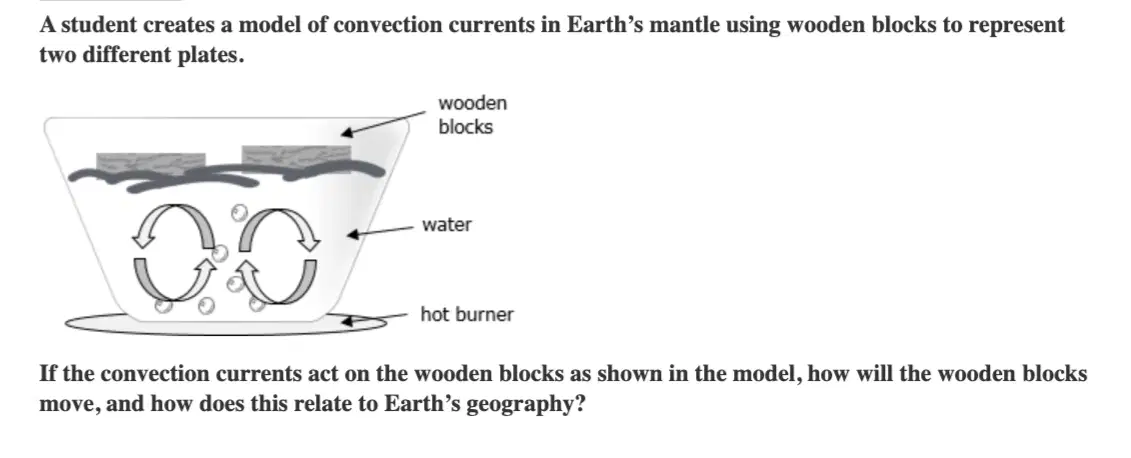
A student creates a model of convection currents in Earth’s mantle using wooden blocks to represent two different plates. If the convection currents act on the wooden blocks as shown in the model, how will the wooden blocks move, and how does this relate to Earth’s geography?
The wooden blocks will diverge, representing seafloor spreading.
The wooden blocks will converge, representing mountain formation.
The wooden blocks will sink, representing island formation.
The wooden blocks will move up and down, representing a volcanic eruption.
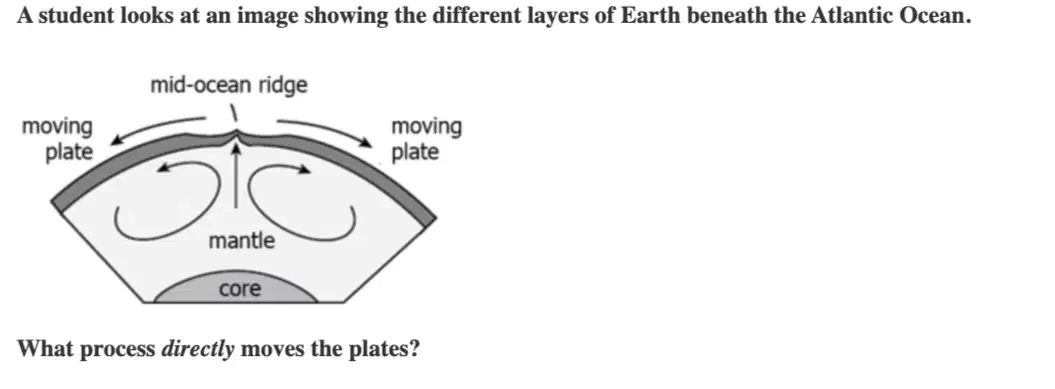
A student looks at an image showing the different layers of Earth beneath the Atlantic Ocean. What process directly moves the plates?
Convection currents in the mantle
Conduction of heat from the core
Movement of the ocean currents
Pressure on the mantle by the plates
Which layer of the Earth would best be described as "plastic and flowing"?
asthenosphere
atmosphere
lithosphere
troposphere
Which statement best explains what causes the lithospheric plates to move?
convection currents in the upper part of the Earth's mantle
convection currents in the lower part of the Earth's crust
currents in the Earth's magnetic field
slow flowing liquid in the Earth's outer core

