
Font size
 Worksheets
COLD WAR/DECOLONIALIZATION MOCK EXAM
Total questions: 25
Worksheet time: 13mins
Which post-World War II event contributed most directly to the start of the Cold War?
The establishment of the United Nations
The division of Germany into occupation zones
The Marshall Plan to rebuild Europe
The creation of Soviet-controlled regimes in Eastern Europe
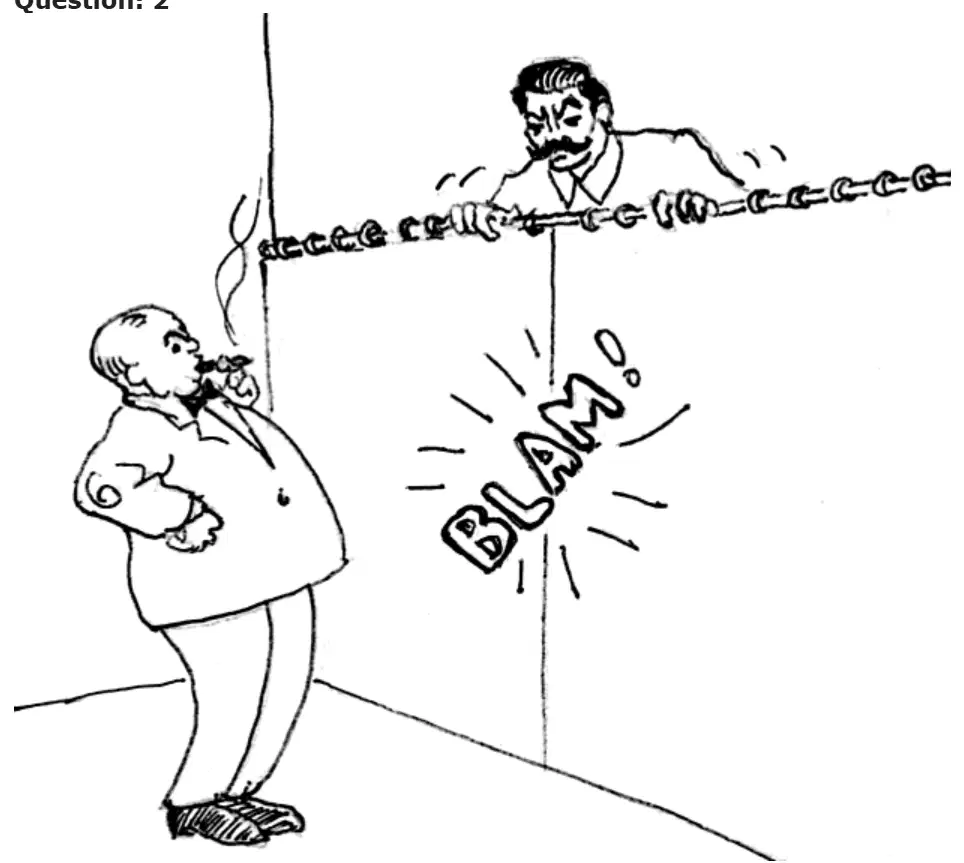
The political cartoon above illustrates the impact of which significant World War II conference?
Yalta Conference
Potsdam Conference
Tehran Conference
Casablanca Conference
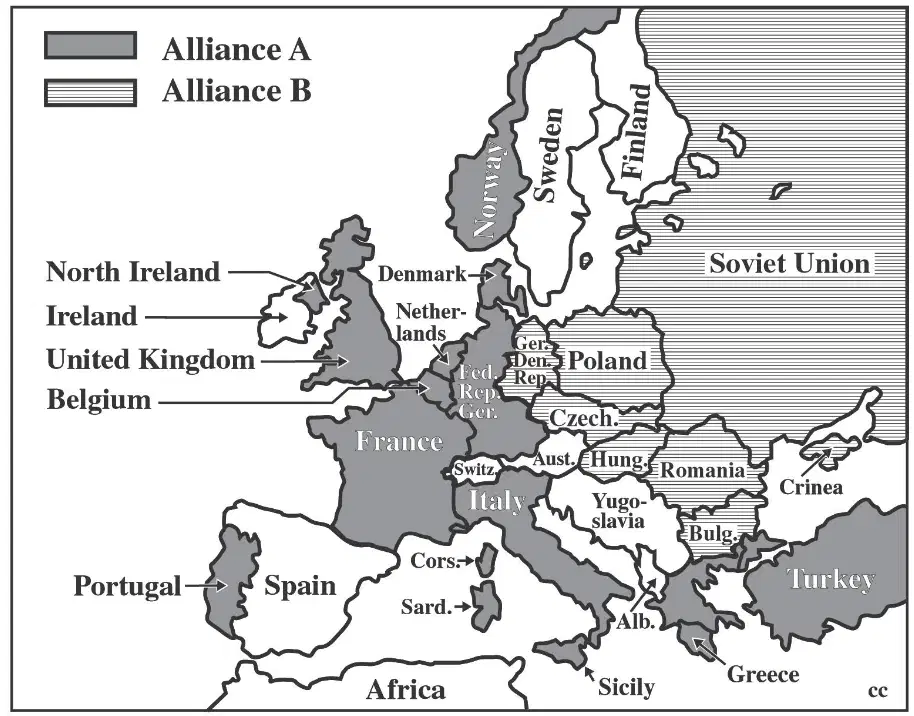
The map above illustrates a system of alliances. During which historical period was this system in place?
Napoleonic Wars
Before World War I
After World War I
During the Cold War
What was one of the ways perestroika aimed to reform the Soviet economy?
by nationalizing all small businesses to increase state control
by allowing factory managers more control over production decisions
by implementing strict government quotas on all consumer goods
by closing off the Soviet economy from foreign influences
What was the alliance formed by the Soviet Union in response to NATO?
the League of Nations
the Warsaw Pact
the Iron Curtain
the Berlin Wall
Which of the following actions is most closely associated with Khrushchev's leadership in the context of Soviet history?
Khrushchev’s initiative to reform Soviet agriculture
Khrushchev’s efforts to promote peaceful coexistence with the West
The Soviet Union’s launch of the first artificial satellite, Sputnik
Khrushchev’s attempt to distance his rule from Stalin-era atrocities
What event is often seen as the peak of Cold War hostilities between the United States and the Soviet Union?
The Cuban Missile Crisis
The Korean War
The Potsdam Conference
The Strategic Arms Limitation Talks
What was a key reason for the rise of communism in China following World War II?
The Communists had advanced technology.
The Nationalists were outnumbered.
The Communists gained the backing of the rural population.
The Nationalists lacked international allies.
What was a key goal of the Cultural Revolution initiated by China in the 1960s?
Foster economic liberalization.
Strengthen traditional cultural practices.
Eliminate political dissent.
Increase foreign investments.

Which phrase in the text best encapsulates Karl Marx’s primary critique of capitalist systems?
“They established three separate political systems.”
“They constructed more jails than educational institutions.”
“They compelled us to consume opium and spirits.”
“They have exploited us thoroughly, leaving our populace destitute.”
What was a primary purpose of the Berlin Wall's construction in 1961?
To facilitate the merging of East and West Germany.
To prevent East Germans from escaping to West Berlin.
To finalize the reconstruction efforts in Berlin after World War II.
To comply with NATO's strategic requirements.
What strategy did President Reagan use to counter Soviet influence during the Cold War?
imposing economic sanctions on the USSR
engaging in diplomatic talks with Soviet leaders
increasing military spending and support for NATO
supporting anti-communist insurgencies in Afghanistan
What was the immediate consequence of Ho Chi Minh's proclamation of Vietnam's independence?
He renounced communism and sought an alliance with the United States
France held a referendum where the majority supported Vietnam's independence
A conflict between South Vietnam and the United States, leading to France granting independence to only North Vietnam
A struggle for independence from France, followed by a military engagement involving the United States
“A Jewish State Is Established” “Yom Kippur War Leads to Peace Talks” “Israel and Jordan Sign a Peace Treaty” Which situation is referred to in these headlines?
Iran-Iraq War
decolonization of Africa
conflict between Israelis and Palestinians
fall of the Berlin Wall
Ho Chi Minh : _________ :: Pol Pot : __________.
Viet Minh
Khmer Rouge
Chinese Communists
Chinese Nationalists
Which of the following was a common result after independence was achieved in many sub-Saharan African nations?
Movement toward a representative government to integrate the various ethnic groups into a common society.
The deliberate isolation of the nation from international politics so as to avoid a new form of imperialism based on economic domination.
The establishment of strong regional alliances to promote economic growth without dependence on developed nations.
The breakdown of society into ethnic rivalries, leading to internal conflicts.
Which challenge has faced many former European colonies in Africa during the twentieth century?
European colonial borders ignored cultural differences.
European governance previously relied on local traditions.
European descendants outnumbered the native population.
European educational standards eliminated government courses.
How did Mohandas Gandhi contribute to India's struggle for independence from British rule? Select TWO correct answers.
He organized the Dandi March to oppose the British salt tax.
He advocated for violent resistance against British forces.
He initiated the Quit India Movement to demand an end to British rule.
He promoted the use of nonviolent resistance and civil disobedience.
He was a key figure in the drafting of the Indian Constitution.
Which of the following was not a role played by Nelson Mandela in South Africa?
receiving the Nobel Peace Prize
serving as the president of South Africa
leading a religious movement
opposing apartheid policies
Describe ONE impact of U.S. military and technological advancements on the conclusion of the Cold War.
By escalating the arms race
By cutting defense budgets
By pioneering missile defense systems
By fostering international diplomacy
Which policy introduced by the Soviet Union in the late 1980s aimed to restructure its economic and political system, ultimately contributing to its collapse in 1991?
Perestroika
Glasnost
Collectivization
Five-Year Plans
How did the economic policies in communist countries contribute to the conclusion of the Cold War?
By promoting technological advancement
By causing economic stagnation
By attracting international trade
By lowering import tariffs
What was a significant factor that led to the end of apartheid in South Africa?
International economic sanctions
Increased military spending
Isolation from the United Nations
Support from the Soviet Union
Which event marked the beginning of the end for the Soviet Union's control over Eastern Europe?
The launch of Sputnik
The Cuban Missile Crisis
The signing of the Helsinki Accords
The fall of the Berlin Wall
What was a primary goal of the Marshall Plan after World War II?
To rebuild the economies of Western Europe
To isolate the Soviet Union economically
To promote communism in Eastern Europe
To establish military bases in Europe

