
 Worksheets
CSUC101_Unit2_EVEN
Total questions: 7
Worksheet time: 10mins
If P, Q, R are Boolean variables, then (P + Q') (P.Q' + P.R) (P'R' + Q') Simplifies to
PQ'
PR'
PQ'+R
PR+Q
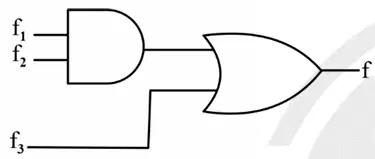
Given f1,f3 and f in canonical sum of products from (in decimal) for the circuit. F1 = Σm (4,5,6,7,8) F3 = Σm (1, 6, 15) F = Σm (1, 6, 8, 15). Then f2 is
Σm (4, 6)
Σm (4, 8)
Σm (6, 8)
Σm (4, 6, 8)
Given f(w, x, y, z) = Σm(0, 1, 2, 3, 7, 8, 10) + Σd(5, 6, 11, 15), where d represents the don’t-care condition in Karnaugh maps. Which of the following is a minimum product-of-sums (POS) form of f(w, x, y, z)?
𝑓 =(𝑤' +𝑧')(𝑥'+𝑧)
𝑓 =(𝑤'+𝑧)(𝑥 +𝑧)
𝑓 =(𝑤+𝑧)(𝑥' +𝑧)
𝑓 =(𝑤+𝑧')(𝑥' +𝑧)

In the Karnaugh map shown below, X denotes a don’t care term. What is the minimal form of the function represented by the Karnaugh map?
b'd'+a'd'
a'b'+b'd'+a'bd'
b'd'+a'bd'
a'b'+b'd'+a'd'
Which one of the following is NOT a valid identity?


Given the function F = P’ + QR, where F is a function in three Boolean variables P,Q and R and P’ = !P, consider the following statements. (S1) F = Σm(4, 5, 6) (S2) F = Σm(0,1,2,3,7) (S3) F = Σm(4, 5, 6) (S4) F = Σm(0,1,2,3,7) Which of the following is true?
(S1) – False, (S2) – True, (S3) – True, (S4) -False
(S1) – True, (S2) – False, (S3) – False, (S4) -True
(S1) – False, (S2) – False, (S3) – True, (S4) -True
(S1) – True, (S2) – True, (S3) – False, (S4) -False
A set of Boolean connectives is functionally complete if all Boolean functions can be synthesized using those. Which of the following sets of connectives is NOT functionally complete?
NAND
implication, negation
OR, negation
EX-NOR

