
NEW
Font size
 Worksheets
PS4.1 Properties of Waves TCAP Review
Total questions: 14
Worksheet time: 7mins

If a scientist wanted to increase the frequency of the wave, what would the scientist need to do?
decrease A
decrease B
increase C
increase D
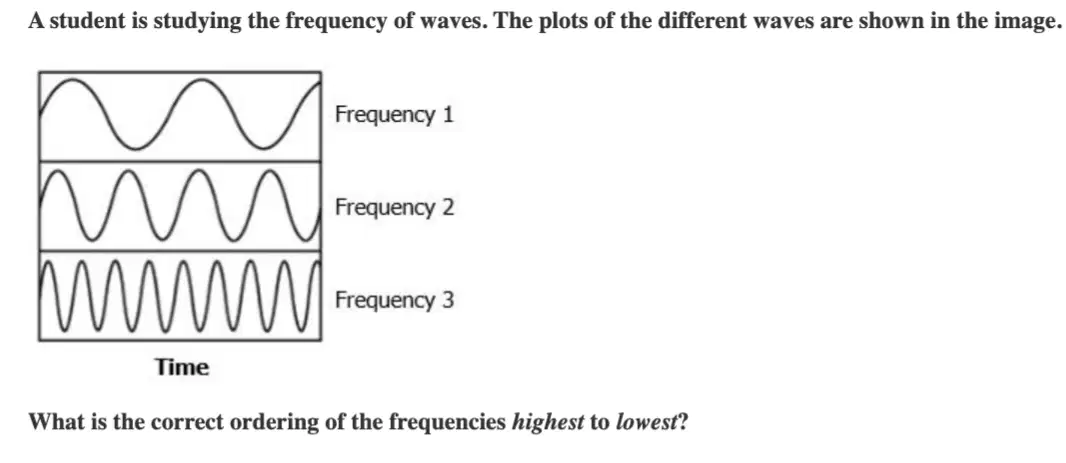
A student is studying the frequency of waves. The plots of the different waves are shown in the image. What is the correct ordering of the frequencies highest to lowest?
1, 2, 3
1, 3, 2
2, 1, 3
3, 2, 1
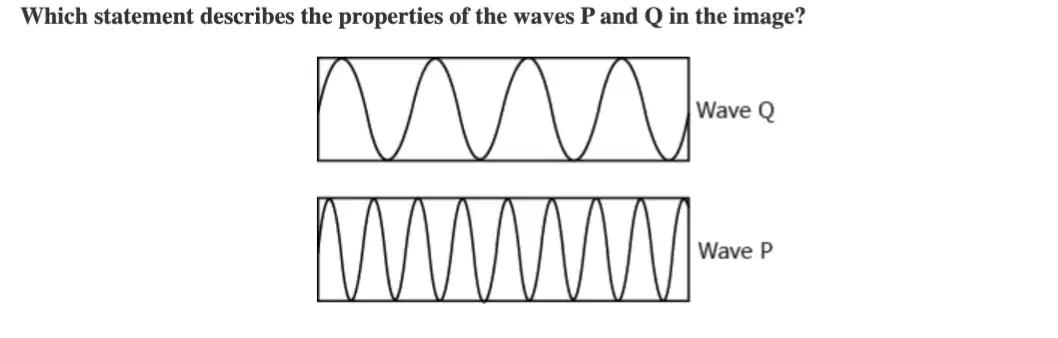
Which statement describes the properties of the waves P and Q in the image?
Both waves have similar amplitudes, but wave P has a greater frequency than wave Q.
Both waves have similar amplitudes, but wave Q has a greater frequency than wave P.
Both waves have similar frequencies, but wave P has a greater amplitude than wave Q.
Both waves have similar frequencies, but wave Q has a greater amplitude than wave P.
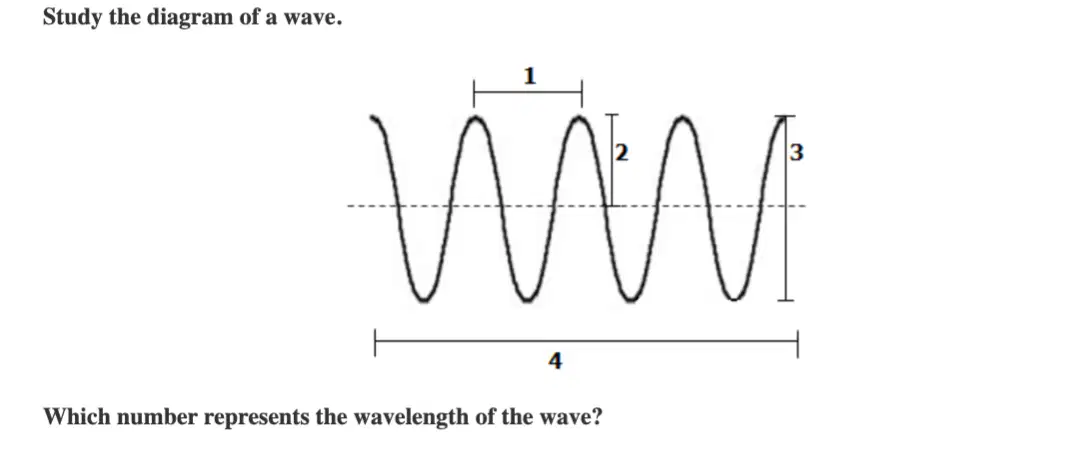
Study the diagram of a wave.
1
2
3
4
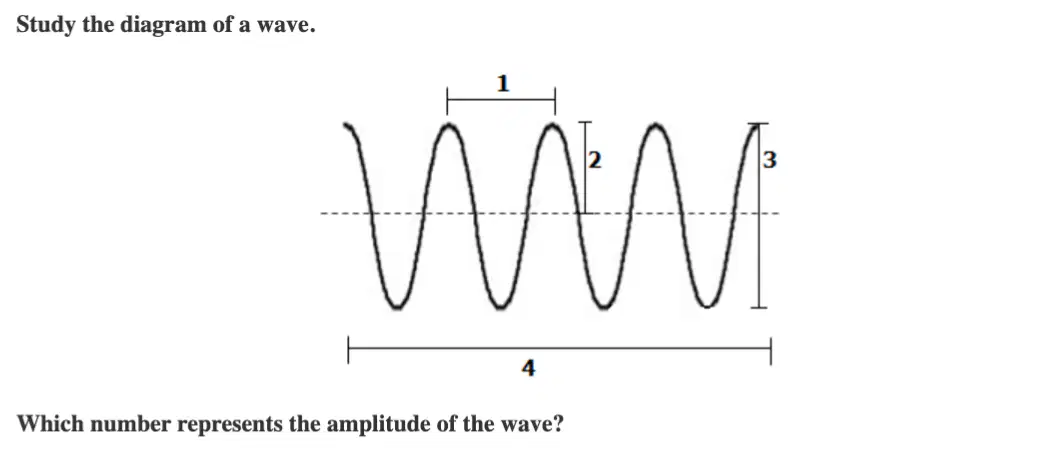
Study the diagram of a wave.
1
2
3
4
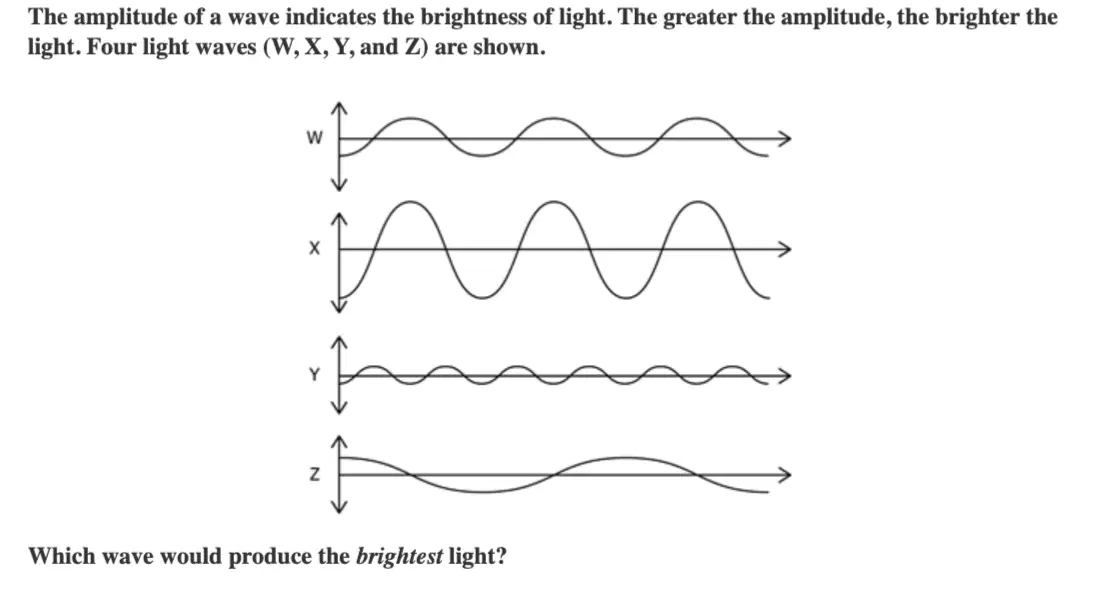
Which wave would produce the brightest light?
W
X
Y
Z

A student analyzes four types of waves. Which wave has the greatest amount of energy?
Wave A
Wave B
Wave C
Wave D
The frequency of a transverse wave increases, but its speed remains constant. How does this influence the wave’s wavelength and the amount of energy carried by the wave?
Both the wavelength and the energy carried by the wave increase
Both the wavelength and the energy carried by the wave decrease
The wavelength decreases, and the energy carried by the wave increases
The wavelength increases, and the energy carried by the wave decreases
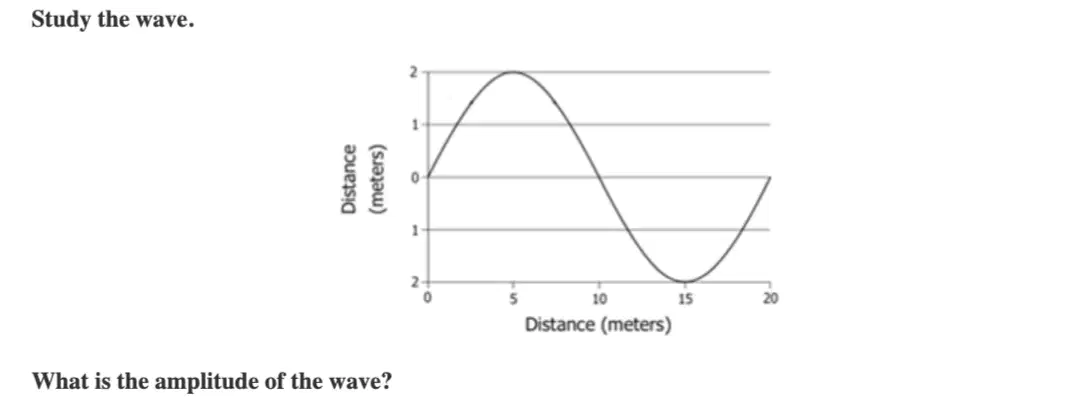
What is the amplitude of the wave?
2 m
4 m
10 m
20 m
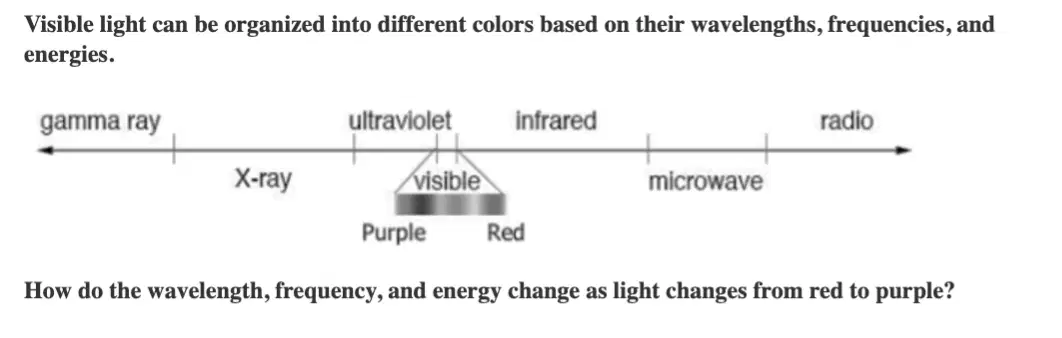
Visible light can be organized into different colors based on their wavelengths, frequencies, and energies. How do the wavelength, frequency, and energy change as light changes from red to purple?
Decreasing frequency, increasing wavelength, and decreasing energy
Decreasing frequency, increasing wavelength, and increasing energy
Increasing frequency, decreasing wavelength, and decreasing energy
Increasing frequency, decreasing wavelength, and increasing energy
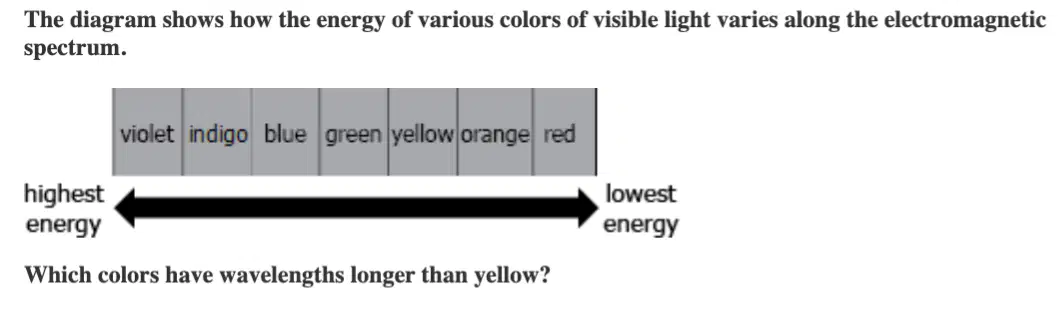
The diagram shows how the energy of various colors of visible light varies along the electromagnetic spectrum. Which colors have wavelengths longer than yellow?
Green and blue only
Orange, green, blue, and indigo
Orange and red only
Green, blue, indigo, and violet
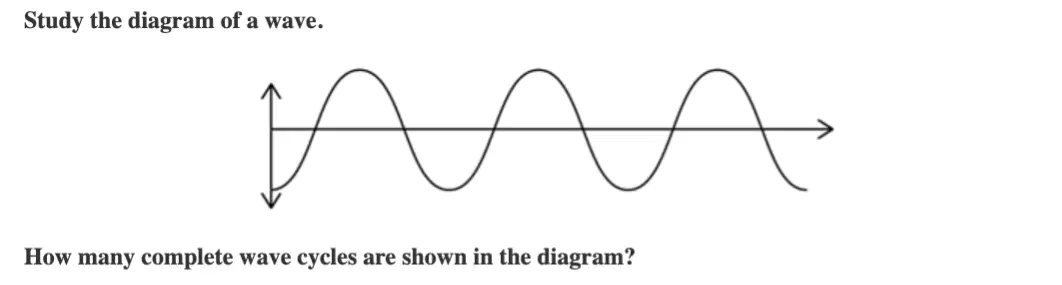
Study the diagram of a wave. How many complete wave cycles are shown in the diagram?
1
2
3
4
Which statement most completely defines a wave?
A wave transfers energy and matter from one point to another through a medium.
A wave transfers energy and matter from one point to another through empty space.
A wave transfers energy through a medium or empty space without transporting matter.
A wave transfers matter through a medium or empty space without transporting energy.

Examine the diagram of transverse waves on the electromagnetic spectrum.
Radio waves have the longest wavelength and lowest frequency.
Visible light has the shortest wavelength and highest frequency.
X-rays have the longest wavelength and highest frequency.
Gamma rays have the shortest wavelength and lowest frequency.

