
 Worksheets
Untitled Quiz
Total questions: 40
Worksheet time: 20mins
A plan that reports the units to produce by a manufacturing company during the budget period is called a
Sales budget.
Cash budget.
Production budget.
Manufacturing budget.
Capital expenditures budget.
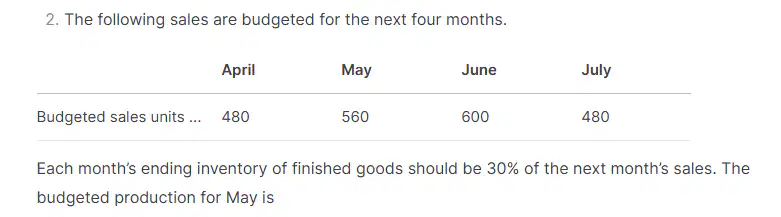
572 units.
560 units.
548 units.
600 units.
180 units.
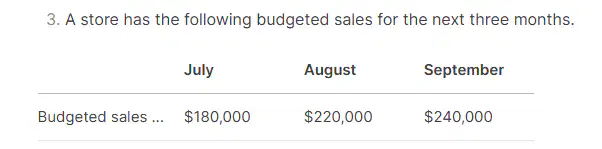
Cash sales are 25% of total sales and all credit sales are expected to be collected in the month following the sale. The total amount of cash expected to be received from customers in September is
240,000
225,000.
60,000.
165,000.
220,000.
A plan that shows the expected cash inflows and cash outflows during the budget period, including receipts from loans needed to maintain a minimum cash balance or repayments of such loans, is called
A rolling budget.
An income statement.
A balance sheet.
A cash budget.
An operating budget.
A hardware store has budgeted cost of sales of 36,000 for its power tool department in July. Management wants to have 7,000 in tool inventory at the end of July. Its beginning inventory of tools is budgeted to be 6,000. What is the budgeted dollar amount of merchandise purchases?
36,000
43,000
42,000
35,000
37,000
Which term describes the situation in which a manager intentionally overbudgets expenses or under budgets revenue?
Participative budgeting
Budgetary slack
Strategic planning
Benchmarking
Benefits of budgeting include
benchmarking.
planning
coordination and communication.
all of the above.
The comprehensive planning document for the entire organization is called the ______ budget.
financial
cash
master
operating
Which of the following budgets must be prepared first, as it serves as a basis for most other budgets?
Production budget
Operating expenses budget
Cash budget
Sales budget
The operating budgets culminate in the budgeted
statement of owners' equity.
balance sheet.
income statement.
statement of cash flows.
Which of the following are noncash expenses that will always result in differences between the budgeted operating expenses for a given period and the budgeted cash payments for the same period?
Depreciation expense and bad debt expense
Advertising expense and bad debt expense
Depreciation expense and rent expense
Advertising expense and rent expense
Which budget reflects the company's plans to invest in new property, plant, and equipment?
Direct materials budget
Operating expenses budget
Cash collections budget
Capital expenditures budget
Which of the following budgets is unique to merchandising companies?
Direct materials budget
Operating expenses budget
Production budget
Cost of Goods Sold, Inventory, and Purchases budget
Which of the following is true?
Only debit card transaction fees are limited by law.
Only credit card transaction fees are limited by law.
Both credit card and debit card transaction fees are limited by law.
Neither credit card nor debit card transaction fees are limited by law.
Which of the following is true for merchants who accept payments made by Visa, MasterCard, and other forms of "plastic"?
Transaction fees are generally a fixed amount per month.
Credit card fees are usually lower than debit card fees.
Transaction fees should be budgeted for in the operating expenses budget.
Retail cards (such as Target and Kohl's charge cards) have similar transaction fees to those issued by Visa and MasterCard.
A company predicts its production and sales will be 24,000 units. At that level, its fixed costs are budgeted at 300,000, and its variable costs are budgeted at 246,000. If its activity level declines to 20,000 units, what will be its budgeted fixed and variable costs?
Fixed, 300,000; variable, 246,000
Fixed, 250,000; variable, 205,000
Fixed, 300,000; variable, 205,000
Fixed, 250,000; variable, 246,000
Fixed, 300,000; variable, 300,000
Using the following information, compute the total actual cost of direct materials used.
- Direct materials standard cost: 5 lbs. × 2perlb=10.
- Total direct materials variance: $15,000 unfavorable.
- Actual direct materials used: 300,000 lbs.
- Actual units produced: 60,000 units.
585,000
600,000
300,000
315,000
615,000
A company uses four hours of direct labor to produce one unit. The standard direct labor cost is 20 per hour. This period the company produced 20,000 units and used 84,160 hours of direct labor at a total cost of 1,599,040. What is its direct labor rate variance for the period?
83,200F
84,160U
84,160F
83,200U
960F
A company’s standard overhead applied is 24,000 and its budgeted (flexible) overhead is 19,200. Actual total overhead is $24,100. The volume variance is
4,800U.
4,800 F.
100F
100 U.
4,900 U.
A company’s standard is $6 per unit in variable overhead (4machinehours×1.50 per hour). Actual variable overhead costs of $150,000 were incurred to produce 24,000 units. The total variable overhead variance is
6,000F
6,000 U.
114,000U
114,000 F.
0
Companies often decentralize their operations by
product line.
customer base.
geographic area.
all of the above.
Which of the following is not an advantage of decentralization?
Improved customer relations
Use of expert knowledge
Frees top management's time
Achieving goal congruence
In terms of responsibility centers, a large corporate division would be considered
cost center.
revenue center.
profit center.
investment center.
Which of the following is true?
Favorable variances should always be interpreted as "good news" for the company
Management by exception means that managers investigate all unfavorable variances but not all favorable variances.
Favorable variances are variances that cause operating income to be higher than budgeted.
Unfavorable variances should always be interpreted as "bad news" for the company.
A segment margin is the operating income generated by subtracting
only direct fixed expenses from a segment's contribution margin.
only common fixed expenses from a segment's contribution margin.
all expenses from a segment's sales revenue.
all fixed expenses from a segment's contribution margin.
Return on investment (ROI) can be restated as which of the following?
Sales margin ÷ capital turnover
Sales margin × capital turnover
Residual income ÷ sales margin
Residual income × sales margin
Which of the following is not a valid strategy for determining a transfer price?
Using a negotiated price
Using some definition of cost
Using the price set by GAAP
Using the market price
Which of the following is false?
The volume variance is due to causes other than volume.
The difference between actual results and the master budget is called the master budget variance.
The master budget variance can be split into two components: a volume variance and a flexible budget variance.
The flexible budget is prepared using the actual volume achieved during the period.
"Number of new products developed" would be a key performance indicator (KPI) for which of the four balanced scorecard perspectives?
Customer
Internal business
Financial
Learning and growth
"Hours of employee training" would be a key performance indicator (KPI) for which of the four balanced scorecard perspectives?
Customer
Internal business
Financial
Learning and growth
Which of the following is true?
Ideal standards are based on currently attainable conditions.
Practical standards are based on ideal conditions.
A standard cost is the budgeted cost for one unit.
Standards should never be updated.
The direct material price variance can be defined as which of the following?
Standard quantity allowed × (Actual price – Standard price)
Actual quantity purchased × (Actual price – Standard price)
Standard price × (Actual quantity used – Standard quantity allowed)
Actual price × (Actual quantity used – Standard quantity allowed)
The direct material quantity variance can be defined as which of the following?
Actual price × (Actual quantity used – Standard quantity allowed)
Standard quantity allowed × (Actual price – Standard price)
Standard price × (Actual quantity used – Standard quantity allowed)
Actual quantity purchased × (Actual price – Standard price)
The direct labor rate variance can be defined as which of the following?
Actual hours × (Actual rate – Standard rate)
Actual rate × (Actual hours – Standard hours allowed)
Standard hours allowed × (Actual rate – Standard rate)
Standard rate × (Actual hours – Standard hours allowed)
The direct labor efficiency variance can be defined as which of the following?
Standard hours allowed × (Actual rate – Standard rate)
Standard rate × (Actual hours – Standard hours allowed)
Actual hours × (Actual rate – Standard rate)
Actual rate × (Actual hours – Standard hours allowed)
Which of the following is not an advantage of using standard costs?
Standards can cause unintended behavioral consequences.
Standards are useful for budgeting.
Standards serve as cost benchmarks.
Standards can simplify bookkeeping.
The variable overhead rate variance can be defined as which of the following?
Standard hours allowed × (Actual rate – Standard rate)
Standard rate × (Actual hours – Standard hours allowed)
Actual rate × (Actual hours – Standard hours allowed)
Actual hours × (Actual rate – Standard rate)
Which of the following is not true about the fixed overhead budget variance?
It is the difference between actual fixed overhead and budgeted fixed overhead.
It is the difference between the budgeted fixed overhead and the standard fixed overhead allocated to production.
It can be either favorable or unfavorable.
It is sometimes referred to as the fixed overhead spending variance.
Which of the following is not true about the fixed overhead volume variance?
It is partially the result of treating fixed overhead costs as if they were variable for allocating the costs to individual units of production.
If production volume is lower than originally anticipated, then fixed overhead cost would be underallocated.
It is partially the result of incorrectly estimating the level of activity when calculating the predetermined fixed manufacturing overhead rate.
If production volume is greater than originally anticipated, the variance will be unfavorable.
Which of the following is not true about standard costing systems?
A standard cost income statement shows cost of goods sold at standard, along with all of the variances needed to adjust cost of goods sold back to actual.
Each type of variance has its own general ledger account.
At the end of the period, the variances are closed to the Sales Revenue account.
Standard costs are used to record the manufacturing costs entered into the inventory accounts.

