
 Worksheets
Electric current, voltage and ohms law
Total questions: 62
Worksheet time: 1hrs 1mins
An alarm clock draws 0.5 A of current when connected to a 120 volt circuit. Calculate its resistance.
240 Ohms
60 Ohms
2401 Ohms
180 Ohms
A circuit consists of a 12 V battery connected across a single resistor. If the current in the circuit is 3 A, calculate the size of the resistor.
36 ohms
0.25 ohms
4 ohms
12 ohms
In a stereo amplifier circuit, there is a resistor across which you measure 25V, and your ammeter indicates 50mA of current through the resistor. What is the resistor’s value in kilohms? In ohms?
2kΩ, 20Ω
0.5kΩ, 500Ω
1.25kΩ, 1250Ω
None of the above
What is the current in a circuit with 6 ohms of resistance and a battery containing 24 Volts?
1/4 A
144 A
4 A
0.4 A
What is the voltage of a circuit with 4 ohms of resistance and 3 amps of current?
12 V
21 V
4/3 V
3/4 V
Longer wires have _______ resistance than shorter wires.
more
less
the same
If a cell provides 12 V to a circuit and 4 Coulombs of charge flows. How much energy is being provided by the cell?
3 J
0.25 J
48 J
16 J
What is the voltage of a circuit with 4 ohms of resistance and 3 amps of current?
12 V
21 V
4/3 V
3/4 V
If the battery produced 12.6 Volts what would be the current flow for a 6 Ohm resistor?
2.1 Amps
2.4 Amps
1.71 Amps
15 Amps
What unit is used to measure the voltage?
Ohms
Omega
Volts
Amps
What is the voltage of a circuit with 4 ohms of resistance and 3 amps of current?
12 V
21 V
4/3 V
3/4 V
What is the resistance of a lightbulb that experiences 9 Volts and 3 amps of current?
1/3 ohms
3 ohms
27 ohms
9 ohms
What is the formula for ohms law?
1+2=3
R X E = I
E =I x R
E= MC squared
Voltage divided by Resistance
(V / R)
Current
Power
Ohms
Watts
(I X R)
The potential difference across a 5 kΩ is 12 V. Find the current flowing through the resistor
60 mA
2.4 mA
1.7 mA
0.998 mA

Two parallel resistors both having their values 28 ohms are connected in parallel. The overall current provided by the 28 V source is.
1 A
2 A
4 A
8 A

Two resistors having values 5 ohms and 10 ohms are connected in series to a 10 V source. Find the current flowing through the circuit:
0.66 A
1.5 A
2 A
2.5 A
10) If you increase the size of the resistor and keep the voltage the same, what will happen to the current?
The current will decrease
The current will increase
The current will stay the same

The circuit with higher resistance will allow less charge to flow, meaning the circuit with higher resistance has less current flowing through it.
True
False
If there are 40 Volts and 5 Amps running through an electrical circuit, what is the resistance of the circuit?
1 Ohm
2 Ohms
4 Ohms
6 Ohms
8 Ohms

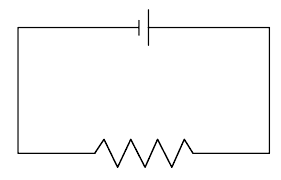
What is the Voltage, V in the circuit shown?
6.5 V
26 V
0.15 V
If the current in an electrical circuit is constant, what will happen to the voltage if the resistance is increased?
The voltage will decrease
The voltage will increase
The voltage will stay the same
According to Ohm's Law, current equals the voltage divided by the _________.
Resistance
Inductance
Capacitance
Power
Conductance
Define Ohm’s Law
a law stating that electric current is proportional to voltage and inversely proportional to resistance.
a law stating that electric current is proportional to resistance and inversely proportional to voltage.
In order to electrical current to flow through a wire the wire must be connected in a ____________ that includes a source of electrical current.
averager matter
Complete loop
In an incomplete loop
Interrupted Circuit
What would happen if in a circuit, the resistance increases but the voltage stays the same?
The current would decrease
The current would increase
The voltage would decrease
The voltage would increase
What would happen if in a circuit the voltage is increase?
The time would increase
The current would increase
The current would decrease
The current would stay the same
Is the unit of resistance.
Om
Ohm
OMS
WHO
is a material that has almost zero resistance when cooled down to low temperatures.
Megaconductor
Superconductor
Omegaonductor
Epsilonconductor
A materials thickness, length and temperature affects its .....
Current
Resistance
Voltage
Time
is the opposition to the flow of charges in a material.
Resistance
Voltage
Time
Current
is a material in which charge cannot flow easily.
Electrical insulator
Electrical conductor
Thermal conductor
Therml insulator
is a material in which electricity can flow easily.
Thermal insulator
Thermal conductor
Electrical conductor
Electrical insulator
is a flow of electric charge that regularly
reverses its direction.
Alternating current
Active current
Direct current
Passive current
Is a charge that flows only in one direction.
Passive current
Active current
Direct current
Alternating current
Are the two kinds of current.
Direct and alternating
Direct and Passive
Direct and Active
Active and Passive
Is defined as a continuous flow of electrons.
Resistance
Electric Current
Ohms
Voltage

