
Font size
 Worksheets
Gas Laws
Total questions: 63
Worksheet time: 5hrs 15mins

Identify your variables
Volume initial
5.6 L
Pressure initial
1.5 atm
Volume final
4.8 L
Pressure Final
X
P1
Initial pressure
V1
Initial volume
P2
Final pressure
V2
Final Volume
Match the following units to their names.
Pressure
mmHg
Volume
L
Temperature
K
Pressure
atm
Moles
mol
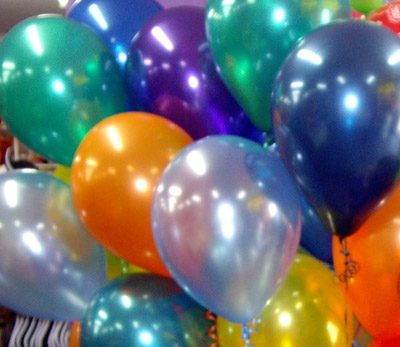
If a balloon is cooled what will happen to the volume?
Volume will increase
Volume will decrease
Volume will not change
Gas molecules can easily be compressed because ___________.
gas molecules are soft
gas molecules are far apart
gas molecules follow the shape of the container

Which container will have lower pressure?
left
right
they both have the same pressure
You go camping and roast marshmallows over a campfire. What happens to the volume of the air bubbles inside the marshmallows?
It increased
It decreased
It stayed the same
Which measure is equal to 1 atm?
1 atm
1 psi
760 kpa
760 mmHg
101.3 torr
What happens to the average kinetic energy of gas particles when they are heated?
it increases
it decreases
it remains the same
it is not possible to determine with the information given
Which graph shows the pressure-temperature relationship expected for an ideal gas?


What is Standard Temperature and Pressure (STP)?
1 Degrees Celsius and 0 atm
0 Degrees Celsius and 1 atm
0 Kevin and 10 atm
273 Celsius and 273 atm

Boyle's law : The pressure and volume of a gas show a _____ relationship.
Inverse
Direct

The following graph shows ____ relationship.
Direct
Inverse
8. If the temperature of a gas is tripled from 100K to 300K, what happens to the volume of the gas?
Cuts in half
Triples
Doubles
Stays the same
9. If the temperature of a gas is cut in half from 200K to 100K, what happens to the volume of the gas?
Cuts in half
Triples
Doubles
Stays the same

Gay–Lussac's Law is a direct relationship between temperature and pressure.
Assuming a constant volume, if the pressure doubles, then the temperature ________
doubles in Kelvin units
doubles in Celsius units
halves in Celsius units
halves in Kelvin units
Gay–Lussac's Law is a direct relationship between temperature and pressure.
Assuming a constant volume, if the pressure halves, then the temperature ________
doubles in Kelvin units
doubles in Celsius units
halves in Celsius units
halves in Kelvin units
A student inflates a balloon with helium then places it in the freezer. The student should expect
the balloon's volume to increase
the balloon's volume to decrease
the balloon's moles to increase
the balloon's moles to decrease
Correctly label the temperature in this thermometer
Correctly label the temperature in this thermometer
Drag the values to the correct labels in the problem on the left
Drag the values to the correct labels in the problem on the left
Drag the values to the correct labels in the problem on the left
Match the following variable to the correct symbol
Initial Volume
V1
Initial Temperature
T1
Final Volume
V2
Final Temperature
T2
particles very close together
Low kinetic energy

particles somewhat close together
particles able to flow

particles very far apart
no definite shape nor volume

particles are "ionized"
very high energy

Where can you find the correct value for standard pressure?
relationship between pressure and volume
temperature and amount of gas remain constant
P1V1 = P2V2
directly proportional
inversely proportional
relationship between temperature and volume
pressure and amount of gas are constant
V1/T1 = V2/T2
relationships in a mixture of gases
sum of the partial pressure of the individual gases
PT = P1 + P2 + P3
relationship between all four variables: temperature, volume, number of moles, and pressure
PV = nRT
R = ideal gas constant

How do gas molecules move?
in a circular motion
in straight line paths
in an orderly fashion
constantly and randomly
A sample of nitrogen dioxide in a 9 L metal cylinder at 9 atm has its temperature changed held constant while its volume is simultaneously changed by a piston to 6 L. What is the final pressure in atmospheres?
Round your answer to the nearest whole number, do not include units in your answer
A gas has a pressure of 98 kPa at 30 °C. What will be the new pressure if the temperature is increased to 35°C? Round answer to ones place. DO NOT INCLUDE UNITS IN YOUR ANSWER
A gas thermometer measures temperature by measuring the pressure of a gas inside the fixed volume container. A thermometer reads a pressure of 248 kPa at 0 ˚C (273 K). What is the temperature, in Kelvin, when the thermometer reads a pressure of 345 kPa? Round your answer to the nearest ones place
What is 50 oC in Kelvin?
A gas occupies a volume of 2.4 L at 14.1 atm. What volume will the gas occupy at 84.6 atm?
A 4.30 L weather balloon at 1.00 atm and 303 K is released. If it shrinks to a size of 3.80 L at 0.670 atm, what is the temperature?
What is the pressure of a fixed volume of a gas at 303 K if it has a pressure of 1.11 atm at 188 K?
A sample of gas at 25oC in an 11L container has a pressure of 660 mmHg. How many moles of gas are in the container?
A steel tank occupies 9.583 L and contains 1.90 mol N2 gas at 31.8 °C. Calculate the pressure of N2 in the tank.
Match the following units to their names.
Pressure
mmHg
Volume
L
Temperature
K
Pressure
atm
Moles
mol
A gas occupies 100.0 mL at a pressure of 780 mm Hg. What is the volume of the gas when its pressure is increased to 880 mm Hg?
A gas has a pressure of 0.410 atm and a volume of 32 L. At what pressure would the volume of the gas change to 28L?
A gas occupies 525 mL at a pressure of 85.0 kPa. What would the volume of the gas be at a pressure of 65.0 kPa?
A gas occupies 3.5 L at standard pressure. Find the volume of the gas when the pressure is 1140 mm Hg.
A gas has a volume of 750 mL at a pressure of 2.15 atm. What will the pressure be if the volume becomes 1.25 L?
If a gas has a volume of 750 mL at 25°C, what would the volume of the gas be at 55°C?
At what temperature would the volume of a gas be 0.550 L if it had a volume of 0.432 L at -20.0°C?
What would the volume of a gas be at -150°C, if it had a volume of 693 mL at 45°C?
3.0 L of a gas is at a temperature of 78°C. Find the volume of the gas at standard temperature.
At what temperature (in °C) would the volume of a gas be equal to 45.7 L, if the volume of that gas was 33.9 L at 12.4°C?
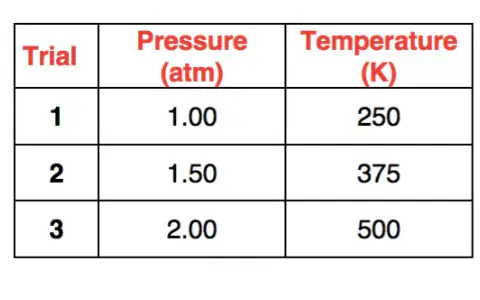
Observe the data table shown at the left for a sample of gas that has a constant volume and number of particles. Use the data table to predict the pressure of the gas when it's temperature is 1000 K.
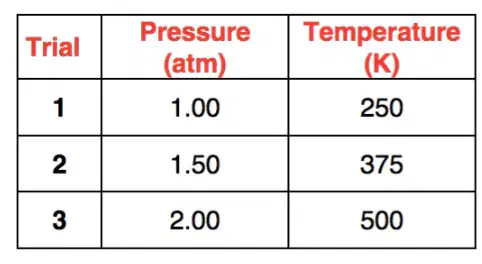
Observe the data table
for a
sample of gas that has a
constant volume and
number of particles. Use
the data table to predict
the pressure of the gas
when it's temperature is
1500 K.
Six containers contain gases which vary as to the size of the gas particles, the speed at which the particles move, and the size of the container (three of the containers are large, three are small). Which container will have the highest gas pressure?
Large container with small particles moving slowly
Large container with large particles moving quickly.
Small container with small particles moving slowly
Small container with small particles moving quickly
Small container with large particles moving quickly
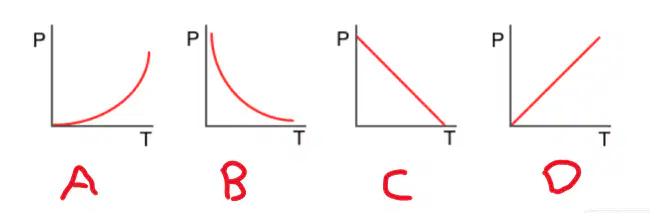
Which plot best represents the relationship between the pressure and the
temperature of a sample of gas? (Assume a constant volume and number of
particles.)Which plot best represents the relationship between the pressure and the
temperature of a sample of gas? (Assume a constant volume and number of
particles.)
A
B
C
D
According to Charles Law, if the temperature is doubled while the volume remains constant, what happens to the pressure?
The pressure will triple
The pressure will decrease
The pressure will double.
The pressure will remain the same
Match the following units to their names.
Pressure
mmHg
Volume
L
Temperature
K
Pressure
atm
Moles
mol
Match the following units with the property
V=
Liters
T=
Celsius
Kelvin
P=
atm
mmHg
N=
Mol

Choose the correct set of variables to solve the following problem:
At what temperature would 4.0 moles of hydrogen gas in a 100 liter container exert a pressure of 1.00 atmospheres?
P = x (unknown), V = 1.0 atm, n = 100 L, R = 8.314 L·kPa/mol·K, T = 4.0 mol
P = 100 L, V = 4.00 mol, n = x (unknown), R = 0.0821 L·atm/mol·K, T = 1.00 atm
P = 4.00 mol, V = x (unknown) , n = 1.0 atm, R = 8.314 L·kPa/mol·K, T = 100 K
P = 1.00 atm, V = 100 L , n = 4.0 mol, R = 0.0821 L·atm/mol·K, T = x (unknown)
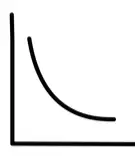
According to this graph, what is the relationship between these two units?
direct
no relationship
inverse
not enough information is given
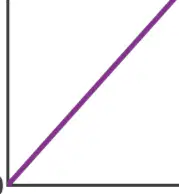
According to this graph, what is the relationship between these two units?
direct
no relationship
inverse
not enough information is given
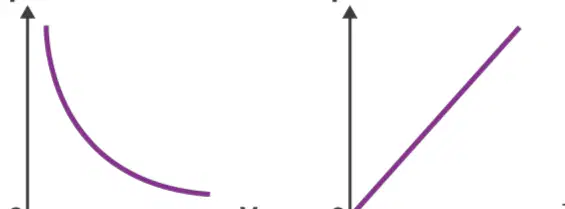
Which of the graphs below shows the relationship between temperature and pressure?
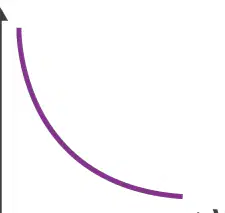
Graph on left

Graph on right
Which of the graphs below shows the relationship between temperature and volume?
Graph on left
Graph on right
Which of the graphs below shows the relationship between volume and pressure?
Graph on left
Graph on right



