
 Worksheets
Emotional Intelligence Session LEADERSHIP & MGT WEEK 13
Total questions: 64
Worksheet time: 32mins
Emotional intelligence (EI) is:
The ability to understand and manage your own emotions and those of others.
A measure of academic intelligence.
A type of physical strength.
A form of mathematical skill.
What are the benefits that emotional intelligence (EI) holds for managers and leaders?
Improved decision-making and team management
Increased technical skills
Reduced need for communication
Decreased employee engagement
How can you identify your own level of emotional intelligence (EI)?
By reflecting on your emotions and reactions in various situations
By ignoring your feelings
By always blaming others for your emotions
By never seeking feedback from others
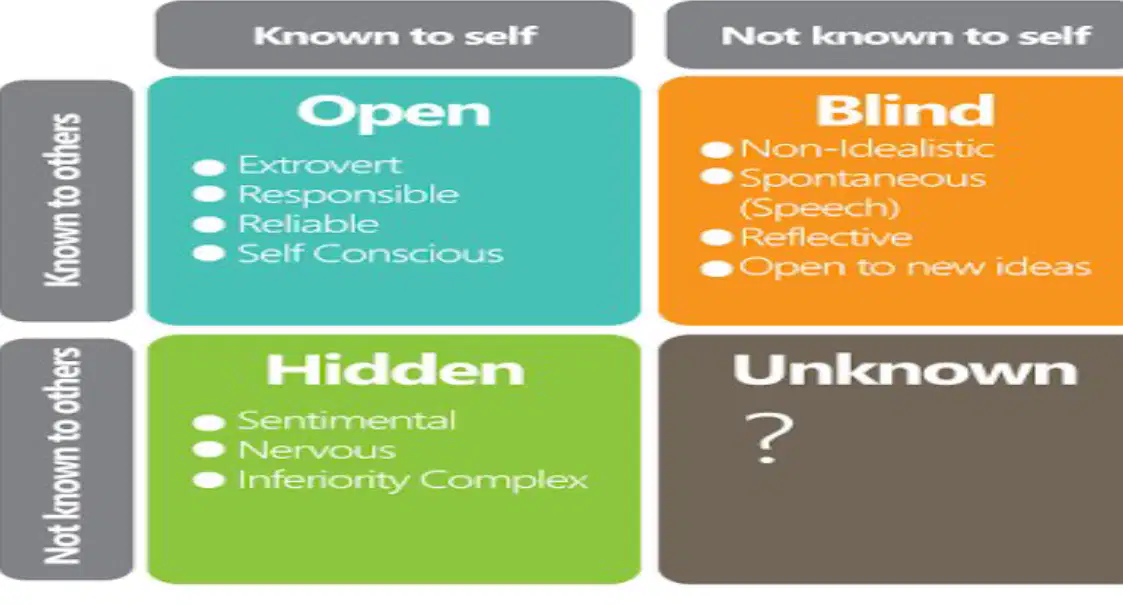
According to the Johari Window model, which of the following traits is found in the 'Open' quadrant?
Sentimental
Extrovert
Non-Idealistic
Spontaneous
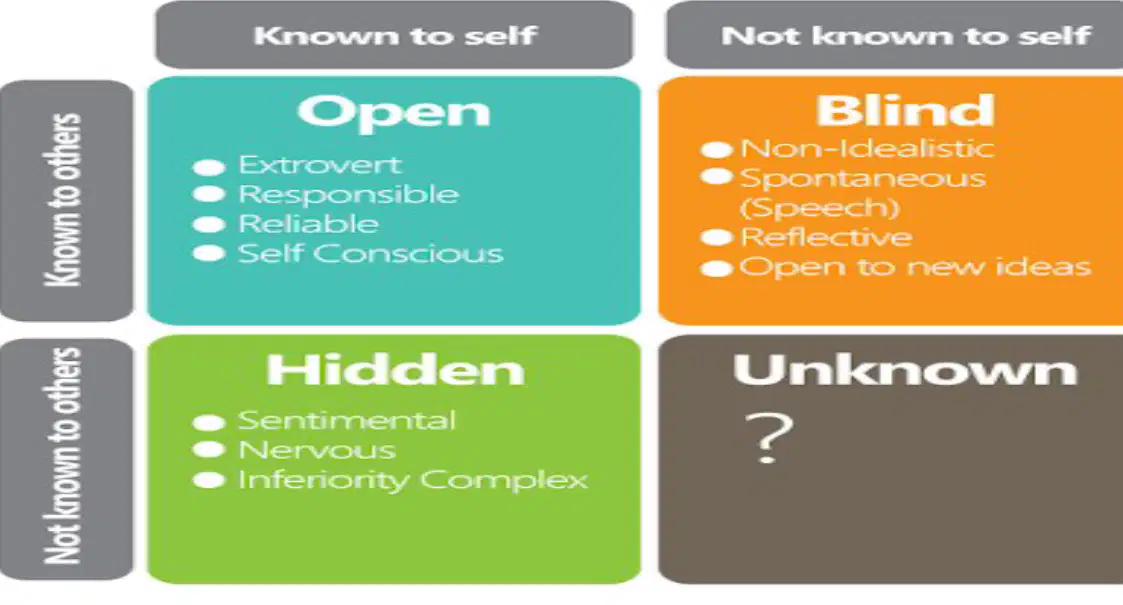
According to the Johari Window model, which of the following traits is found in the 'Blind' quadrant?
Responsible
Inferiority Complex
Non-Idealistic
Self Conscious
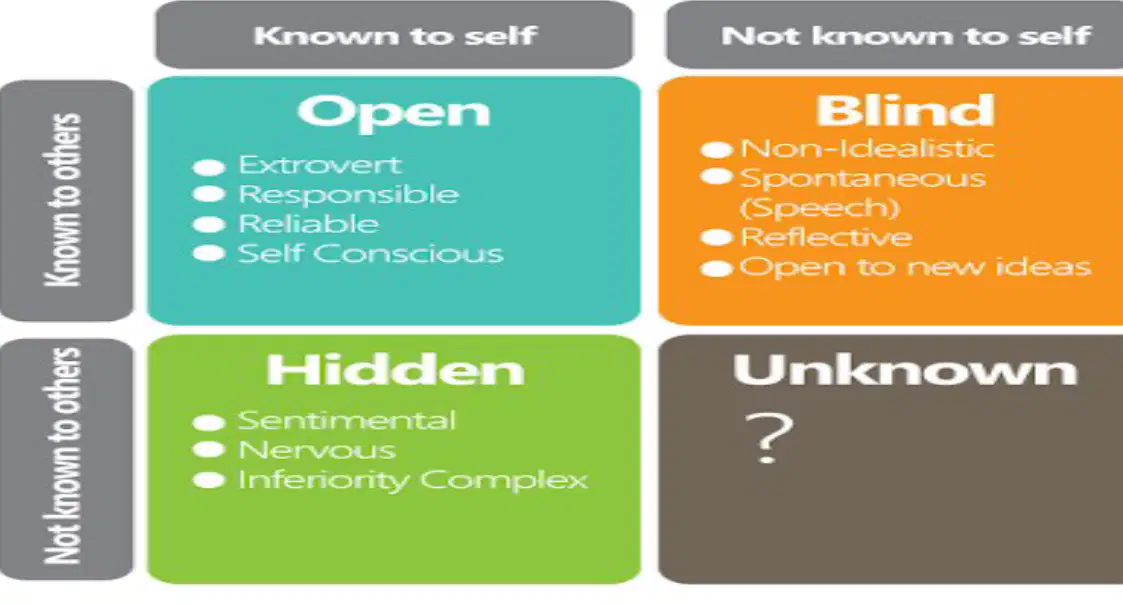
According to the Johari Window model, which of the following traits is found in the 'Hidden' quadrant?
Reliable
Sentimental
Reflective
Open to new ideas
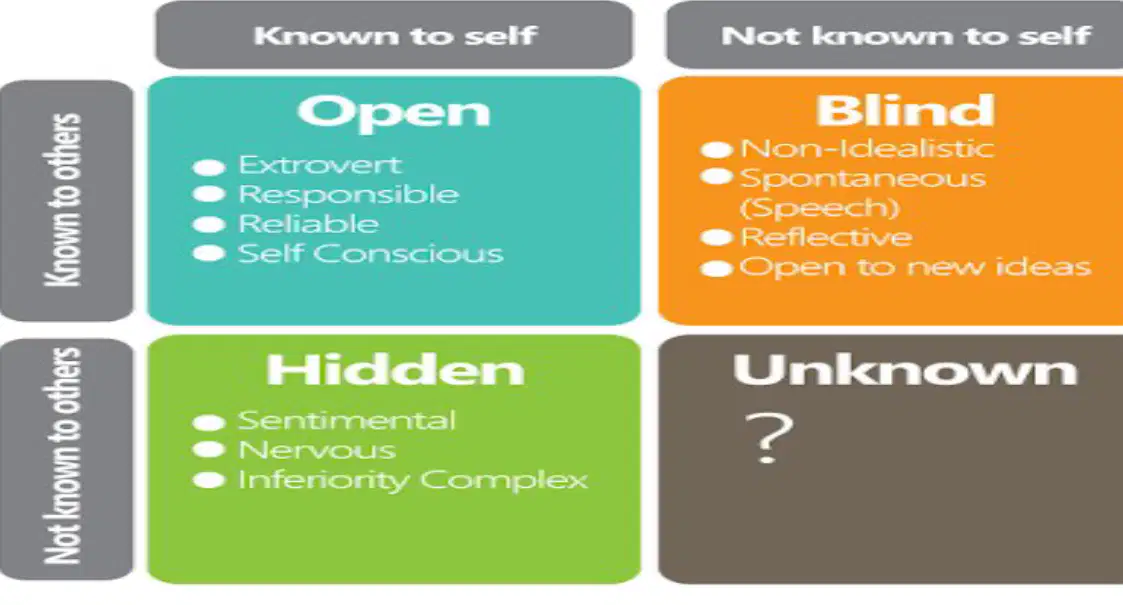
The "Open" quadrant of the Johari Window model includes the trait _________.
Responsible
Secretive
Unknown
Hidden

The "Blind" quadrant of the Johari Window model includes the trait _________.
Spontaneous (Speech)
Reserved (Emotion)
Self-aware (Thought)
Secretive (Behavior)
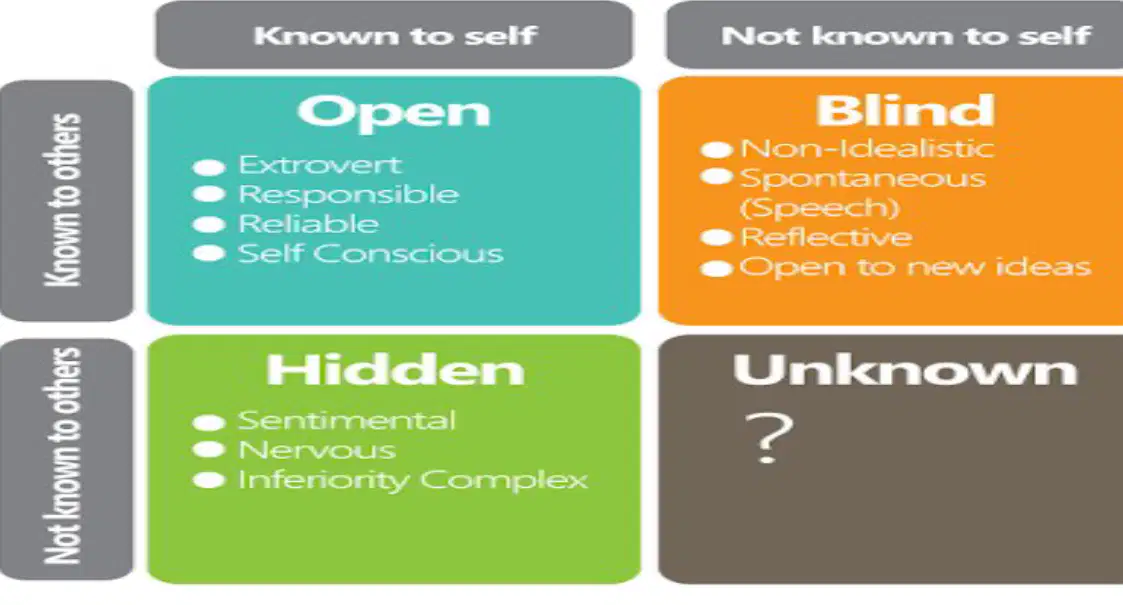
The 'Hidden' quadrant of the Johari Window model includes the trait _________.
Nervous
Open
Blind
Unknown
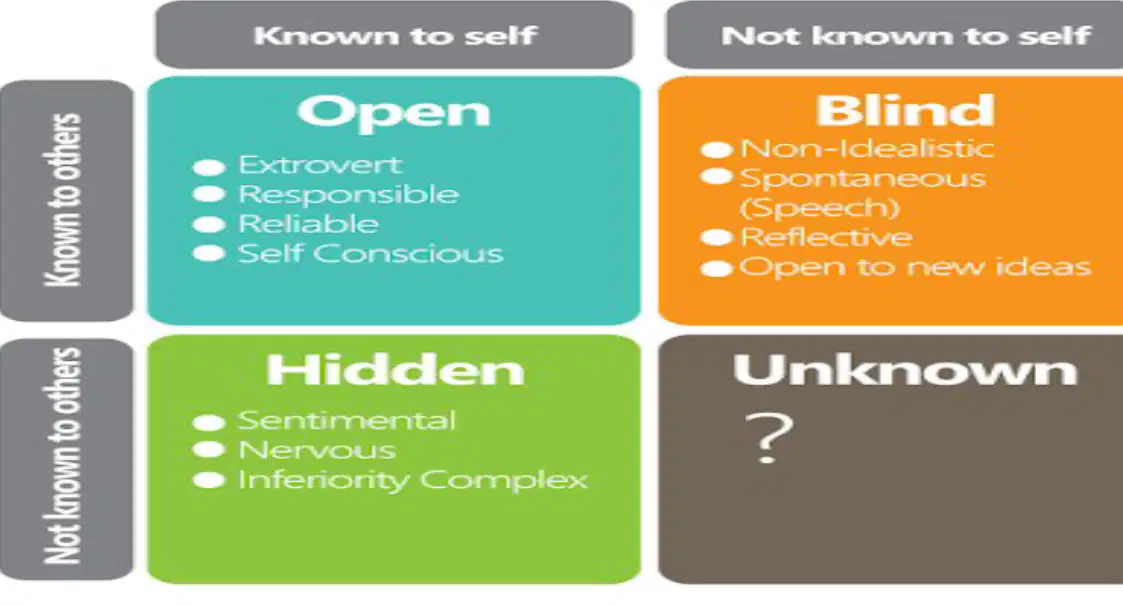
According to the Johari Window model, which quadrant contains the trait 'Self Conscious'?
Open
Blind
Hidden
Unknown
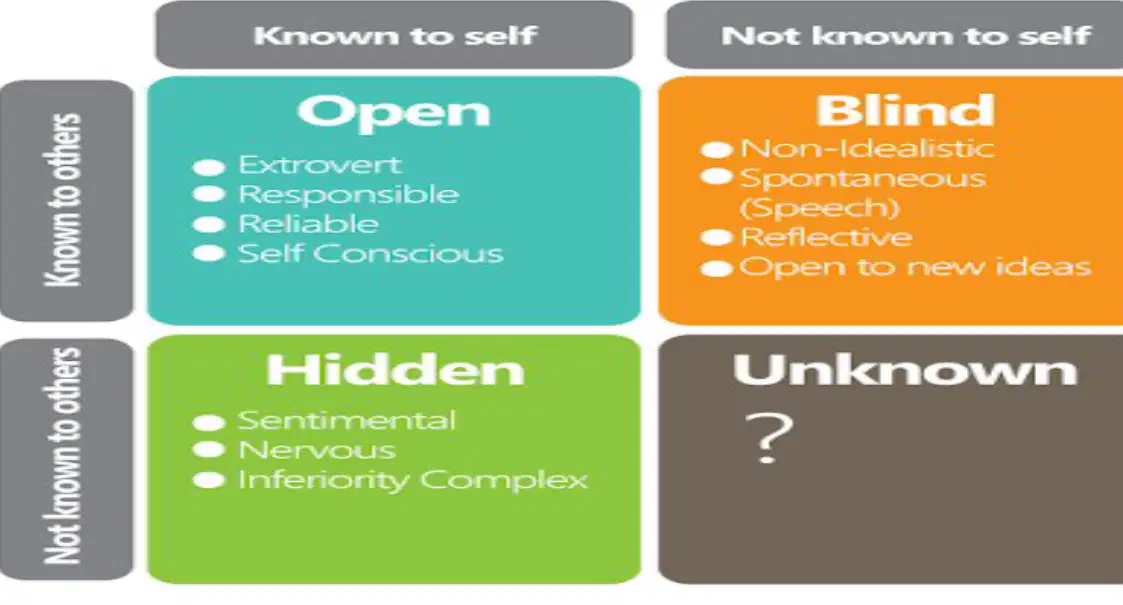
According to the Johari Window model, what is represented in the 'Unknown' quadrant?
Extrovert
Non-Idealistic
?
Inferiority Complex
Who created the Johari Window Model?
Joseph Luft and Harry Ingham
Abraham Maslow and Carl Rogers
Sigmund Freud and Erik Erikson
John Watson and B.F. Skinner
In which year was the Johari Window Model created?
1955
1962
1948
1970
The Johari Window Model emphasizes which of the following?
Hard skills
Soft skills such as behaviour, empathy, co-operation, inter group development and interpersonal development
Technical skills
Physical skills
The Johari Window Model works using how many area quadrants?
(a)
Anything you know about yourself and are willing to share is part of your (a) ?
Individuals build trust between themselves by:
Disclosing information to others
Learning about others from the information they disclose
Both A and B
None of the above
Any aspect that you do not know about yourself, but others within the group have become aware of, is in your _________?
blind area
open area
hidden area
unknown area
According to the Johari Window Model, feedback from others can help you become aware of:
Only your positive traits
Only your negative traits
Both your positive and negative traits as perceived by others
None of the above
According to the Johari Window Model, overcoming personal issues that may be inhibiting your personal or group dynamics within the team is possible.
True
False
Aspects about yourself that you are aware of but might not want others to know, this quadrant is known as your _________
hidden area
open area
blind area
unknown area
What is the area called that is unknown to you or anyone else?
Open area
Blind area
Hidden area
Unknown area
It is possible to ________ by asking for feedback from people.
increase your open area
decrease your confidence
reduce your knowledge
ignore your weaknesses
Honest feedback can reduce the size of your blind area.
True
False
Interrupting people before they have finished making their point can cause frustration.
True
False
Alternatively, people may always want to talk to you because you are a good _______.
listener
speaker
writer
reader
Sometimes you don’t realise these aspects of your character until it is _______ out.
pointed
written
called
sent

Reflection: Why is it important to work on each of the areas discussed? Open, Blind, Hidden and Unknown.
Because it helps in personal growth and self-awareness.
Because it is required by law.
Because it is a tradition.
Because it is easy to do.
Fill in the blank: One type of feedback mechanism is _________.
360 Degree feedback
Annual leave
Payroll processing
Inventory management
Fill in the blank: One type of feedback mechanism is _________
Self Assessment Tests
Final Exams
Lecture Notes
Group Projects

What is emotional intelligence (EI)?
The ability to understand and manage emotions
The ability to solve mathematical problems
The ability to memorize facts quickly
The ability to run long distances
According to Goleman, what is Emotional Intelligence (EQ) defined as? Emotional Intelligence (EQ) is defined as the ability to identify, assess, and control one's own emotions, the emotions of others, and that of ________.
groups
animals
machines
nature
According to Goleman, Emotional Intelligence (EQ) is defined as the ability to:
Identify, assess, and control one's own emotions
Identify, assess, and control the emotions of others
Identify, assess, and control the emotions of groups
All of the above
What does Self Awareness involve? Self Awareness involves recognising and understanding our moods, our emotions and our _______.
drivers
hobbies
friends
skills
How does Self Awareness affect others? Self Awareness includes understanding how our moods and emotions _______ others.
affect
ignore
hide
separate
What is Self Regulation? Self Regulation is the ability to control or redirect _______ and moods.
impulses
thoughts
memories
actions
Which of the following is a part of Self Regulation?
Acting without thinking
Thinking before acting
Ignoring emotions
None of the above
What is empathy?
The ability to understand the emotional make up of others.
Managing and building relationships and networks.
Finding common ground and building rapport.
None of the above.
Being skilful in treating people according to their emotional reactions is an example of which component?
Empathy
Social Skills
Motivation
Self-awareness
Which component involves managing and building relationships and networks?
Empathy
Social Skills
Self-regulation
Motivation
Finding the common ground and building rapport is a part of which component?
Empathy
Social Skills
Self-awareness
Motivation
What does the 'Motivation' component refer to in the context of the Five Components?
A passion for work that goes beyond money or status
The ability to understand others' emotions
Managing relationships effectively
Having technical skills
Which of the following is a characteristic of motivation according to the Five Components?
Pursuit of goals with energy and persistence
Ability to work alone
Focus on monetary rewards
Avoiding challenges
This final component was only recently added by _________
Daniel Goleman
Howard Gardner
Peter Salovey
John Mayer
Reflection: Why each of these components are important?
Because they contribute to the overall effectiveness.
Because they are optional.
Because they are unrelated.
Because they are not necessary.
Fill in the blank: One of the characteristics is Self awareness, which includes (a) and realistic self assessment.
Self regulation includes being trustworthy, integrity, and ________.
Open to change
Being stubborn
Ignoring feedback
Avoiding responsibility
Which of the following is NOT a sub-point of Empathy?
Build talent
Cross cultural sensitivity
Realistic self assessment
Integrity
________ is a characteristic that includes self confidence and realistic self assessment.
Self awareness
Empathy
Motivation
Adaptability
Which of the following is a sub-point of Self regulation?
Self confidence
Trustworthy
Build talent
Cross cultural sensitivity
Fill in the blank: Empathy includes build talent and ________.
Cross cultural sensitivity
Financial management
Technical expertise
Physical strength
Which of the following is NOT a characteristic listed in the image?
Self awareness
Self regulation
Empathy
Communication
Fill in the blank: One of the social skills is to ________ change.
Lead
Ignore
Resist
Delay
Fill in the blank: Being very ________ is considered a social skill.
persuasive
silent
aggressive
indifferent
Fill in the blank: Being effective at ________ teams is a social skill.
building
destroying
ignoring
avoiding
Fill in the blank: A characteristic of motivation is a strong drive to ________.
achieve
relax
ignore
hesitate
Fill in the blank: Being ________ is a characteristic of motivation.
optimistic
lazy
indifferent
pessimistic
Leaders with high EQ create an environment of _______ and fairness.
trust
competition
confusion
indifference
Leaders with high EQ are able to handle _______.
change
money
technology
machinery
Fill in the blank: Leaders with high EQ lead (a) .
Leaders with high EQ drive their _______.
team
car
house
computer
Leaders with high EQ encourage _______ and new ideas.
innovation
conflict
stagnation
routine
Fill in the blank: Leaders with high EQ generate _______.
optimism
conflict
indifference
confusion
Leaders with high EQ transform team _______.
performance
uniforms
schedules
locations

