
 Worksheets
coordination revision
Total questions: 11
Worksheet time: 6mins
During the generation of an action potential in a neuron, what is the primary event that causes the rapid depolarization phase?
Opening of voltage-gated potassium (K⁺) channels
Influx of sodium (Na⁺) through voltage-gated sodium channels
Efflux of chloride (Cl⁻) ions through ligand-gated channels
Activation of the sodium-potassium pump
How do non-gated potassium channels differ from gated potassium channels in neurons?
non-gated K+ channel open during depolarization; gated ones are always open
non-gated K+ channel require ATP; gated ones do not
non-gated K+ channel are always open; gated ones open only during action potentials
gated K+ channel allow all ions to pass; gated ones are selective for potassium only
What is the primary reason Na⁺ influx at one segment of the axon triggers an action potential in the next segment?
Na⁺ ions actively pull K⁺ ions forward along the axon
The local increase in positive charge depolarizes adjacent membrane to threshold potential
Voltage-gated Na⁺ channels are linked across segments and open simultaneously
The Na⁺/K⁺ pump pushes Na⁺ ions down the axon to propagate the signal
A neuron is at resting membrane potential (around –70 mV). If the neuron is submerged in iced water which depolarizes the membrane to –55 mV, what will most likely be the value of its action potential?
What are the ligands in the neuromuscular junctions?
During muscle contraction, what happens to the length of the actin and myosin filaments?
Both actin and myosin filaments shorten
Actin shortens, but myosin remains the same
Neither filament shortens
Myosin shortens while actin stays the same
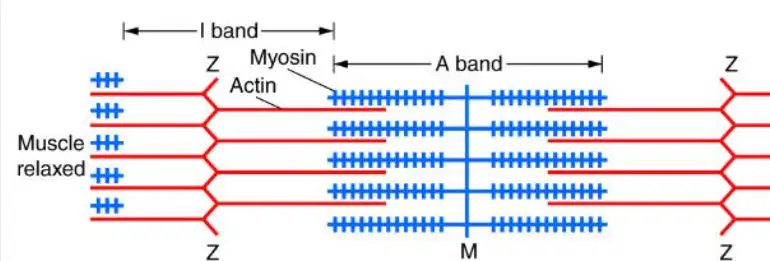
What is true about the sarcomere during muscle contraction?
The A band shortens while the I band stays the same.
Both the H zone and I band shorten.
The Z lines move farther apart.
The actin filaments shorten to pull on myosin.
Which of the following correctly describes a role of ATP in muscle contraction?
ATP disconnects the cross bridge
ATP binds to actin to expose the binding sites.
ATP energizes the power stroke
ATP used to transport calcium ions into the sarcoplasm
What is the role of the adenylyl cyclase in cell signaling?
It catalyzes the conversion of ATP into cyclic AMP
It catalyzes the breakdown of cAMP into ATP
It catalyzes the activation of protein kinase A
It catalyzes the binding of G-proteins to receptors on the cell membrane
Which of the following best describes how steroid hormones initiate a response in a target cell?
Steroid hormones bind to G protein couples receptors on the cell surface,
Steroid hormones diffuse through the plasma membrane and activates G protein
Steroid hormones diffuse through the plasma membrane of target cells and form a hormone-receptor complex
Steroid hormones bind to membrane receptors and activate adenylate cyclase to produce cAMP
How would a high level of phytochrome Pfr affect flowering in long-day plants?
It inhibits flowering by promoting hormone inactivation.
It has no effect on flowering in long-day plants.
It promotes flowering by stimulating florigen production.
It prevents conversion of hormone precursors into active forms.

