
 Worksheets
DM - Unit 1 - Intro to Design
Total questions: 57
Worksheet time: 29mins
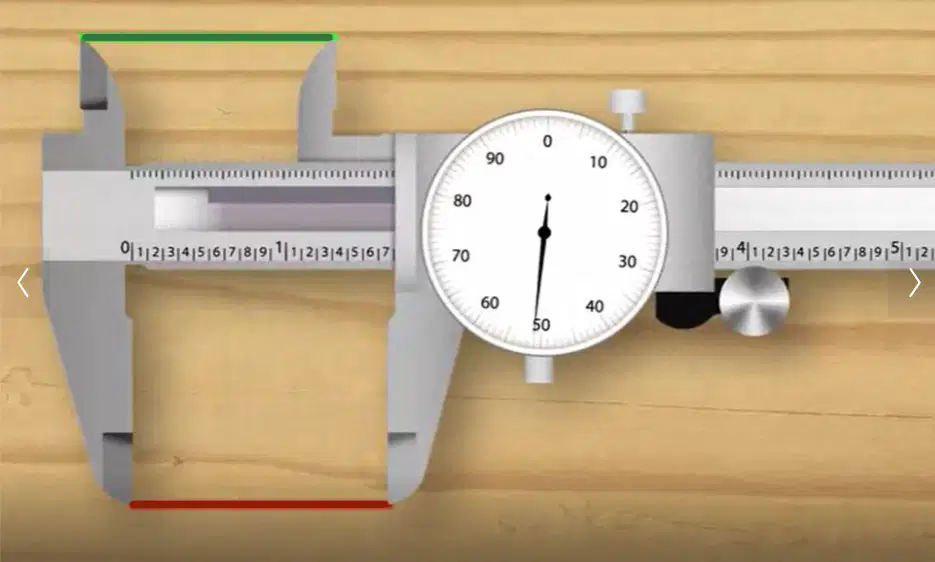
What is the measurement shown on this dial caliper?
1.751
7.051
5.071
7.501

What is the measurement shown on this dial caliper?
0.700 inches
0.070 inches
0.170 inches
7.000 inches
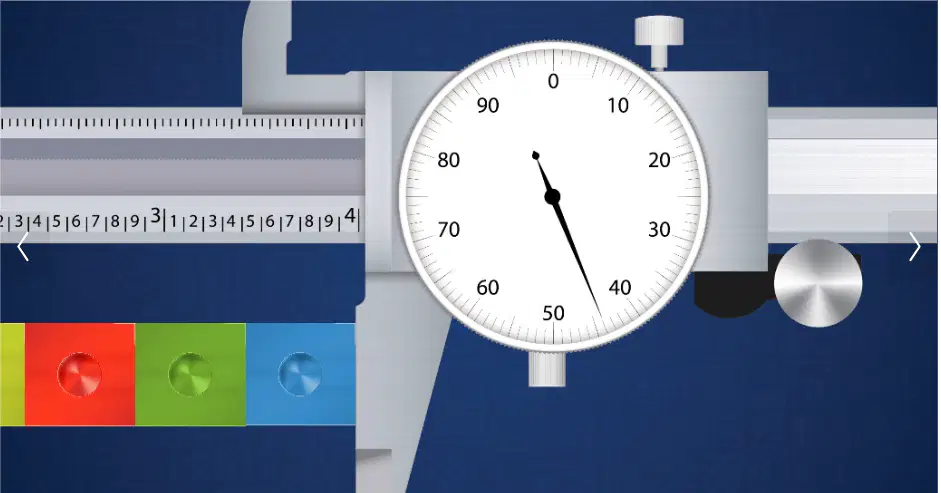
What is the measurement shown on this dial caliper?
4.044 inches
4.400 inches
5.044 inches
0.444 inches
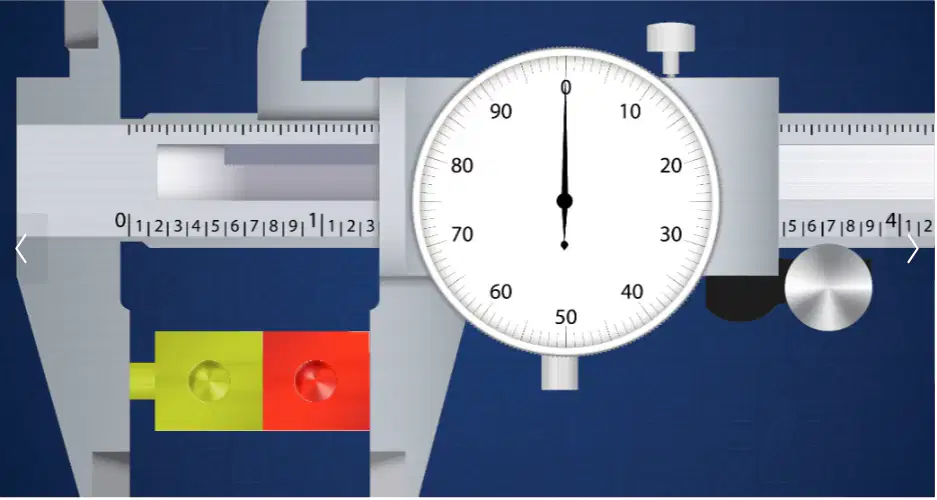
What is the measurement shown on this dial caliper?
1.300 inches
1.030 inches
1.003 inches
0.130 inches
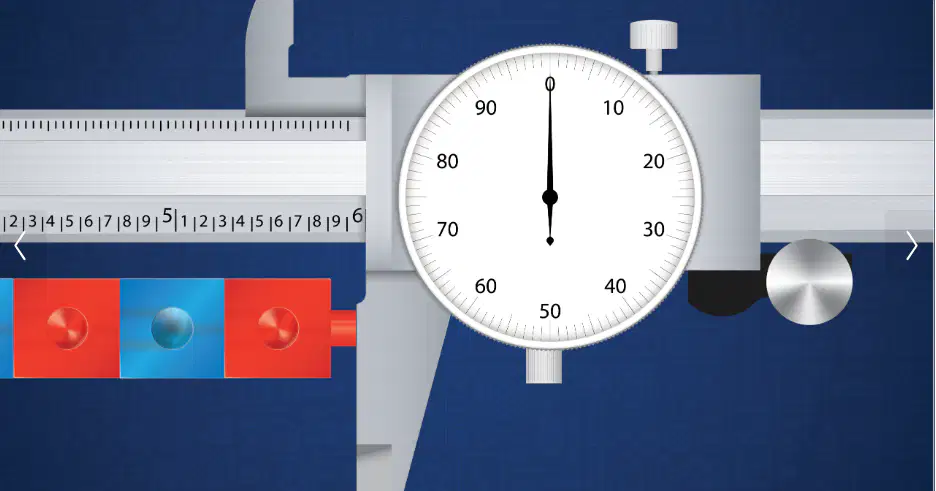
What is the measurement shown on this dial caliper?
6.000 inches
6.100 inches
0.600 inches
6.010 inches
What does the term "accuracy" refer to when measuring a 3D object?
The extent to which a measurement is close to its true value
The ability to measure the longest dimension of an object
The total number of measurements taken from an object
The ability to measure multiple dimensions at once
What does the term "precise" mean in the context of using a dial caliper?
The measurement is consistently repeatable.
The measurement is exactly what you expect it to be.
The measurement is the longest possible dimension of the object.
The measurement uses the largest units available.
Which part of a dial caliper allows it to measure with greater accuracy than a standard ruler?
The dial
The clamp
The handle
The extension bar
How do you check if a dial caliper is properly calibrated?
Bring the external measuring jaws together and check if the dial reads 0
Bring the internal measuring jaws together and check if the dial reads 1
Set the dial to 5 and adjust the clamp screw
Measure the object and compare it with a ruler
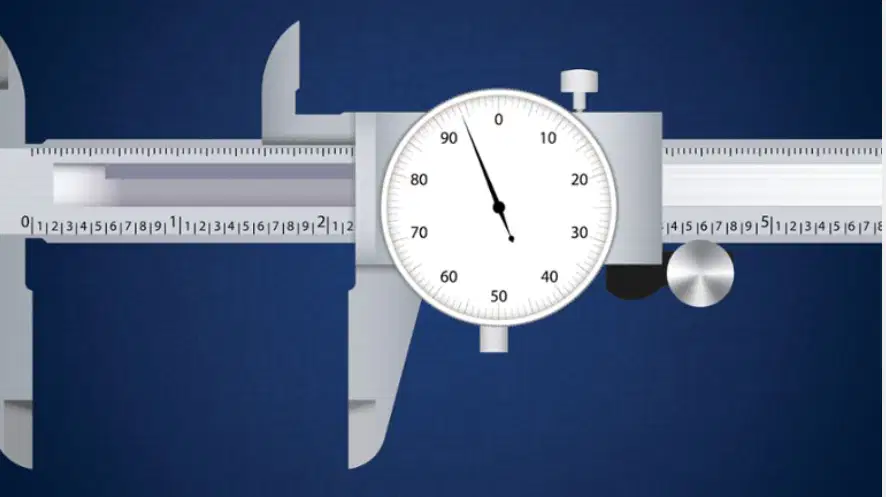
A dial caliper shows a reading of 94 on the dial and a "2" is visible on the bar. What is the correct total measurement if the hatch mark after the 2 is not visible?
2.194 inches
2.094 inches
2.294 inches
2.394 inches
Which of the following is the primary limitation of using a ruler to measure 3D objects?
Rulers are only as accurate as your eyes can see.
Rulers cannot measure length.
Rulers are unable to measure flat surfaces.
Rulers are too flexible, which makes them bend when measuring curved surfaces.
What is a dial caliper primarily used for? (Choose the best answer.)
Measuring linear (straight) dimensions, thickness, or diameter with high precision
Measuring distances between objects
Calculating the total surface area and volume of irregularly shaped objects accurately
Drawing straight lines on surfaces
Why is it important to have both accuracy and precision in measurements?
To prevent errors that can result in flawed products and customer dissatisfaction
To ensure the tool you use is functioning properly
To ensure that measurements are taken quickly and efficiently without any interruptions
To check measurements using multiple methods
How do engineers use statistical data in the design process?
To evaluate and improve the performance of a design
To make a final product without needing to test it again
To collect opinions about the appearance of a design
To explain why the design looks better than other designs
Why is it important to exclude outliers in a box and whiskers plot?
To provide a clearer view of the central tendency and spread of the main data set
To make the plot look more visually appealing
To ensure the minimum and maximum values are accurately represented
To make the minimum and maximum values the same as the first and third quartiles
What is an outlier in a data set?
A value that is much smaller or larger than most of the other data points
A value that falls within the middle 50% of the data
A value that represents the average of the data
A value that appears most frequently and represents the data’s mode
What is the purpose of creating a box and whiskers plot in statistical analysis?
To visualize measures of center and spread in a data set
To calculate the mean of a data set
To compare different data sets
To organize data points in a list from smallest to largest values
What does the median represent in a data set?
The middle value when data is arranged in order
The total sum of all data points
The difference between the highest and lowest values in the data set
The highest value in the data
In a dataset, if the middle 50% is between 10 and 30, which of the following is true?
25% of the data points are larger than 30
50% of the data points are smaller than 10
The median is equal to 30
The minimum is greater than 10
Which of the following correctly defines the range of a dataset?
The distance between the highest and lowest values
The sum of the minimum and maximum values
The number of data points in the dataset
The difference between the most frequent and least frequent values
Which of the following measurements are used to determine the center of a data set?
Mean and median
Mean and range
Median and mode
Range and spread
Why did societies eventually create standard units like the foot or the meter?
To create a measurement system that everyone could use consistently.
To allow people to measure faster using their hands and feet.
To ensure that measurements could vary depending on who was measuring.
To develop a system based entirely on ancient Egyptian practices.
What is the metric system primarily based on?
Units of meters, liters, grams, and Celsius
Units of miles, gallons, and Fahrenheit
The length of a person's arm and feet
Units of feet, inches, and pounds
Which of the following is true about the metric system?
It is a decimal system that is used internationally for measuring length, volume, mass, and temperature.
It uses inconsistent units that vary by country.
It is based on body measurements such as cubits and feet.
It is only used in the United States.
What are the small lines that divide the length of a ruler between each whole number called?
Hatch marks
Hyphens
Dashes
Markers
Why is it important to align the object you are measuring with the starting hatch mark on the ruler?
To ensure that the object’s measurements are consistent and accurate.
To make sure you measure from the middle of the object.
To allow for easier conversion between measurement systems.
To make the measurement process faster.
What does the term dimensioning refer to in the context of sketching and designing objects?
The act of labeling an object’s height, width, and depth.
The process of coloring a sketch.
The technique of drawing objects in 3D.
The method of erasing unnecessary parts of a sketch.
Why is adding dimensions to a sketch important?
It helps others understand the exact size and proportions of the object.
It adds color and texture to the drawing.
It makes the sketch more decorative.
It replaces the need for a written explanation of the object.
What should you do if your ruler does not have a labeled "0" hash mark?
Begin measuring from the unmarked starting point, ensuring your object lines up at the correct edge.
Start your measurement from the second tick mark.
Estimate the beginning of the ruler.
Use the middle of the ruler to start measuring.
Why are dimensions important when building the skimmer?
They provide accurate measurements for cutting and assembling.
They help determine the skimmer's color and material.
They show where to add decorative features to the skimmer.
They allow the skimmer to be adjusted after it is built.
What does the term "dimension" refer to in the context of the skimmer sketch?
A measurement taken in only one direction.
A measurement that includes height and width.
A measurement used to compare different objects.
A measurement that changes depending on the material used.
Which three primary views are typically shown in a multiview sketch?
Top, Front, and Right
Left, Bottom, and Back
Front, Side, and Bottom
Top, Left, and Front
How might using linking cubes help you when creating a multiview sketch?
They help you visualize the object from different perspectives
They allow you to draw more accurate curves
They ensure that your drawing is proportional
They help you measure the dimensions of the object more precisely
What is the primary purpose of a thumbnail sketch?
To offer a quick, simple drawing that captures basic proportions and essential details
To provide a detailed and to-scale representation of an object
To show an object from three different views
To create a 3D representation of an object at a 30-degree angle
Why are the edges of the object in an isometric sketch drawn at 30-degree angles?
To make the object appear three-dimensional
To ensure the object looks realistic when viewed from above
To allow for easy measurement of angles
To create a front view only
What additional information could you add to a sketch to provide other team members with a more accurate design drawing?
Detailed measurements and labels
Shadows and color
Background scenery
Irregular patterns and textures
What is an isometric sketch?
A drawing that shows three sides of an object simultaneously at a 30-degree angle
A sketch drawn at a 45-degree angle to show depth and perspective
A sketch used to show the internal structure of an object using hidden lines
A proportional drawing that focuses on the front view only
Which of the following best defines a thumbnail sketch?
A quick, small sketch that captures basic proportions and key details
A detailed, to-scale representation of an object with exact measurements
A three-dimensional drawing showing multiple angles of an object
A drawing used to create precise architectural blueprints
What does the term "hidden line" refer to in a multiview sketch?
A dashed line representing the edges of an object that are not visible from the current view
A solid line used to define the visible edges of an object
A curved line used to show rounded edges and surfaces of an object
A line used to indicate the direction of movement in an object
What is isometric graph paper primarily used for?
Drawing three-dimensional objects with consistent 30-degree angles
Drawing sketches that focus on the internal structure of an object
Creating multiview sketches with accurate front, top, and side views
Measuring exact dimensions in a perspective sketch
How is a multiview sketch best described?
A drawing that shows three primary views (top, front, and right) of an object
A sketch that shows all sides of an object in one perspective
A small, quick sketch that highlights the key features of an object
A sketch that is drawn at a 30-degree angle to show multiple sides
What is a solution in the context of the design process?
The answer to a problem or opportunity.
A working model used to test a design concept.
An accurate representation of an object.
A systematic problem-solving strategy that designers follow to come up with a solution to a problem.
What might designers do if they find issues during the evaluation of their solution?
Return to a previous step in the design process to make changes
Present the solution as is
Discard the entire project
Ignore the issues and move on
The design process is:
A systematic problem-solving strategy that designers follow to come up with a solution to a problem.
The answer to a problem or opportunity.
Repeating process steps to continuously improve a work product.
A tool for comparing design solutions against one another, using specific criteria that are based on project requirements.
Which step comes after generating concepts in the design process?
Designing a solution
Testing the solution
Identifying the problem
Documenting the requirements
The design process is rarely linear and straight forward. So, why do designers often repeat steps in the design process?
To evaluate, reflect, redefine, and redesign the solution until it is optimal (the best it can be)
To ensure they stay within budget
To avoid making any changes to the initial design
To finalize the solution as quickly as possible
What do designers create during the "design a solution" step?
Technical drawings and models
A marketing plan
A list of possible ideas
A final product
What is a prototype?
A working model used to test a design concept.
The answer to a problem or opportunity.
An accurate representation of an object
A tool for comparing design solutions against one another, using specific criteria that are based on project requirements.
What type of engineer is one who helps in designing bridges?
Civil
Mechanical
Electrical
Once a variety of concepts and solutions have been brainstormed, how do designers decide which solution to pursue?
Compare design solutions against one another, using a decision matrix to pick a few or hopefully the best one.
Immediately start building a prototype for each solution
Present all solutions to the client for feedback
Move on to testing
What is meant by collaboration in a design team?
Working together on a common purpose.
The answer to a problem or opportunity.
Repeating process steps to continuously improve a work product.
A tool for comparing design solutions against one another, using specific criteria that are based on project requirements.
What does the term "iterations" refer to in the design process?
Repeating process steps to continuously improve a work product.
The answer to a problem or opportunity.
A systematic problem-solving strategy that designers follow to come up with a solution to a problem.
Documents that can include client interview responses, observations, research, design drawings, prototypes, photos, videos, test results, or satisfaction surveys.
What do designers do during the "evaluate the solution" step?
Test the solution's effectiveness, reflect on the design, and suggest improvements
Create a new prototype
Document the design process
Brainstorm new ideas
What is the final action step in the design process?
Presenting the solution
Evaluating the feedback
Generating new concepts
Testing the prototype
What is a decision matrix used for in the design process?
A tool for comparing design solutions against one another, using specific criteria that are based on project requirements.
Documents that can include client interview responses, observations, research, design drawings, prototypes, photos, videos, test results, or satisfaction surveys.
Guidelines regarding how a group interacts, communicates, and conducts themselves as a part of the team.
A systematic problem-solving strategy that designers follow to come up with a solution to a problem.
What is the first step in the design process?
Identify a problem or an opportunity
Create a solution
Test the solution
Generate Concepts
Which statement best describes the relationship between tolerance and accuracy?
Accuracy is how close you are to the target, and tolerance is the limit of what’s still acceptable
Tolerance measures how close the results are to each other, and accuracy measures if the results are repeatable
Tolerance measures how close something is to the target
Tolerance only matters when using a digital caliper