
Font size
 Worksheets
Strategy implementation, SAFe and barriers to implementation
Total questions: 88
Worksheet time: 49mins
The SAFe model is:
A framework for scaling Agile across the enterprise
A project management tool
A software development language
A type of database
Apply the SAFe criteria to the chosen organisation.
SAFe criteria applied to the chosen organisation.
SAFe criteria ignored for the chosen organisation.
SAFe criteria partially applied to the chosen organisation.
SAFe criteria not relevant to the chosen organisation.
Evaluate a case study in relation to SAFe criteria.
It involves assessing the case against SAFe principles and practices.
It requires ignoring SAFe guidelines.
It focuses only on financial outcomes.
It disregards team collaboration.
What will you be able to do after this week's session on Managing Strategic Change?
Understand how organisations set out to manage strategic change
Learn about financial accounting
Study marketing strategies
Practice public speaking
Reality does not always compare with the original plans when managing strategic change.
True
False
Which chapters of Johnson and Scholes Exploring Corporate Strategy should you read in preparation for next week's session?
Chapters 1 and 2
Chapters 10 and 11
Chapters 15 and 16
Chapters 20 and 21
Where can you find the Harvard Business Review article 'Choosing strategies for change' for next week's session?
In the library
On Teams
On the college website
In the textbook

In what year did Amazon go public and start its 2nd distribution?
1997
1995
2000
2002
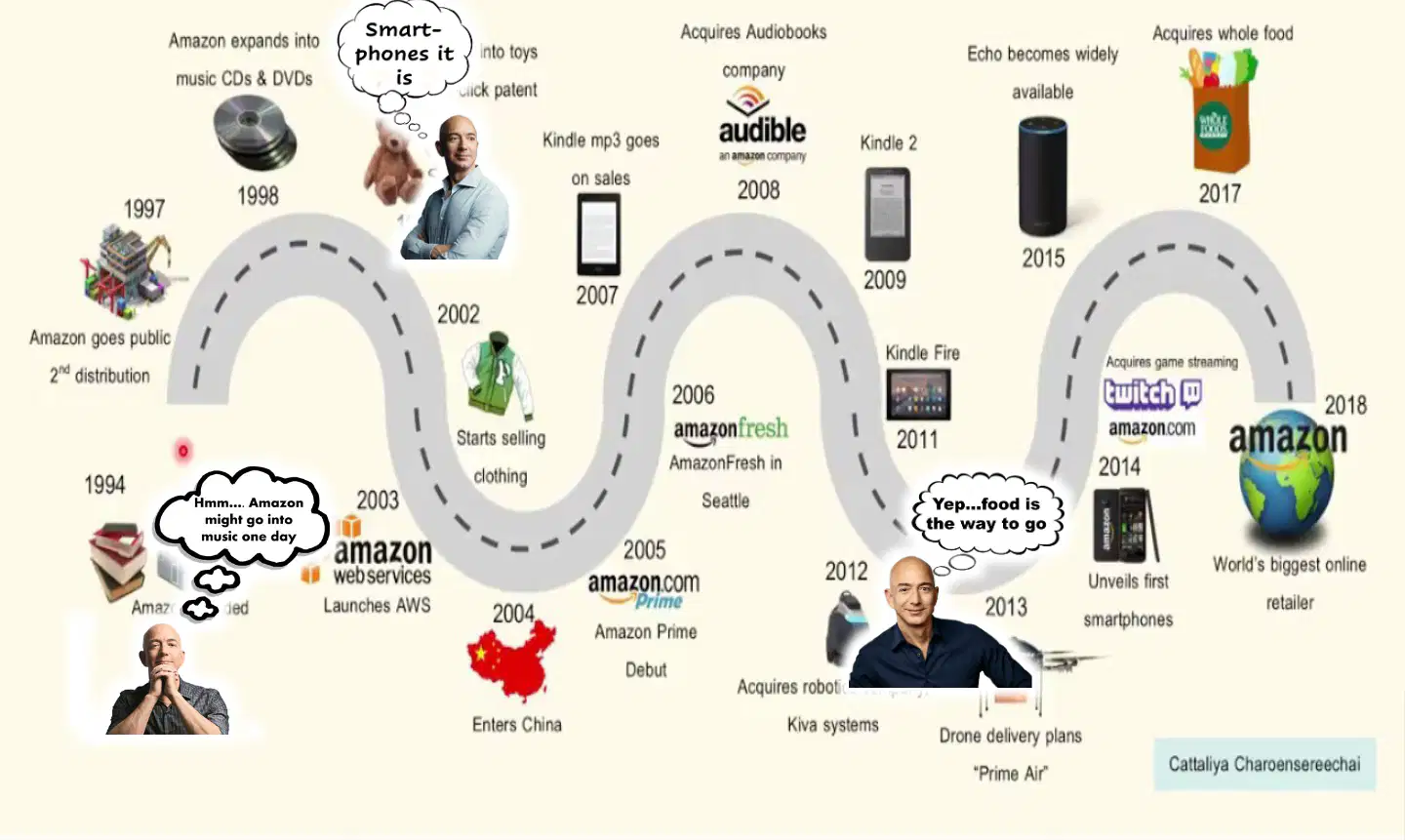
Which product category did Amazon expand into in 1998?
Music CDs & DVDs
Electronics
Clothing
Home Appliances

When did Amazon launch Amazon Web Services (AWS)?
(a)

Amazon entered which country in 2004?
China
India
Brazil
Australia

What was the name of the service Amazon debuted in 2005?
Amazon Prime
Amazon Fresh
Amazon Go
Amazon Web Services

In which year did Amazon start selling clothing?
2002
1998
2005
2010

What major event happened for Amazon in 2006 in Seattle?

Which device did Amazon release in 2007?
Kindle mp3 goes on sales
iPad
Nook
Surface Pro

What company did Amazon acquire in 2008?
Audiobooks company (Audible)
Online shoe retailer (Zappos)
Streaming service (Netflix)
Social media platform (Twitter)

Which version of Kindle was released in 2009?
Kindle 2
Kindle Oasis
Kindle Paperwhite
Kindle Voyage

What product did Amazon release in 2011?
Kindle Fire
Amazon Echo
Fire Phone
Amazon Prime Video

Which robotics company did Amazon acquire in 2012?
Kiva systems
Boston Dynamics
iRobot
Fetch Robotics

What was Amazon's drone delivery plan called in 2013?
Prime Air
SkyNet
DroneXpress
AirDrop
ParcelFly

Which game streaming company did Amazon acquire in 2014?
Twitch
Mixer
YouTube Gaming
Dailymotion

When did Echo become widely available?
2015
2013
2017
2019

Which major food company did Amazon acquire in 2017?
Whole Foods
Trader Joe's
Kroger
Safeway

In what year did Amazon become the world's biggest online retailer?
(a)
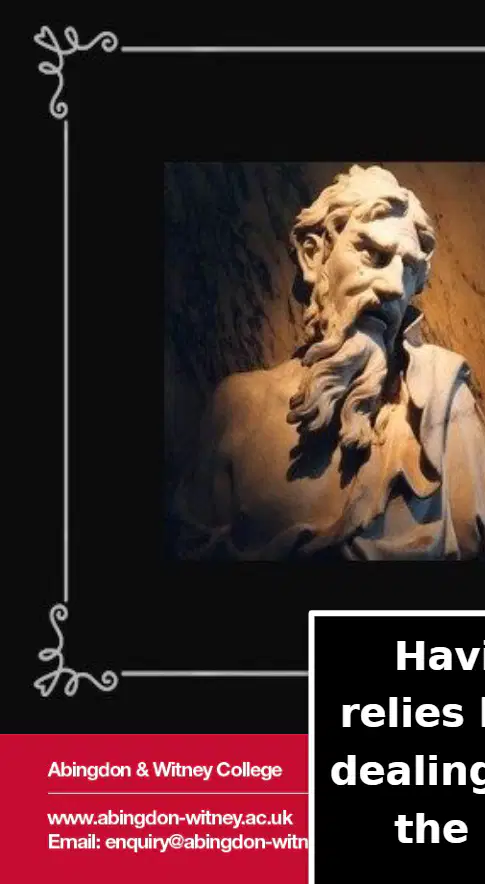
Who said the quote: 'The only thing that is constant is change'?
Socrates
Plato
Heraclitus
Aristotle
According to the image, what is the only thing that is constant?
Change
Time
Distance
Speed
Why is dealing with change considered one of the most difficult aspects of a management role, according to the statement in the image?
Because it requires adapting to new situations and overcoming resistance.
Because it involves only routine tasks.
Because it is always predictable and easy to manage.
Because it does not affect employees.
In order for strategic change to be effective, the organisational ______ must be understood to gauge the receptiveness or resistance to change.
context
budget
location
schedule
In order for strategic change to be effective, the type of ______ employed to achieve change must be appropriate to the context and end result.
strategy
location
budget
employee
Fill in the blank: Strategic change is about creating _______ advantage through improving an organisation's competitive position through improving certain elements such as its cost position and differentiation from competitors.
competitive
financial
technological
operational
Fill in the blank: One way organisations can plan for strategic change is as part of an (a) planning cycle (process usually found within large organisations).
Fill in the blank: Externally imposed change occurs when (a) decide to make change – perhaps with new management.
Fill in the blank: _______ change is based on a series of decisions over a period of time.
Emergent
Planned
Sudden
Random
Fill in the blank: Logical change develops by _______ and learning from experience.
experimentation
observation
imitation
memorization
Fill in the blank: A _______ process (perhaps a Boardroom battle) is one way organisations can plan for strategic change.
political
technical
financial
operational
Fill in the blank: Shareholder _______ and influence is a way organisations can plan for strategic change.
power
wealth
location
number
Fill in the blank: The four key elements involved in strategic change are 1. ________, 2. Managing types of change programmes, 3. Levers for change, 4. Leading and managing change.
Diagnosis
Implementation
Evaluation
Communication
Which key element of strategic change involves the organisational context of change?
Levers for change
Diagnosis
Leading and managing change
Managing types of change programmes
Which key element of strategic change is about deciding on the means of change to fit the change programme and diagnosis?
Levers for change
Diagnosis
Leading and managing change
Managing types of change programmes
Fill in the blank: ________ refers to styles of leadership and roles in managing change as a key element in strategic change.
Leading and managing change
Organizational structure
Financial planning
Market segmentation
Fill in the blank: Understanding the __________ context will help identify the appropriate type of strategic change that is needed.
organisational
financial
technological
geographical
What does organisational context refer to?
The financial status of the organisation
The receptiveness or resistance to change
The number of employees
The market share
Fill in the blank: One model used to diagnose the organisational context is the organisation __________.
kaleidoscope
microscope
telescope
periscope
Which factor in Strategic Change Programmes is described as: 'Who has the power to enact change? SMT within, what about stakeholder groups and those resistant to change?'
Power
Culture
Structure
Resources
Which factor in Strategic Change Programmes is described as: 'How quickly is change needed?'
Time
Scope
Resources
Leadership
Which factor in Strategic Change Programmes is described as: 'What is the breadth of change needed across an organisation and the depth of change in culture?'
Scope
Timeline
Resources
Leadership
Which factor in Strategic Change Programmes is described as: 'What resources and characteristics need to be maintained, improved and abandoned?'
Preservation
Transformation
Diversification
Elimination
Which factor in Strategic Change Programmes is described as: 'Diverse set to ideas to take forward, may be restricted by a homogeneous workforce.'
Diversity
Leadership
Communication
Innovation
Which factor in Strategic Change Programmes is described as: 'What is the capability of management to carry out change?'
Capability
Vision
Resources
Resistance
Which factor in Strategic Change Programmes is described as: 'Are there sufficient resources (financial, managerial, physical etc) to carry out change?'
Capacity
Urgency
Vision
Readiness
Which factor in Strategic Change Programmes is described as: 'How ready for change are the workforce? Are there pockets or levels of resistance?'
Readiness
Leadership
Resources
Communication
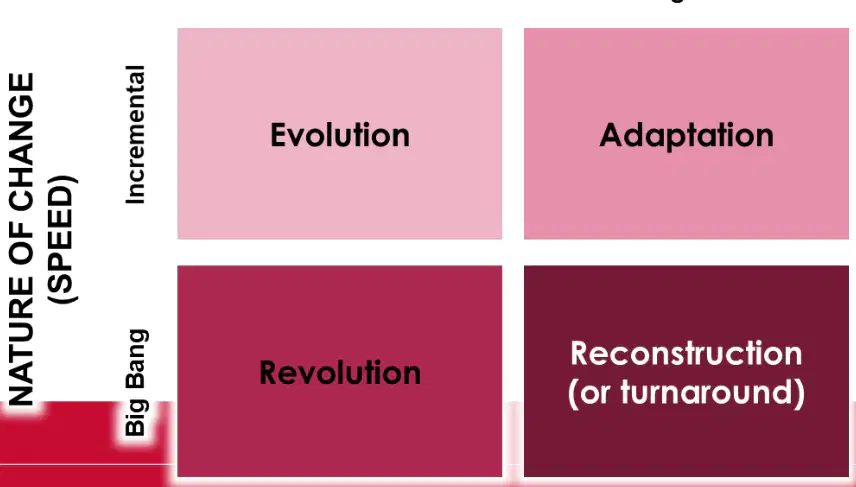
According to the diagram, what are the four generic types of strategic change?
Evolution, Adaptation, Revolution, Reconstruction (or turnaround)
Planning, Organizing, Leading, Controlling
Innovation, Expansion, Reduction, Stabilization
None of the above
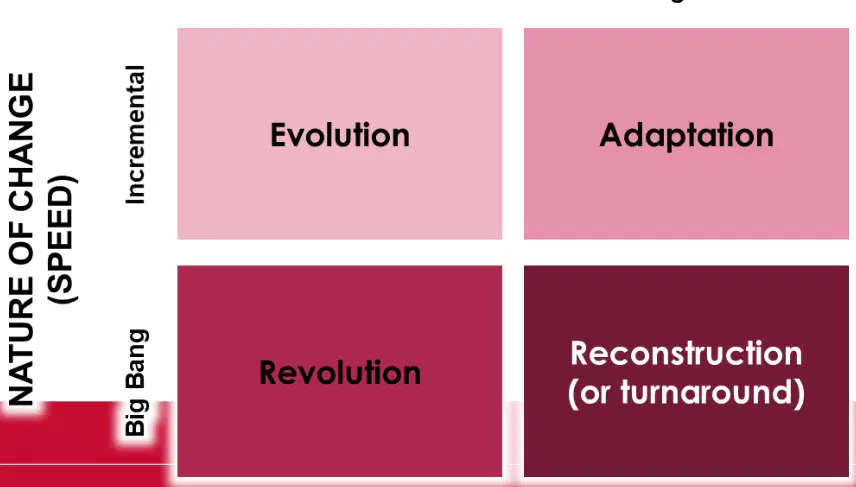
Fill in the blank: The type of strategic change that is both incremental and leads to transformation is called ________.
Evolution
Revolution
Stagnation
Regression
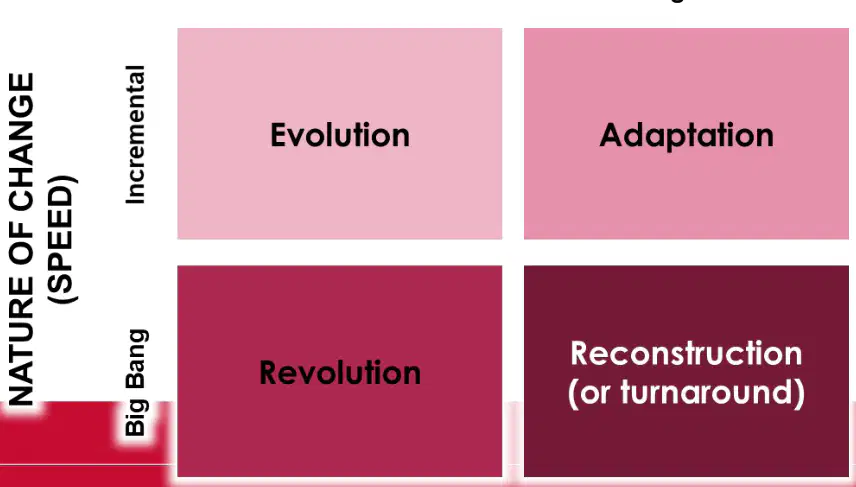
Which type of strategic change is characterized by a 'Big Bang' nature of change and results in realignment?
Evolution
Adaptation
Revolution
Reconstruction (or turnaround)
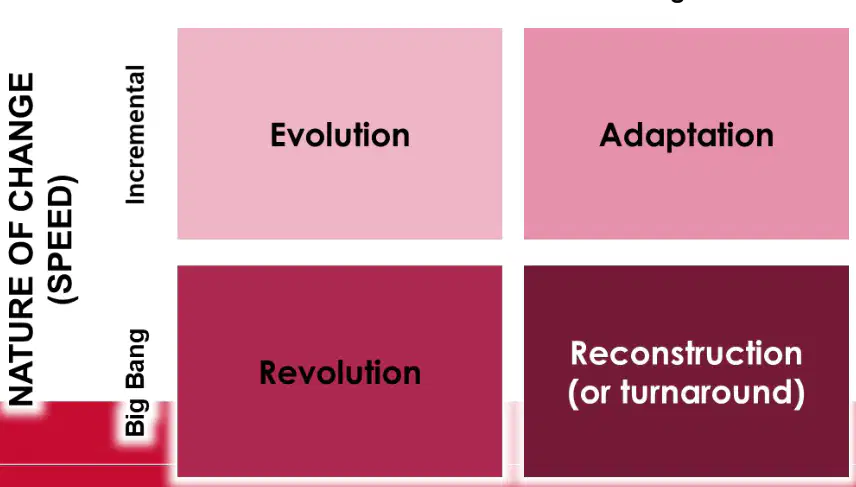
Fill in the blank: ________ is the type of strategic change that is incremental and results in realignment.
Adaptation
Reconstruction
Evolution
Revolution
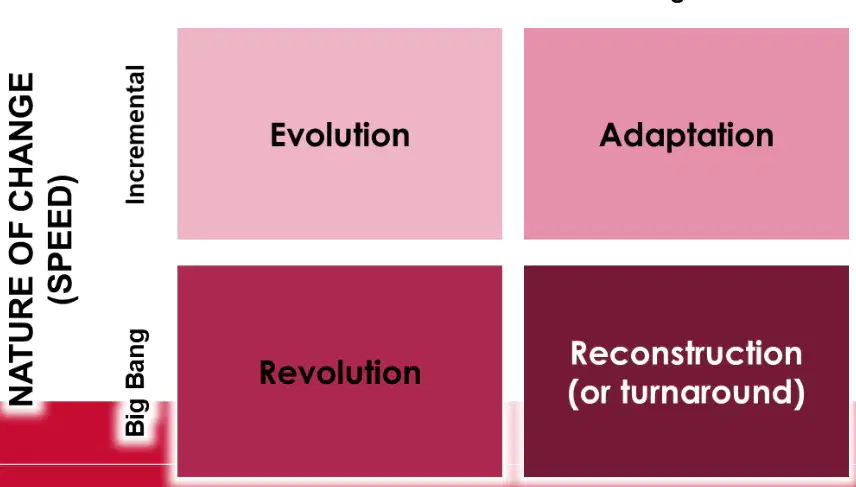
Which axis in the diagram represents the speed of change?
End Result (Extent)
Nature of Change (Speed)
Transformation
Realignment

According to the diagram, what does 'Incremental' change allow for?
Immediate transformation
Time for the build up of skills and installation of the shift in organizational paradigm
Major changes to existing practices
Changes beyond the current business model
Fill in the blank: 'Big bang' change happens all at once, usually in times of _______.
crisis
celebration
routine
prosperity
Which type of change does not require major changes to existing practices, culture ethos, etc.?
Realignment
Transformation
Adaptation
Reconstruction
Transformational change requires changes beyond the current business model.
True
False
What is the main difference between realignment and transformational change according to the diagram?
Realignment does not require major changes to existing practices, while transformational change requires changes beyond the current business model.
Realignment always involves a complete overhaul of the organization, while transformational change only tweaks minor processes.
Transformational change is less significant than realignment and focuses on small improvements.
Realignment and transformational change are essentially the same and do not differ in their impact.
According to the diagram, which type of change is described as 'gradual, building on or amending what the organisation has been doing previously'?
Evolution
Revolution
Transformation
Disruption
Which of the following is in line with the current business model and organisational culture?
A) Evolution
B) Adaptation
C) Transformation
D) Realignment
Might include changes in product design or methods of production, launches of new products or related diversification.
True
False
What is the most common form of change in organisations?
Evolution
Revolution
Stagnation
Regression
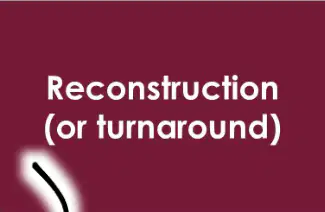
Which type of change involves rapid change and disruption?
Adaptation
Reconstruction (or turnaround)
Realignment
Incremental change
Reconstruction (or turnaround) fundamentally changes the culture or business model.
True
False
Fill in the blank: Reconstruction (or turnaround) might include changes in organisational structure or new ________ programmes, acquisition or divestment.
cost-cutting
recruitment
training
marketing
When are turnaround strategies most likely to be applied?
During periods of stable performance
In times of radical performance decline
When launching a new product
During market expansion
Which of the following is a priority in turnaround strategies?
Actions that give quick and significant improvements
Long-term planning only
Maintaining the status quo
Reducing employee benefits
Reconstruction (or turnaround) strategies are appropriate in which of the following situations?
Economic recessions
Failure of major investment projects
Sudden collapse of markets
All of the above
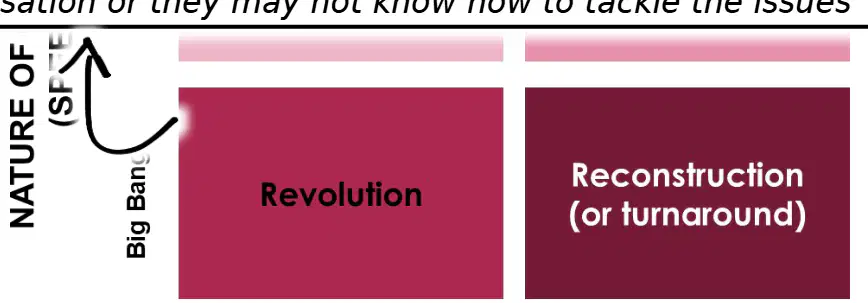
Which type of organizational change requires rapid and major strategic and cultural change?
Evolution
Revolution
Adaptation
Incremental change
Fill in the blank: The need for change may not be evident to people in the organization or they may not know how to tackle the ________.
issues
celebrations
vacations
profits
Fill in the blank: May be present due to many years of strategic ________.
drift
planning
growth
success
Fill in the blank: Requires fast strategic change but also likely deep ________ change.
cultural
financial
technological
structural
Fill in the blank: May be in circumstances where organizational culture has prevented response to changing environments to the point where pressures are so extreme, they threaten ________.
continuity
growth
profitability
innovation
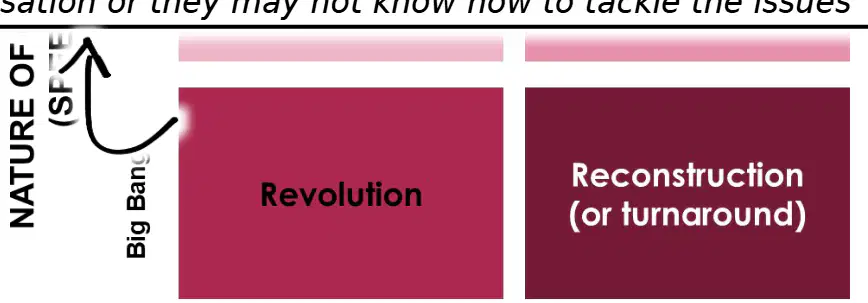
Which type of change is also known as 'turnaround'?
Revolution
Reconstruction
Evolution
Adaptation
What is organisational ambidexterity?

Which type of change is described as incremental in nature?
A) Evolution
B) Revolution

Which type of change is described as a 'Big Bang' in nature?
A) Evolution
B) Revolution

Which of the following is NOT a characteristic of transformation as described in the image?
Gradually results in transformation
Involves building on and exploiting existing strategic capabilities
Requires ongoing commitment to Dynamic Capabilities
Easy to achieve due to lack of competing pressures
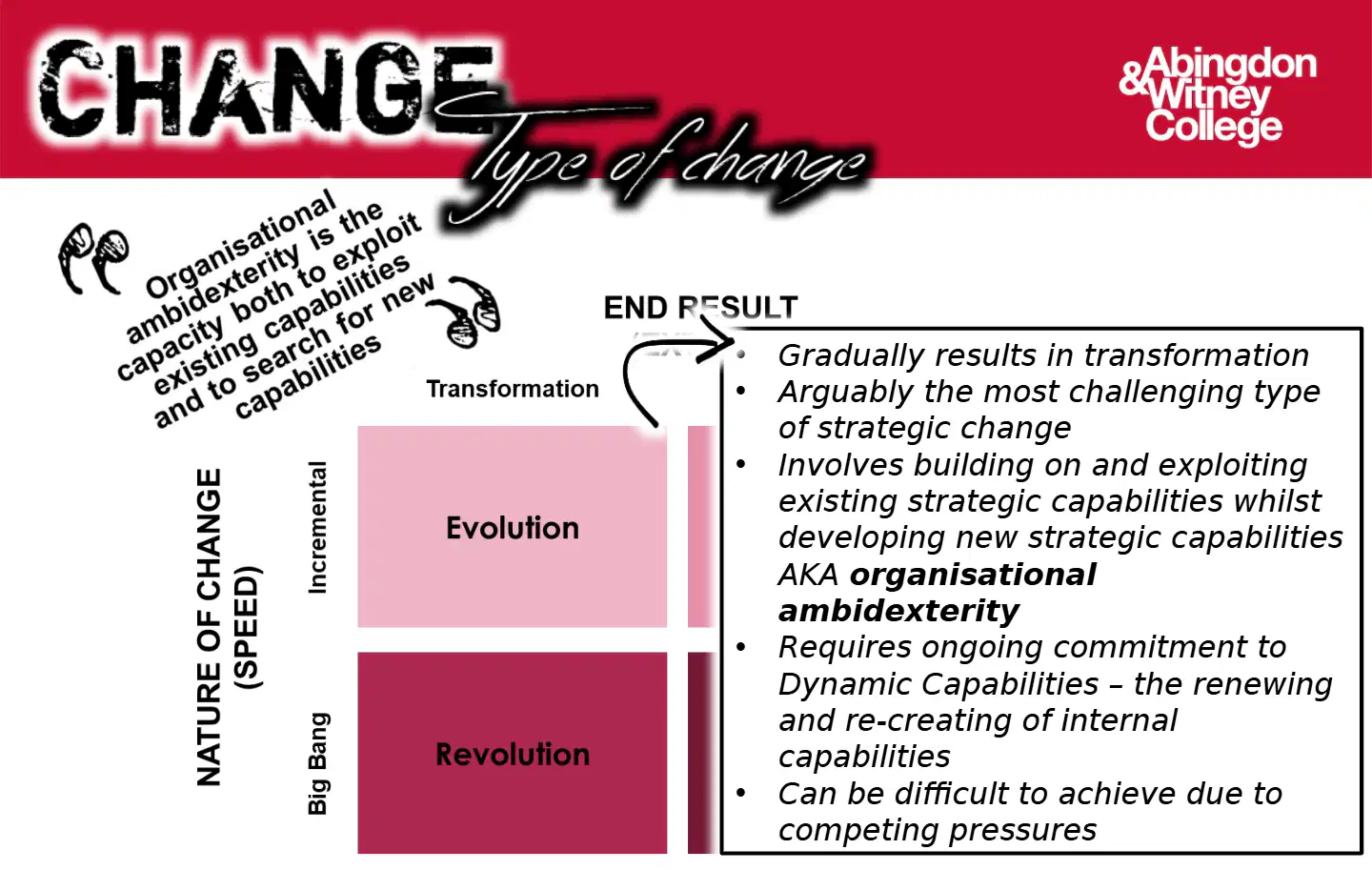
Fill in the blank: Organisational ambidexterity involves building on and exploiting existing strategic capabilities whilst developing new strategic capabilities.
True
False
Once adequate assessment is done, the ______ of change are required.
levers
levels
layers
leaders
Who devised an 8 step strategy for implementing change in 1995?
Lewin
Kotter
Maslow
Herzberg
Fill in the blank: Communicating the need for change and the consequences of not ________ is important in establishing a sense of urgency.
changing
listening
planning
communicating
Which of the following statements is true about significant change?
Less significant change requires a more significant sense of urgency
More significant change will require more significant sense of urgency
Significant change does not require urgency
Change and urgency are unrelated
Fill in the blank: The first step in driving change, according to the image, is to _________.
Establish a sense of urgency
Create a vision for change
Empower broad-based action
Consolidate gains and produce more change
Which of the following is described as creating a team responsible for driving change and ensuring management buy-in, support, and active participation?
Establish a sense of urgency
Create a guiding coalition
Implement new technology
Evaluate performance

