
 Worksheets
Copy of Unit 6 Test "The Roaring 20's"
Total questions: 45
Worksheet time: 23mins
Name
Class
Date
1.

1.
a)
Morals and values changed with women more than any other social group.
b)
A fear of communism emerged throughout the United States.
c)
Prohibition became an instant success in solving many of the nation’s problems.
d)
The government’s return to laissez-faire ideals helped to allow businesses to prosper.
2.

2.
a)
They are all factors that encouraged new democratic voting procedures.
b)
They are all factors contributing to the American fear of communism.
c)
They are all factors that encouraged international trade amongst members of the League of Nations.
d)
They are all concerned with promoting government assistance programs in the United States.
3.

3.
a)
The U.S. government made efforts to protect the beliefs and ideas that helped form America.
b)
The U.S. government chose to become more involved with foreign entanglements.
c)
The U.S. government passed legislation to ensure consumer protection and health.
d)
The U.S. government encouraged new forms of foreign political influence.
4.

4.
a)
There were fewer restrictions on immigrants.
b)
There were greater opportunities for employment.
c)
There were fewer demands by political machines.
d)
There were greater opportunities for property ownership.
5.

5.
a)
All of these events led to a decrease in support for political change in the workforce.
b)
All of these events led to an increase in support of child labor laws across the country.
c)
All of these events led to a decrease in the number of factories in northern cities.
d)
All of these events led to the increase in the standard of living experienced by most Americans.
6.
6. Which of the following statements best describes an effect of the U.S. automobile industry’s growth during the 1920s?
a)
The average purchase price for a new car increased.
b)
The population in urban areas decreased in comparison to rural areas.
c)
Oil and steel production in the United States increased.
d)
The construction of paved roads increased across the country.
7.

7.
a)
Harding supported increasing business expansion and consumer manufacturing.
b)
Harding supported American participation in the League of Nations.
c)
Harding supported increasing government regulation of industry and agriculture.
d)
Harding supported expanding colonial holdings in the Caribbean.
8.
8. Which of the following best describes the increase in labor strikes after the end of World War I?
a)
Numerous labor strikes following the war were an attempt to allow women to keep their jobs.
b)
Numerous labor strikes following the war were an attempt to demand higher wages and better conditions.
c)
Numerous labor strikes following the war were an attempt to discourage other workers from joining unions.
d)
Numerous labor strikes following the war were attempts to protest against child labor.
9.

9.
a)
Race riots following World War I were caused by police brutality.
b)
Race riots following World War I were due to disenfranchisement.
c)
Race riots following World War I were due to competition for jobs and housing in the inner cities.
d)
Race riots following World War I were due to the Jim Crow Laws in the South.
10.
10. Which factors were the major causes of the Red Scare and Palmer Raids that followed World War I?
a)
The success of the Communist Party of America in U.S. congressional and presidential elections.
b)
The increase in race riots across the country along with the rise of the Ku Klux Klan.
c)
The successful Bolshevik Revolution in Russia and the rise of radical labor unions such as the Industrial Workers of the World (IWW).
d)
The failure of the United States to join the League of Nations and the unpaid German war debts.
11.
11. Which of the following events was an outcome of the Red Scare of the 1920s?
a)
The ratification of the 18th Amendment and the enforcement of Prohibition through the Volstead Act.
b)
The trial and the subsequent sentencing to death of Italian-American anarchists, Sacco and Vanzetti.
c)
The beginning of the Harlem Renaissance.
d)
The exposure of the Teapot-Dome Scandal involving prominent government officials.
12.

12.
a)
Population in the United States had reached its maximum capacity.
b)
The American government was concerned about the spread of the Spanish Influenza.
c)
Congress wanted to protect African-Americans from competition from unskilled labor jobs.
d)
Congress was responding to the nativists’ calls to keep America safe from radical immigrants.
13.

13.
a)
The scandal involved the leasing of U.S. Navy petroleum to private businesses in exchange for bribes.
b)
The scandal involved the leasing of conservation lands to Native American groups in the Great Plains.
c)
The scandal involved a former World War I veteran who was convicted of defrauding the government.
d)
The scandal involved the selling of arms to a foreign enemy in exchange for American hostages.
14.
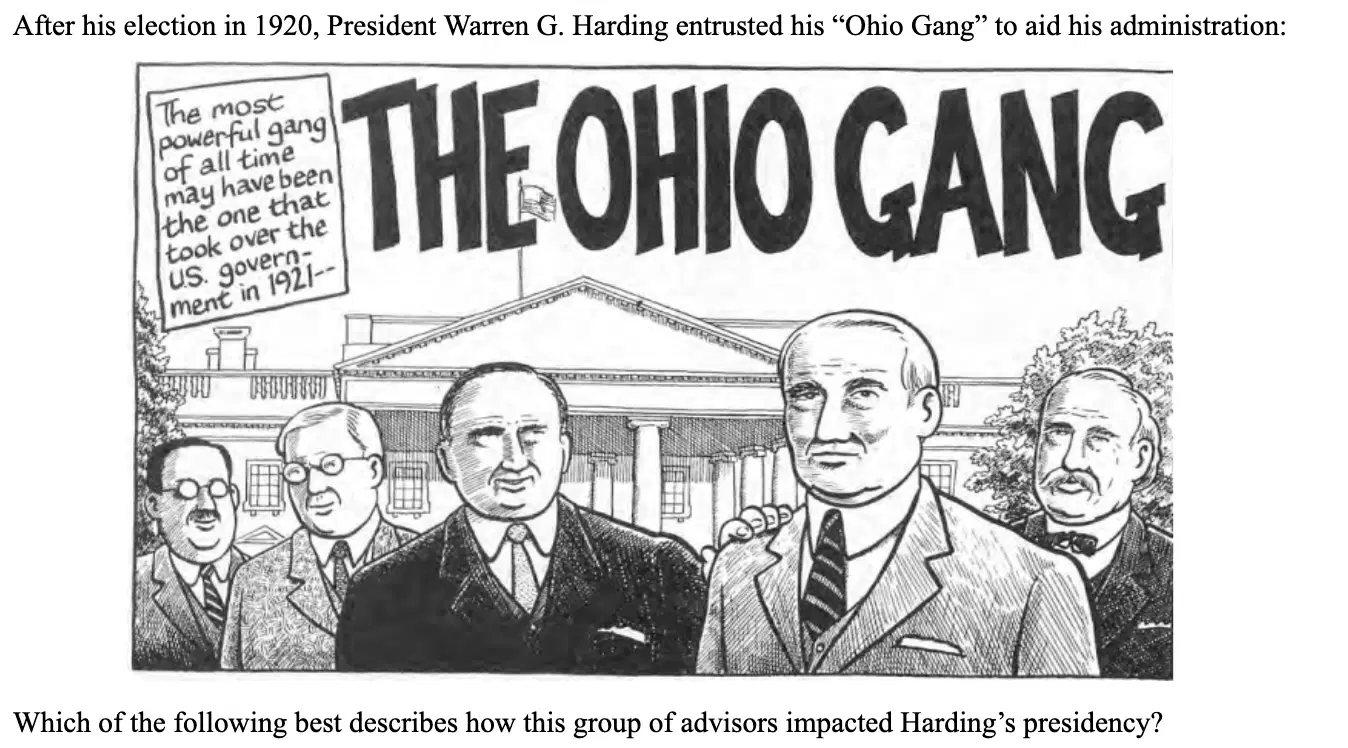
14.
a)
Several of its members promoted socialist reform in the government.
b)
The group provided more subsidies for farmers than any other presidential administration.
c)
Several of its members embarrassed the nation with political scandals.
d)
The group pressured the legislative branch to increase military spending throughout the 1920s.
15.

15.
a)
Decreased demand for housing in urban areas.
b)
Decreased availability of raw materials.
c)
Reduced investment in the stock market.
d)
Increased pro-business policies.
16.

16. All of the following statements are true of Calvin Coolidge EXCEPT:
a)
Coolidge supported Republican laissez-faire objectives while in the White House.
b)
Coolidge gave the United States the “return to normalcy” that Warren G. Harding had originally promised.
c)
Coolidge supported an increase in income tax rates.
d)
Coolidge favored policies that would increase business across the country.
17.
17. Why is the decade following World War I often referred to as the “Roaring Twenties”?
a)
Political reforms throughout the decade made government more democratic.
b)
The United States assumed more of a leadership role in world affairs following the war.
c)
America experienced great economic prosperity throughout most of the decade.
d)
Foreign trade prospered more than ever following the Great War.
18.
18. Which of the following best describes the efforts of Henry Ford and his attempt to build a loyal customer base across the United States in the 1920s?
a)
Ford is best remembered for developing vehicles that minimized pollution released into the atmosphere.
b)
Ford is best remembered for manufacturing reliable and affordable vehicles through his assembly line.
c)
Ford is best remembered for offering custom-made specialty vehicles for American consumers.
d)
Ford is best remembered for introducing safety features and fuel-efficient engines for vehicles.
19.
19. In the 1920s, the mass production of cars were due to the standardization of parts and the moving assembly line. How did these developments alter the physical landscape of the United States?
a)
Roads were built to accommodate traffic congestion.
b)
Apartment complexes were built to house the factory workers.
c)
Trolleys were refurbished to transport the vast urban population.
d)
Automobile factories were relocated to isolated rural areas.
20.

20.
a)
The increasing number of women employed in high paying jobs.
b)
A decline in American-made products replaced by imported goods.
c)
A rise in the standard of living brought on by growing consumerism.
d)
The unequal distribution of wealth between regions in the United States.
21.
21. Which of the following ideas formed the basis of the debate in the Scopes Trial of 1925?
a)
The modernist view that academics should be free of religious influence.
b)
The socialist philosophy that students should abandon religious teachings.
c)
The traditionalist belief that science was superior to religion.
d)
The fundamentalist belief that science could coexist with religion.
22.
22. Which of the following was a result of the passage of the Volstead Act during the Prohibition Era?
a)
The Volstead Act expanded influence by religious groups in the United States.
b)
The Volstead Act reduced memberships within American labor unions.
c)
The Volstead Act led to changed affiliations in political parties by voters.
d)
The Volstead Act increased the responsibilities of law enforcement across the country.
23.

23.
a)
Prohibition was an issue that distinguished traditionalists from progressives.
b)
Traditionalists believed that Prohibition was a fundamentally modern movement.
c)
Prohibition was passed with the support of both traditionalists and progressives.
d)
Progressives believed that Prohibition would end the traditionalist social outlook.
24.

24. What can one conclude about the following information in the 1920s?
a)
All are factors which led to a decrease in domestic issues in the United States.
b)
All are factors which led to the failure of the 18th Amendment.
c)
All are factors which led to the passing of the 20th Amendment.
d)
All are factors which led to the American rise in the standard of living.
25.
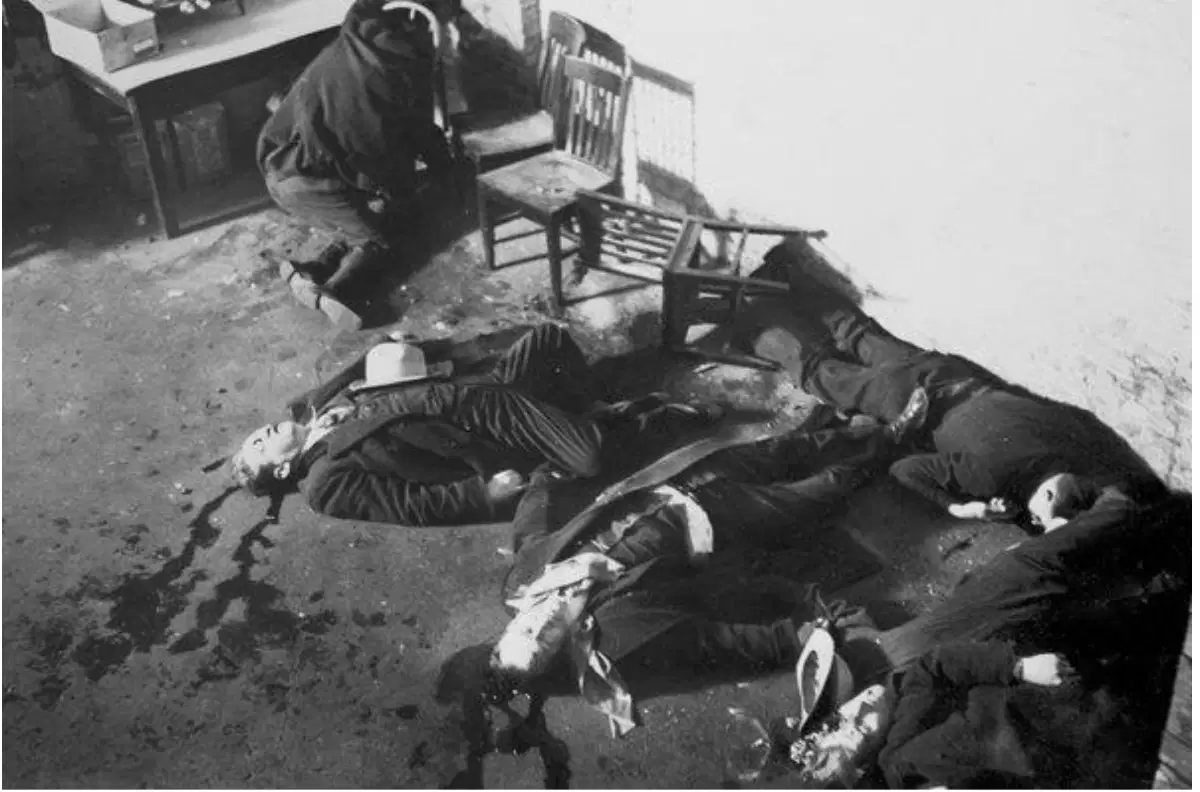
25. The following photograph was taken in Chicago in 1929:
Which of the following is NOT a true statement concerning the St. Valentine’s Day Massacre?
a)
The event allowed Al Capone to gain criminal control over the city of Chicago.
b)
The event occurred during the Prohibition Era as a result of rivalries between inner city gangs.
c)
The event led to the direct arrest of Chicago gangster Al Capone.
d)
The event symbolized the South Side’s climatic victory over the North Side in Chicago.
26.
26. Which of the following is NOT a true statement concerning women in the 1920s?
a)
Flappers tended to embrace the traditional roles of women.
b)
Flappers were typically young, stylish, and rebellious.
c)
Flappers embraced many of the new liberal attitudes that were common in urban areas.
d)
Flappers embraced new fashions of the era—including bobbed hairstyles and excessive makeup and jewelry.
27.
27. Which of the following best describes the impact of The Jazz Singer on the entertainment industry in 1927?
a)
The film’s release signaled the beginning of the colored motion picture industry.
b)
The film’s release was the first in which an African-American actor starred in a motion picture.
c)
The film’s release brought an end to the silent film era in American history.
d)
The film’s release led to a decrease in movie attendance throughout the 1930s.
28.
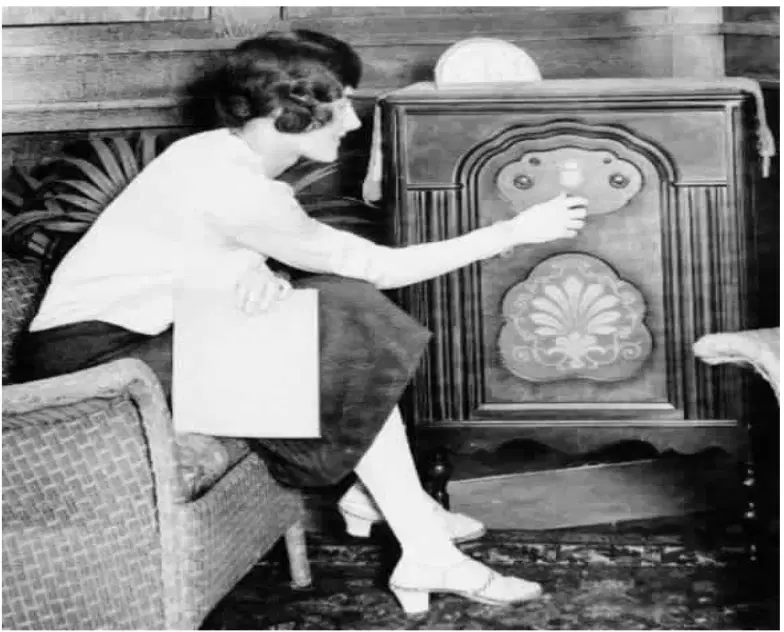
28. What major impact did events like the one pictured below have on American society in the 1920s?
a)
It led to the role of urbanization in preserving traditional culture.
b)
It led to the rise of a youth-based counterculture.
c)
It led to the role of immigrants in the formation of urban culture.
d)
It led to a rise of mass culture through new forms of news and entertainment.
29.

29.
a)
Radio hosts
b)
Famous athletes
c)
Jazz musicians
d)
Movie actors
30.

30.
a)
The opening day of the World’s Fair in Paris, France.
b)
The first man-powered flight in human history.
c)
The completion of the first solo flight across the Atlantic Ocean by American Charles Lindbergh.
d)
The ceremony celebrating the completion of the Eiffel Tower.
31.
31. Which of the following best describes the group known as the “Lost Generation”?
a)
Men who evaded the military draft during the First World War.
b)
Scientists who developed alternative theories of the universe and how it was created.
c)
Authors who were disillusioned by the experience of World War I.
d)
Women in the United States who had lost their jobs to returning World War I veterans.
32.
32. Which of the following statements best explains a result of the Harlem Renaissance?
a)
African-American artists helped foster a new sense of unity and cultural pride.
b)
Artists spread political and social ideals of nationalism to the American public.
c)
Artists and musicians began to include themes of discontent about American foreign policy.
d)
African-American artists became homeowners and landlords in urban areas.
33.

33.
a)
His writings exposed the unsafe living conditions of immigrants in urban areas.
b)
His writings raised public awareness about the injustices of living in a segregated society.
c)
His writings uncovered a scandal involving oil companies in Teapot Dome, Wyoming.
d)
His writings exposed the dangerous conditions in America’s meatpacking plants.
34.

34. Study the photograph below:
Which of the following best describes the ideas of Marcus Garvey during the Harlem Renaissance?
a)
Marcus Garvey encouraged African-Americans to embrace white culture in the United States.
b)
Marcus Garvey encouraged African-Americans to protest outside the White House for equality.
c)
Marcus Garvey encouraged African-Americans to adopt the methods of W.E.B. Dubois, another leader in the civil rights movement.
d)
Marcus Garvey encouraged African-Americans to move back to Africa to create their own powerful and segregated nation.
35.

35.
a)
The support for the spread of democracy nationwide.
b)
The promotion of isolationist policies by the United States government.
c)
The support for an expanded alliance system throughout Europe.
d)
The endorsement of imperialistic acquisitions in the Pacific.
36.

36.
a)
These acts were intended to protect American business investments in foreign territories.
b)
These acts were intended to provide some form of protection to the American people.
c)
These acts were passed in order to encourage U.S. businesses from forming monopolies.
d)
These acts were intended to grant federal aid and assistance to the Federal Reserve.
37.
37. What did 1896 presidential candidate William Jennings-Bryan advocate for during his campaign? (Ch. 7)
a)
William Jennings-Bryan advocated for higher tariffs, arguing that Democrats benefitted from them.
b)
William Jennings-Bryan advocated for the enactment of laws that restricted immigration to the United States.
c)
William Jennings-Bryan advocated for the free and unlimited coinage of silver in circulation, which would aid the struggling American farmer.
d)
William Jennings-Bryan advocated for more government subsidies for those involved in the agriculture sector.
38.

38. This quote is from an editorial published in a newspaper, The Chicago Defender, in 1917:
Which of these developments was encouraged by the editorial? (Ch. 11)
a)
The population shift to the Sun Belt during and after World War I.
b)
The rise of American imperialism in the early twentieth century.
c)
The Great Migration of African-Americans during the Great War.
d)
The Cold War rivalry between the Soviet Union and the United States.
39.

39.
a)
The excessive growth of American industry is weakening the nation.
b)
Democratic government prevents industrialists from gaining power.
c)
Industrialization improves the working conditions for employees.
d)
Government regulations prevent industrial innovation.
40.

40.
a)
“If the military does not remain in the Philippines, there is a good chance the Filipinos will invade Hawaii.”
b)
“If American troops leave the Philippines, the Filipinos will attempt to seek U.S. statehood.”
c)
“By annexing the Philippines, the United States will seek national sovereignty.”
d)
“We must annex the Philippines to advance American interests abroad.”
41.
41. U.S. Senator Henry Cabot Lodge opposed which feature of the Treaty of Versailles following World War I? (Ch. 11)
a)
The territories of Alsace and Lorraine being returned to France.
b)
The governing of surrendered colonies by certain states under the mandate system.
c)
The committing of signatories by the U.S. in order to protect the independence of other nations in Europe.
d)
Germany being required to accept sole responsibility for the Great War.
42.
42. Which of the following is NOT a characteristic of the robber barons in the late nineteenth century? (Ch. 6)
a)
They used both vertical and horizontal integration tactics in order to gain total control of their industries.
b)
They created large corporations by buying out their competition.
c)
They justified their success and wealth based on the economic philosophy of Social Darwinism.
d)
They favored government regulations of business.
43.
43. Which of the following best identifies the issues that led to the 1919 Supreme Court case Schenck vs. United States? (Ch. 11)
a)
The United States government restricted freedom of speech during World War I.
b)
The United States government restricted freedom of religion during World War I.
c)
The United States government restricted the production of consumer goods during World War I.
d)
The United States government restricted immigration during World War I.
44.
44. Which of the following statements would be MOST supported by a nativist? (Ch. 7)
a)
“Since the United States is supposed to be the land of the free and the country of opportunity, then let all those who desire freedom and a better life come to the United States.”
b)
“Immigration is bad for this country. Immigrants take jobs that would otherwise go to those born here, and their ways corrupt and pollute our way of life. We need laws to prevent immigration.”
c)
“Cultural diversity is a good thing. It is our difference and the way foreigners hold onto their traditional ways that make our nation great.”
d)
“God bless the Irish, the Germans, and the Italian immigrant. Give ‘em a home here, I say! But blast the Chinese… Keep them out by all means!”
45.
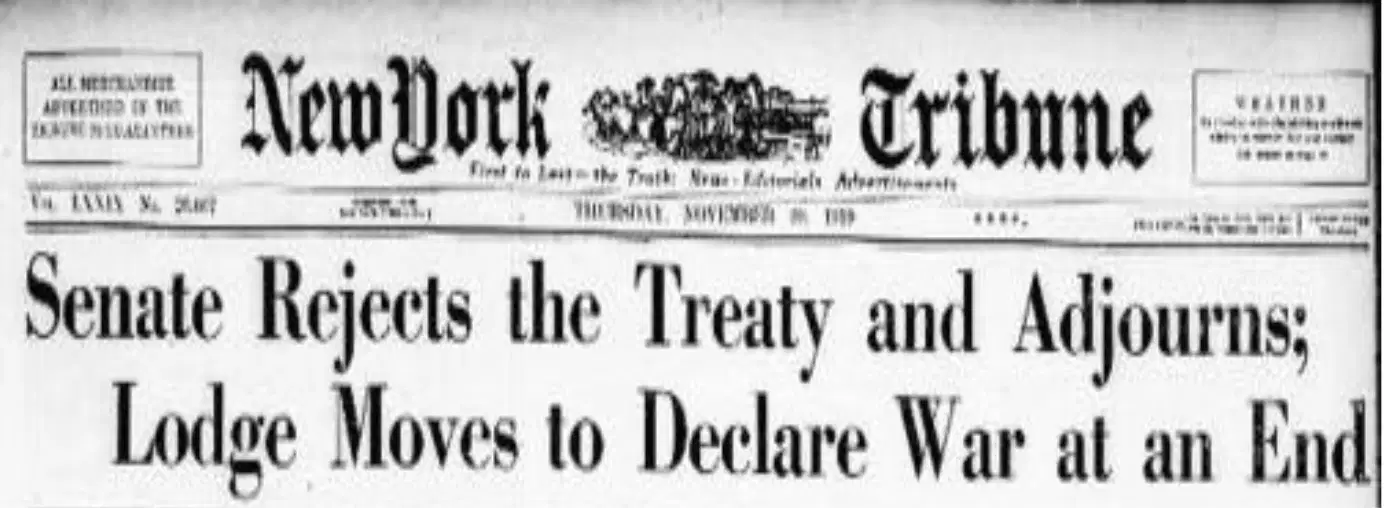
45. Study the picture below:
Which of the following best explains the result of this headline published in 1919? (Ch. 11)
a)
The League of Nations was weakened in its ability to maintain worldwide peace.
b)
The United States Senate approved formal alliances with European powers following World War I.
c)
The League of Nations ordered a trade embargo against the United States.
d)
The United States assumed a powerful and more direct leadership role in world affairs.
100 %

