

wayground logo

Free Printable Worksheets

Font size

S
M
L
XL
Worksheets

REVIEW: Solar System, Asteroids, Comets, and Meteors

Total questions: 30

Worksheet time: 16mins
Name
Class
Date
1.
Which of the following is a main way that scientist classify planets?
a)
by their shape
b)
by their color
c)
by what they are made of
d)
by their temperature
2.
How do you describe the orbit of each planet around the Sun in our solar system?
a)
no defined shape
b)
elliptical/oval
c)
circular
d)
spherical
3.
Which list has the planets in order of furthest from the sun to closest?
a)
mercury, earth, Venus, mars, Jupiter, Saturn, Neptune, Uranus.
b)
neptune, uranis, saturn, jupiter, mars, earth, venus, mercury
c)
neptune, uranis, jupiter, saturn, mars, venus, earth, mercury
d)
venus, mercury, earth, neptune, uranus, saturn, jupiter, mars
4.
Where are asteroids found?
a)
Asteroid Belt
b)
Oort Cloud
c)
Kuiper Belt
d)
Between Mars and Earth
5.
Where are comets found? (check all that apply)
a)
Asteroid Belt
b)
Oort Cloud
c)
Kuiper Belt
d)
Between Mars and Earth
6.
What happens to a comet as it gets closer to the Sun?
a)
The comet melts and completely disintegrates, never to be seen again.
b)
The comet forms a tail that can be seen as the comet's orbit nears the Sun.
c)
The comet begins to melt and speeds up just before it melts into the Sun.
7.
A small rock found in space.
a)
Meteor
b)
Asteroid
c)
Comet
d)
Meteoroid
e)
Meteorite
8.
A small space rock that strikes the surface of the Earth.
a)
Meteor
b)
Asteroid
c)
Comet
d)
Meteoroid
e)
Meteorite
9.
A small space rock that enters the Earth's atmosphere.
a)
Meteor
b)
Asteroid
c)
Comet
d)
Meteoroid
e)
Meteorite
10.
Small space object made up of ice, dust, and particles.
a)
Meteor
b)
Asteroid
c)
Comet
d)
Meteoroid
e)
Meteorite
11.
Sometimes referred to as a "shooting star".
a)
Meteor
b)
Asteroid
c)
Comet
d)
Meteoroid
e)
Meteorite
12.
A very large space rock.
a)
Meteor
b)
Asteroid
c)
Comet
d)
Meteoroid
e)
Meteorite
13.
May be the shattered remains of objects left over from the time when the planets were formed.
a)
Asteroid Belt
b)
Oort Cloud
c)
Meteoroid
14.
Where is the Asteroid Belt located?
a)
Between the orbits of Mars and Jupiter
b)
Beyond the orbit of Pluto
c)
Between the orbits of Jupiter and Saturn
15.
The process of going directly from a solid to a gas. This is the process that creates the tail of a comet.
a)
sublimate
b)
condensate
c)
evaporate
16.
What contributed to the extinction of dinosaurs 65 million years ago?
a)
asteroid impact
b)
volcanic eruption
c)
ice age
17.
What comprises the structure of a comet?
a)
nucleus, coma, tail
b)
nucleus, coma, gases.
c)
nucleus, tail, gases
d)
nucleus, tail, ice
18.
The tail of a comet _________ .
a)
always points towards the Sun
b)
always points away from the Sun
c)
always points towards Earth
d)
always points away from Earth
19.
These are made mostly of rock. (check all that apply)
a)
stars
b)
asteroids
c)
meteoroids
d)
comets
20.
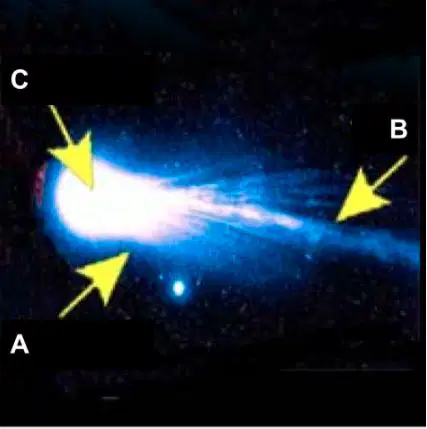
Identify the nucleus of the comet below.
a)
A
b)
B
c)
C
21.

Which planet is NOT one of the

"Gas Giants"?

a)

Uranus

b)

Venus

c)

Neptune

d)

Saturn

22.

Label the planets

23.

List all of the planets in order from closest to the Sun to farthest from the Sun.

(a)  

24.

In which direction do planets go around the Sun?

a)

Clockwise

b)

Counterclockwise

25.

What characteristics do terrestrial planets have in common? (click all that apply)

a)

rocky

b)

high mass

c)

gaseous

d)

large radius

26.

What characteristics do Gas Giants have in common? (click all that apply)

a)

rocky

b)

low mass

c)

gaseous

d)

small radius

27.

How far away is Earth from the Sun?

a)

1 AU

b)

100 AU

c)

1 light year

d)

1,000 AU

28.

What is the biggest threat that would most likely lead to the extinction of life on Earth?

a)

Blocked Sunlight

b)

Asteroid Impact

c)

Acid Rain

d)

Increasing CO2 levels

29.

What is the shape of the orbit of comets around the Sun?

a)

Square

b)

Oval

c)

Circle

d)

Irregular

30.

What is the cause of meteor showers?

a)

Traveling into a black hole.

b)

Earth's orbit traveling through the tail of a comet.

c)

Aliens throwing rocks at Earth.

d)

In space, instead of raining water like on Earth, it actually rains rocks.
