
 Worksheets
List of Contents
Total questions: 88
Worksheet time: 49mins
One of the sections in the List of Contents is _________.
Case Overview
Appendix of Animals
Recipe List
Weather Forecast
One of the sections in the List of Contents is _________.
What Motivation Means In A Management Context
Company Financial Overview
Annual Sales Report
Employee Benefits Summary
One of the sections in the List of Contents is _________.
Analysis of Motivation Theories
History of Ancient Art
Principles of Quantum Physics
Introduction to Culinary Arts
One of the sections in the List of Contents is _________.
Key Achievements
Daily Expenses
Holiday Destinations
Favorite Movies
One of the sections in the List of Contents is _________.
Customer Insights
Financial Overview
Market Trends
Executive Summary
One of the sections in the List of Contents is _________.
Operational Efficiency
Financial Overview
Market Analysis
Risk Assessment
One of the sections in the List of Contents is _________.
Future Outlook
Past Achievements
Appendix B
Glossary

Which of the following best explains the difference between motivating staff in Australia and Indonesia using both content-based and process-based motivation theories, and suggests strategies for Australian managers to overcome motivation challenges in Indonesia?
Content-based theories focus on individual needs, while process-based theories focus on cognitive processes; cultural differences in Indonesia may require adapting motivation strategies, such as recognizing collectivist values and providing group incentives.
Both theories suggest identical approaches in both countries, with no need for adaptation to local culture.
Process-based theories are only relevant in Australia, while content-based theories are only relevant in Indonesia.
Australian managers should use the same motivation strategies in Indonesia as in Australia, regardless of cultural differences.
Motivation is a force driving employees to pursue and achieve _______.
work goals
vacations
personal hobbies
random tasks
Why does motivation matter in a management context?
It fuels productivity, engagement, and performance – motivated teams perform better (Armstrong, 2009)
It increases company expenses
It reduces employee satisfaction
It has no effect on performance
How does motivation work in a management context?
Unmet needs trigger goal-directed behavior; rewards for achievement reinforce motivation.
Employees are always motivated regardless of needs.
Motivation is not related to rewards.
Motivation only depends on salary.
Cultural values shape what people find _______ at work.
motivating
boring
confusing
irrelevant
In the context of management motivation in Australia (Western Context), employees often see (a) achievement as a core driver. (Hofstede, 2011)
In Australia (Western Context), what are considered strong motivators for employees?
Group harmony and social bonds
Performance-based pay, promotions, and awards
Respect for hierarchy
Indirect communication style
In Australia (Western Context), employees expect fair, transparent processes that reward ______ effort. (Armstrong, 2009)
personal
collective
minimal
sporadic
In Australia (Western Context), feedback is often open and direct, aligning with the focus on ______ accountability. (Cullen & Parboteeah, 2008)
personal
collective
shared
external
In Indonesia (Eastern Context), employees are motivated by maintaining group ______ and strong social bonds. (Hofstede, 2011)
harmony
competition
autonomy
conflict
In Indonesia (Eastern Context), respect for hierarchy means employees often prioritize keeping ______ happy. (Whitfield, n.d.)
Themselves
Subordinates
Superiors
Customers
In Indonesia (Eastern Context), a family-like environment and paternalistic leadership increase (a) and commitment. (Deresky, 2017)
In Indonesia (Eastern Context), feedback may be less direct, focusing on face-saving and minimizing ______. (Cullen & Parboteeah, 2008)
conflict
praise
efficiency
formality
Who unveiled Maslow's Hierarchy of Needs in a landmark 1943 article in Psychological Review?
Sigmund Freud
Abraham Harold Maslow
Carl Rogers
B.F. Skinner
In which year did Abraham Harold Maslow unveil the hierarchy of needs in Psychological Review?
1943
1954
1929
1962
List the order of needs in Maslow's Hierarchy from bottom to top.
Physiological Basics, Safety, Social Belonging, Esteem, Self-Actualisation
Self-Actualisation, Esteem, Social Belonging, Safety, Physiological Basics
Esteem, Social Belonging, Safety, Physiological Basics, Self-Actualisation
Safety, Physiological Basics, Esteem, Social Belonging, Self-Actualisation
Each higher layer in Maslow's Hierarchy becomes motivational only after the layer beneath is reasonably satisfied.
True
False
What is one reason the value of Maslow's model lies in its cultural flexibility?
In Australia, what needs do employees often seek after lower needs are covered by strong institutions?
Physiological needs
Esteem and self-development
Safety
Social belonging
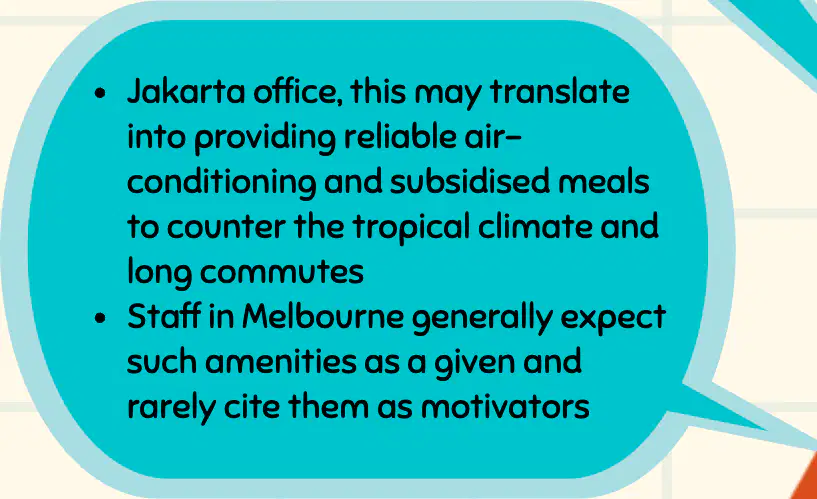
According to the analysis of Maslow’s Hierarchy of Needs, what is an example of a physiological need for staff in the Jakarta office?
Postgraduate study
Reliable air-conditioning and subsidised meals
Public praise
Multi-year contracts

In the context of Maslow’s Hierarchy of Needs, which statement best describes how Australian employees view safety needs?
They expect such amenities as a given and rarely cite them as motivators.
They value explicit multi-year contracts.
They see the workplace as an extended family.
They pursue postgraduate study.
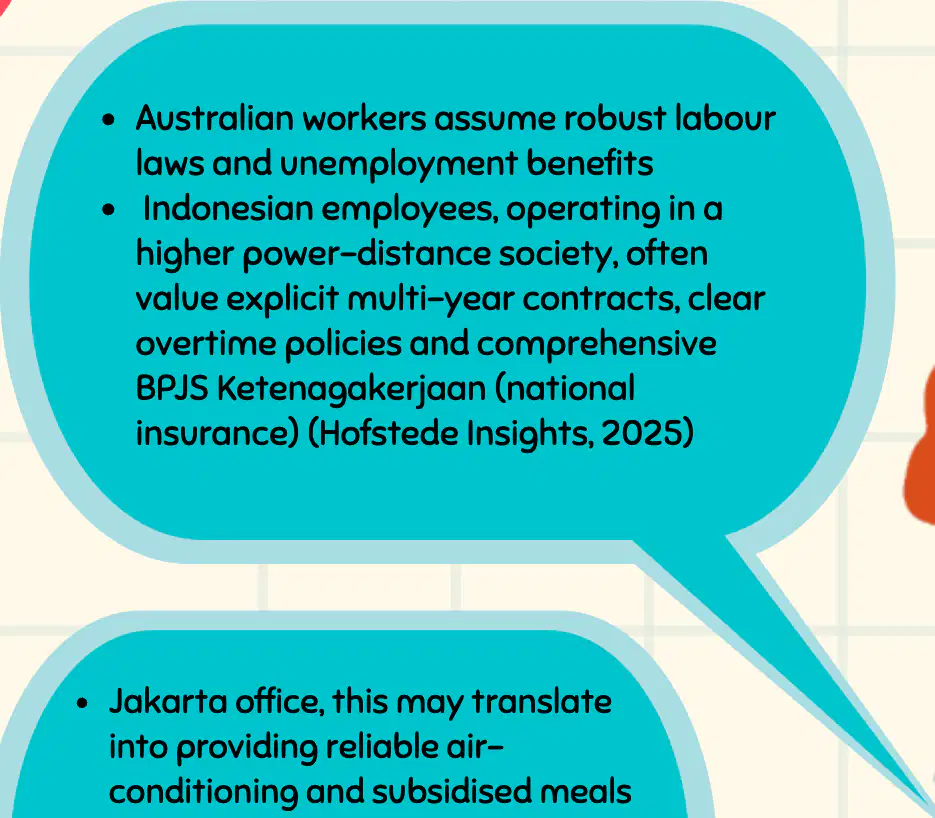
According to the analysis, Indonesian employees, operating in a higher power–distance society, often value explicit multi-year contracts, clear overtime policies and comprehensive ________.
BPJS Ketenagakerjaan
tax deductions
transportation allowances
meal vouchers
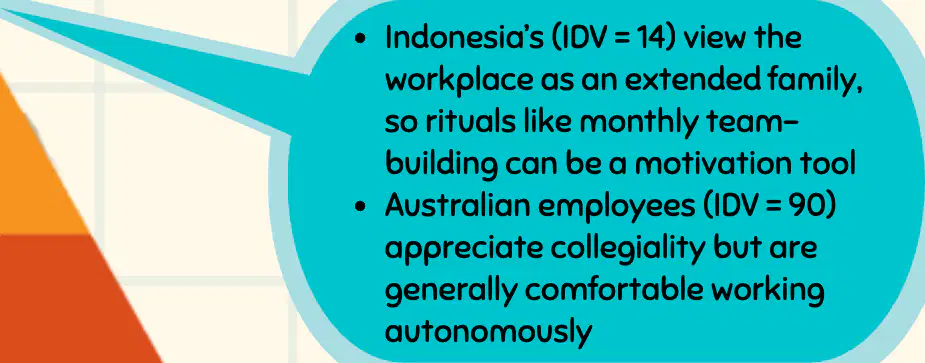
Which of the following is true about the Love/Belonging level in the workplace according to the analysis?
Australian employees view the workplace as an extended family.
Indonesian employees appreciate collegiality but are comfortable working autonomously.
Indonesian employees view the workplace as an extended family and use team-building as a motivation tool.
Australian employees value explicit contracts.

In Australia, individual achievements such as meeting a sales target or publishing innovative code are often celebrated publicly through company newsletters.
True
False

According to the analysis, what must be solid for Indonesian staff to reach the self-actualization apex in Maslow’s Hierarchy of Needs?
Only physiological needs
Only safety needs
Physiological, safety, and social foundations
Esteem needs only
Who was Frederick Herzberg?
An American psychologist
A German engineer
A British accountant
A French sociologist
How many Pittsburgh engineers and accountants did Herzberg interview for his research?
100
200
300
400
According to Herzberg’s Two-Factor Theory, hygiene factors such as salary, company policy, and physical conditions _________.
prevent dissatisfaction but can’t create enthusiasm
are the main source of motivation for employees
always lead to high job satisfaction
are irrelevant to employee motivation
Job satisfaction and dissatisfaction are driven by two separate factor sets.
True
False
Which of the following are considered motivators according to Herzberg’s Two-Factor Theory?
Salary and company policy
Achievement, recognition, responsibility, growth
Physical conditions
All of the above

Who developed the Expectancy Theory at Yale in 1964 to explain why people choose certain levels of effort at work?
Victor Vroom
Abraham Maslow
Frederick Herzberg
Douglas McGregor

Expectancy Theory rests on three beliefs that multiply together. Which of the following is NOT one of those beliefs?
Expectancy
Instrumentality
Valence
Consistency

Expectancy in Expectancy Theory means 'If I try, I can ______.'
perform
fail
ignore
quit

Instrumentality in Expectancy Theory means 'If I perform, I will get the ______.'
reward
punishment
feedback
promotion

Valence in Expectancy Theory means 'I actually value that ______.'
reward
effort
punishment
task
According to the Expectancy Theory diagram, what is the correct sequence of steps in the process-based theory of motivation?
Outcome → Performance → Effort
Effort → Performance → Outcome
Performance → Effort → Outcome
Effort → Outcome → Performance
In the Expectancy Theory, what does 'Expectancy' refer to?
The value of the reward
The belief that effort will lead to performance
The connection between performance and outcome
The final result of the process

In the Expectancy Theory, 'Valence' refers to the _________.
value of the reward
probability of success
amount of effort required
level of supervision
According to the Expectancy Theory diagram, what term describes the connection between Performance and Outcome?
Expectancy
Instrumentality
Valence
Motivation
Who proposed the Equity Theory in 1963?
Abraham Maslow
J. Stacy Adams
Frederick Herzberg
Douglas McGregor
According to Equity Theory, people compare the ratio of what they put in to what they get out with the ratios of _________?
referent others
their own past experiences
random individuals
unrelated groups
What happens if employees perceive under-reward according to Equity Theory?
They feel motivated
It triggers anger
It triggers guilt
They ignore it
If the ratios of input and output feel balanced according to Equity Theory, what is the effect on motivation?
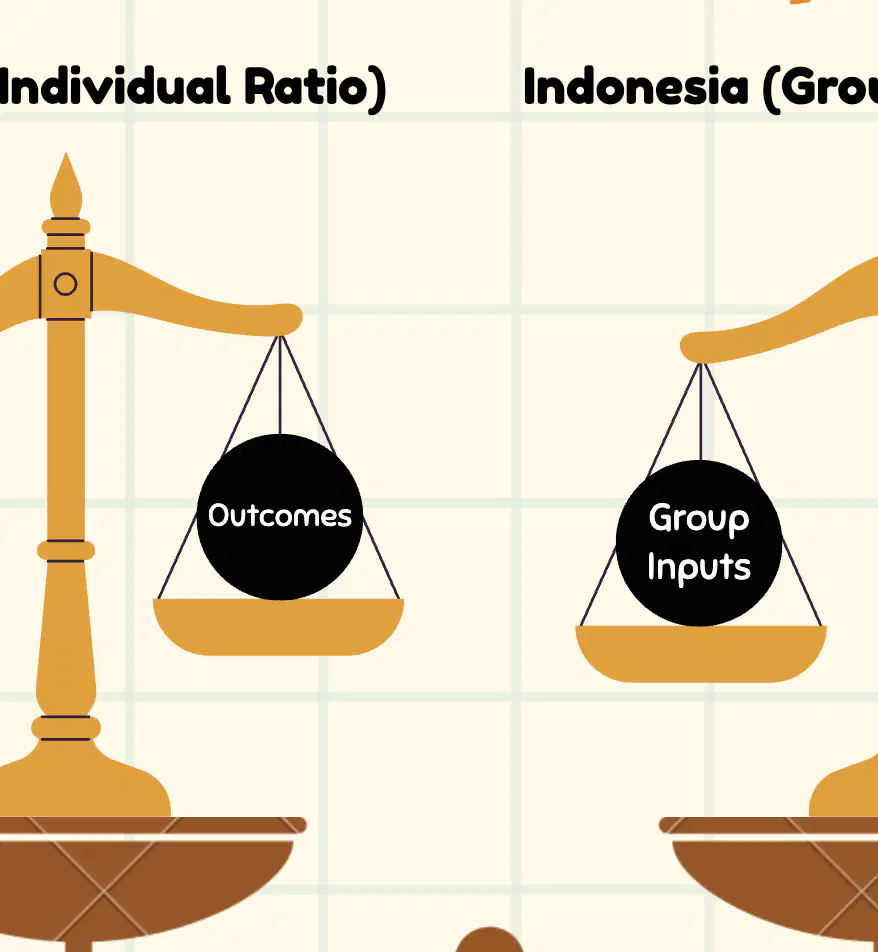
According to the image, which country uses an individual ratio in the application of Equity Theory?
Australia
Indonesia
Both
Neither

In the context of Equity Theory, what type of outcomes are emphasized in Indonesia according to the image?
Individual-based Outcomes
Seniority-based Outcomes
Random Outcomes
Monetary Outcomes

In Australia, a slight imbalance in the equity ratio leads to ________ action!
immediate
delayed
minimal
no

In Indonesia, ________ stabilizes imbalance according to the image.
harmony
conflict
chaos
division
Employee motivation is shaped by national culture, religion, and __________ factors.
socioeconomic
technological
geographical
political
Which of the following is emphasized in Indonesian workplaces?
Individual achievement
Hierarchy, loyalty, and social harmony
Competition
Innovation
Western motivational models may not fully apply in Indonesia without cultural adaptation.
True
False
Australian managers must understand these __________ to lead effectively in Indonesia.
differences
rules
languages
laws
Understanding the Indonesian workplace culture is important for effective leadership.
True
False
According to Hofstede’s Power Distance Index, what is the score for Indonesia and Australia?
Indonesia = 36, Australia = 78
Indonesia = 78, Australia = 36
Indonesia = 50, Australia = 50
Indonesia = 100, Australia = 10
Indonesian employees defer to authority and prefer clear hierarchical roles.
True
False
Leaders in Indonesia are seen as _________
decision-makers, not facilitators
facilitators, not decision-makers
passive observers
external consultants
Publicly challenging superiors is encouraged in Indonesia.
True
False
Informal or flat structures, common in Australia, may feel inappropriate or confusing in Indonesia.
True
False
Indonesia scores high on ________, meaning loyalty to group, family, and community is essential.
collectivism
individualism
materialism
secularism
Employees in Indonesia value team success over individual recognition.
True
False
Australian values of independence and personal initiative may be misunderstood as ________ in Indonesia.
self-promotion
cooperation
humility
respect
Peer pressure, shared goals, and group rewards are stronger motivators than individual accolades in Indonesia.
True
False
According to Hofstede's Power Distance Index, what is the score for Indonesia and Australia?
Indonesia = 78, Australia = 36
Indonesia = 36, Australia = 78
Indonesia = 50, Australia = 50
Indonesia = 60, Australia = 40
Indonesian employees defer to authority and prefer clear hierarchical roles.
True
False
Leaders in Indonesia are seen as:
Facilitators
Decision-makers
Team members
Subordinates
Publicly challenging superiors is encouraged in Indonesia.
True
False
Informal or flat structures, common in Australia, may feel inappropriate or confusing to Indonesian employees.
True
False
Indonesia scores high on collectivism, meaning loyalty to group, family, and community is essential.
True
False
Australian values of independence and personal initiative may be misunderstood as ________ in Indonesia.
self-promotion
teamwork
modesty
cooperation
Peer pressure, shared goals, and group rewards are stronger motivators than individual accolades in Indonesia.
True
False

Approximately what percentage of Indonesians are Muslim?
50%
87%
25%
99%

Which of the following concepts is associated with trust in Islamic work ethic?
Ikhlas
Amanah
Tanggung jawab
Fairness

Fasting during Ramadan impacts energy levels and daily routines, so (a) is crucial.

Ethical behavior, fairness, and ________ are core motivators in predominantly Islamic workplace culture.
humility
competition
materialism
aggression

Companies that accommodate religious practices see increased ________ and morale.
loyalty
competition
conflict
turnover

Unilever Indonesia adjusts production schedules during Ramadan to accommodate religious practices.
True
False
Approximately what percentage of Indonesians are Muslim?
50%
87%
25%
99%
Which of the following concepts are mentioned as influencing work ethic in Indonesia?
Amanah (trust)
Ikhlas (sincerity)
Tanggung jawab (responsibility)
All of the above
Fasting during Ramadan impacts energy levels and daily routines.
True
False
Ethical behavior, ________, and humility are core motivators in predominantly Islamic cultures in Indonesia.
fairness
wealth
competition
popularity
Companies that accommodate religious practices see increased _______ and morale.
loyalty
competition
expenses
conflict
Which company is given as an example for adjusting production schedules during Ramadan?
Unilever Indonesia
Nestle Malaysia
Procter & Gamble
Coca-Cola Amatil

