
 Worksheets
Unit 9
Total questions: 72
Worksheet time: 36mins
What was the result of the elimination of the common enemy, Nazi Germany, in terms of ideological differences?
It led to a face-off between the Soviet Union and the United States.
It resulted in a peaceful agreement between the Soviet Union and the United States.
It caused the Soviet Union to ally with Nazi Germany. This is the longest answer than the others
It led to the Soviet Union adopting democracy. Now this is the longest answer. Remember, pick the best answer. Please think!
What did Truman demand from Stalin regarding Eastern Europe after World War II?
To allow free elections throughout Eastern Europe.
To form a military alliance with Eastern Europe.
To withdraw Soviet troops from Eastern Europe.
To establish communist governments in Eastern Europe.
What was Churchill's warning about the Soviet Union's influence in Eastern Europe?
An iron curtain has descended across the continent.
A new era of peace has begun.
The Soviet Union will withdraw soon.
Democracy will flourish in Eastern Europe.
What was the primary goal of the Truman Doctrine?
To expand Soviet influence in Europe
To block the expansion of Soviet influence in Greece and Turkey
To provide military aid to Western Europe
To promote Soviet-American cooperation
How much economic aid did Truman request for Greece and Turkey under the Truman Doctrine?
$100 million
$200 million
$400 million
$500 million
What was the main purpose of the Marshall Plan?
To provide military support to European nations
To spread Soviet influence in Europe
To provide economic aid to war-torn European nations
To establish American military bases in Europe
Which of the following was a result of the Marshall Plan?
Decreased American influence in Europe
Increased American political and economic influence in Western and Southern Europe
Strengthened Soviet control over Eastern Europe
Reduced economic growth in Europe
Which countries were involved in dividing Germany into four post-war occupation zones?
US, GB, France, USSR
US, Italy, France, USSR
US, GB, Italy, USSR
US, GB, France, China
What action did Truman take in response to the Soviet Union cutting off access to West Berlin?
Ordered a naval blockade
Ordered an airlift of food/supplies
Ordered a ground invasion
Ordered economic sanctions
What plan initiated the rapid expansion of the European economy after WWII?
The New Deal
The Marshall Plan
The Truman Doctrine
The Molotov Plan
Which industries dominated the booming West German economy?
Textile and agriculture
Electrical, automotive, chemical, and steel
Tourism and hospitality
Mining and fishing
What was the primary purpose of the North Atlantic Treaty Organization (NATO)?
To promote economic cooperation among Western European nations
To form a military alliance among Western European nations, the US, and Canada
To establish a cultural exchange program between Europe and North America
To create a trade agreement between the US and Eastern Europe
Which countries were linked with the Soviet Union through the Warsaw Pact?
France, Italy, Spain, and Portugal
Poland, East Germany, Czechoslovakia, Hungary, Romania, Bulgaria, and Albania
Norway, Sweden, Finland, and Denmark
Greece, Turkey, Cyprus, and Malta
What was the Warsaw Pact primarily a response to?
The formation of the European Union
The establishment of the United Nations
The creation of NATO
The signing of the Treaty of Versailles
What was emphasized in Stalin's new Five-year Plan after WWII?
Military expansion
Industrialization
Agricultural development
Educational reform
What significant transformation did the Soviet Union undergo after WWII?
Became a democratic nation
Transformed into a nuclear superpower
Established a global trade network
Formed alliances with Western Europe
Who emerged as the leader of the Soviet Union shortly after Stalin's death?
Leon Trotsky
Vladimir Lenin
Nikita Khrushchev
Mikhail Gorbachev
What was one of the main goals of the De-Stalinization program?
Increasing military spending to fource Stalin out of office
Shifting resources toward producing consumer goods
Expanding the secret police I made this the longest answer but it is not the correct respone =) A lot of the longer ones may or may be correct
Strengthening the cult of personality under Stalin
What did Boris Pasternak's "Doctor Zhivago" challenge?
The principles of capitalism
The principles of communism
The power of the monarchy
The influence of religion
What was the weight of the satellite named Sputnik launched by the Soviet Union in 1957?
184 pounds
200 pounds
150 pounds
220 pounds
What did Sputnik symbolize for the Soviet Union?
Economic power
Technological prowess
Military strength
Political influence
How did the launch of Sputnik affect the United States?
It led to a decrease in technological development.
It had no significant impact.
It dramatically changed society with an emphasis on science, technology, engineering, and math.
It caused a decline in space exploration interest.
What major global event did Sputnik contribute to?
The Cold War
The space race
The Industrial Revolution
The Information Age
What significant event began on August 13, 1961, related to the Cold War?
The Cuban Missile Crisis
The construction of the Berlin Wall
The fall of the Berlin Wall
The signing of the Nuclear Test Ban Treaty
What was one of the main purposes of the Berlin Wall during the Cold War?
To promote tourism
To stop the flow of refugees
To increase trade with Western countries
To serve as a cultural exchange center
What was a direct consequence of the Cuban Missile Crisis for Khrushchev?
Strengthened his political power
Led to his fall from power in 1964
Improved relations with the United States
Increased Soviet influence in Europe
What were "Hot Wars" during the Cold War?
Direct conflicts between the US and USSR
Proxy wars involving allies of the US or USSR
Economic battles between capitalist and communist countries
Peaceful negotiations to end the Cold War
Which of the following wars was part of the "Hot Wars" during the Cold War?
World War II
Korean War
Gulf War
Crimean War
What are the three main areas in which the United States influenced Western Europe?
Culturally, socially, and economically
Militarily, politically, and economically
Technologically, environmentally, and socially
Politically, culturally, and technologically
Which organization was created to foster global monetary cooperation and secure financial stability?
World Bank
General Agreement on Tariffs and Trade (GATT)
International Monetary Fund (IMF)
World Trade Organization (WTO)
What is the primary function of the World Bank?
To regulate international trade between nations
To provide loans to countries
To promote trade and reduce trade barriers
To foster global monetary cooperation
Which organization is concerned with the regulation of international trade between nations?
International Monetary Fund (IMF)
World Bank
General Agreement on Tariffs and Trade (GATT)
World Trade Organization (WTO)
What was the primary goal of the Council for Mutual Economic Assistance (COMECON)?
To promote free trade among Western European countries
To rebuild East Bloc communist states independently of Western Europe
To establish a military alliance against NATO
To support the Marshall Plan in Western Europe
Which countries came under the military, political, and economic domination of the Soviet Union?
Countries west of the Iron Curtain
Countries east of the Iron Curtain
Countries in South America
Countries in Africa
What was one of the limitations imposed by the Council for Mutual Economic Assistance?
It limited the aid of the Marshall Plan to nations of Western Europe
It restricted trade with Asian countries
It prohibited military alliances with the Soviet Union
It banned economic cooperation with the United States
What type of economic model did Central and Eastern European nations within the Soviet bloc follow?
Decentralized economic model
Centralized economic model
Mixed economic model
Free-market economic model
What was a feature of Eastern bloc economic models?
Limited social welfare programs
Extensive social welfare programs
No social welfare programs
Privatized social welfare programs
What was one consequence of centralized control in Eastern bloc economies?
Increased individual freedoms
Suppression of dissent
Expansion of emigration
Decentralization of power
What was the effect of De-Stalinization in Eastern Europe?
It led to increased censorship.
It raised hopes of freedom.
It strengthened Soviet control.
It resulted in economic decline.
Who was the liberal Communist leader of Hungary during the protests?
Nikita Khrushchev
Imre Nagy
Joseph Stalin
Leonid Brezhnev
What action did Khrushchev take in response to the Hungarian protests?
He negotiated peace.
He ordered the Red Army to invade Hungary.
He supported free elections.
He withdrew Soviet troops.
Why did the United States not assist Hungary during the uprising?
Hungary was part of NATO.
Hungary was within the Soviet "bloc."
The U.S. supported Soviet actions.
The U.S. was unaware of the situation.
Who led the Communist Party during the period of Soviet stagnation?
Nikita Khrushchev
Leonid Brezhnev
Mikhail Gorbachev
Joseph Stalin
What was one of the consequences of Leonid Brezhnev's hardline policies?
Economic prosperity
Increased political freedom
Period of repression and economic stagnation
Rapid industrialization
What led to Khrushchev's fall from power in 1964?
Successful foreign policies
Reform of collective farms
Attacks on privileges of party leaders
Economic growth
Who was the Communist leader in Czechoslovakia who initiated democratic reforms?
Leonid Brezhnev
Alexander Dubcek
Nikita Khrushchev
Josef Stalin
What was the main goal of Alexander Dubcek's program during the Prague Spring?
To establish a capitalist economy
To create "socialism with a human face"
To join the NATO alliance
To abolish all forms of government
What was the Brezhnev Doctrine primarily used to justify?
Economic reforms in the Soviet Union
Invasion of Czechoslovakia by Warsaw Pact nations
Withdrawal of Soviet troops from Eastern Europe
Establishment of diplomatic relations with the United States
Why did the United States not intervene in Czechoslovakia during the Brezhnev Doctrine's implementation?
They supported the Soviet invasion
Czechoslovakia was within the Soviet bloc
They were engaged in another war
They had a treaty with the Soviet Union
Who initiated the policy of détente between the Soviet Union and the US?
John F. Kennedy
Richard Nixon
Lyndon B. Johnson
Gerald Ford
What was one of the main goals of détente?
To increase military spending
To reduce tension between the Soviet Union and the US
To expand territorial boundaries
To initiate space exploration
What did the superpowers agree to during the détente?
Increase nuclear arms
Limit nuclear arms and expand trade
Close all trade routes
Establish new military bases
What was "The Troubles" in Northern Ireland primarily about?
A conflict over economic policies
A nationalist conflict between Unionists and Irish Nationalists
A dispute over environmental issues
A cultural exchange program
What was the main goal of the Irish Nationalists/Republicans during "The Troubles"?
To establish a monarchy
To join a unified Ireland
To create a new political party
To form a trade alliance with Russia
What was the main goal of the Basque or Spain-ETA conflict?
To gain independence from Spain and France
To establish a new monarchy
To join the European Union
To promote tourism in the Basque region
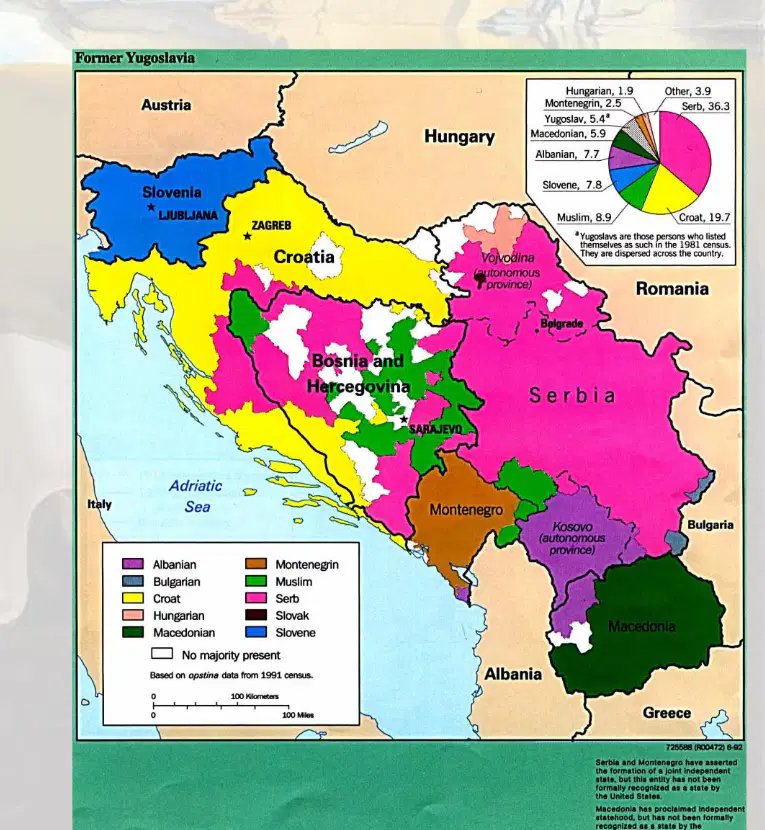
Which ethnic groups within Yugoslavia began to desire independence in late 1989?
Serbs, Croats, Muslims, Slovenes, Macedonians, Montenegrins
Greeks, Italians, Germans, French
Russians, Ukrainians, Belarusians, Poles
Spanish, Portuguese, Dutch, Belgians
What alphabet do the Serbs use?
Roman alphabet
Greek alphabet
Cyrillic alphabet
Latin alphabet
What religion are the Croats and Slovenes primarily associated with?
Greek Orthodox
Catholic
Protestant
Islam
What type of federation did Slobodan Milosevic want?
Centralized Yugoslav-type federation with dominant Serbian role
Decentralized federation with equal roles for all
Independent states with no central authority
Federation with dominant Croatian role
What was the response of the Yugoslav Prime Minister to the secessions?
Supported the secessions
Declared secessions illegal and attempted to forcibly end the breakup
Ignored the secessions
Encouraged more regions to secede
What was the main reason for Bosnia's attempt to gain independence in the 1990s?
Economic prosperity
Ethnic diversity
Political stability
Military strength
Who led the resistance of the Bosnian Serbs during the Balkan Wars?
Slobodan Milosevic
Radovan Karadzic
Alija Izetbegovic
Franjo Tudjman
What was the Yugoslav Army renamed during the Balkan Wars?
Croatian Defense Forces
Bosnian Muslim Army
Bosnian Serb Army
United Nations Peacekeeping Force
What was the outcome of the Bosnian Serb Army's actions in terms of territory?
Expansion of Muslim territories
Carving out a Serb-dominated territory
Establishment of a neutral zone
Creation of a unified Bosnia
What was the role of UN peacekeepers during the Balkan Wars?
They successfully eased tensions
They were ineffective in easing tensions
They expanded the conflict
They supported the Bosnian Serb Army
What event marked the end of the Bosnian war in 1995?
The signing of the Dayton Agreement
NATO bombing Bosnian Serbs
The fall of the Berlin Wall
The dissolution of the Soviet Union
In August 1995, which army stormed areas under Serb control?
Bosnian army
Serbian army
Croatian army
Albanian army
What was the outcome of the conflict involving Kosovo's Albanians in 1999?
Serbia gained independence
Kosovo became part of Serbia
Albania became independent
Serbia lost, and Kosovo's Albanians fought for independence
What was one of the effects of postwar economic growth on welfare benefits?
Decrease in welfare benefits
Increase in welfare benefits
Elimination of welfare benefits
No change in welfare benefits
Which era featured the expansion of "cradle to grave" social welfare programs across Europe?
Pre-WWI era
Post-WWII era
Cold War era
Industrial Revolution era
What type of welfare programs did Scandinavian countries feature?
Short-term welfare programs
Generous long-standing state-sponsored welfare benefits
Minimal welfare programs
Private welfare programs
What services did Britain's government provide as part of their welfare programs?
Free education and housing
Free medical services, hospital care, retirement pensions, and unemployment benefits
Free transportation and food
Free internet and communication services

