
 Worksheets
4.1.2 CAMS
Total questions: 20
Worksheet time: 10mins
What is the main function of a cam mechanism?
To create electrical circuits
To change the direction or rhythm of movement of other parts
To store energy
To measure temperature
A cam usually causes (a) movement of another part when an axle rotates the cam.

Identify the part labeled as 'Follower'.
The 'Follower' is the vertical rod that moves up and down, following the cam's motion.
The 'Follower' is the rotating disc that drives the mechanism.
The 'Follower' is the stationary base supporting the system.
The 'Follower' is the spring attached to the cam.
What is the purpose of using parametric modeling techniques in the activity described?
To make the model look colorful
So that your model can be quickly changed to adapt to new criteria
To make the model heavier
To reduce the size of the model

What is the name of the cam shown in the diagram?
Pear Shaped Cam
Cylindrical Cam
Heart Cam
Snail Cam

Which cam is associated with a flat follower and a center of rotation?
Eccentric Cam
Cylindrical Cam
Heart Cam
Snail Cam
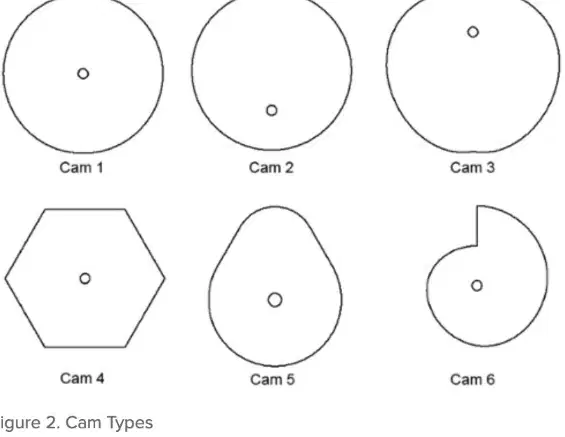
Match each Cam Type to the correct Cam Number from the diagram above.
Heart
Cam 3
Snail
Cam 6
Circular
Cam 1
Hexagonal
Cam 4
Eccentric
Cam 2
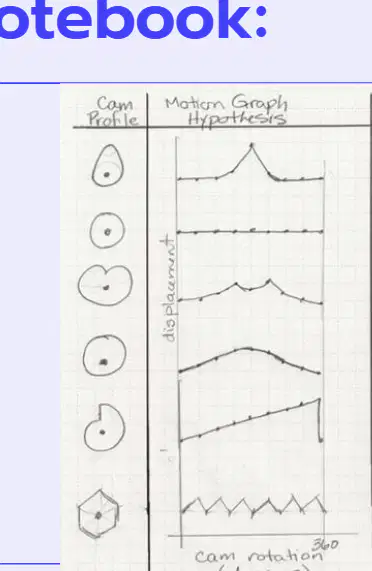
Match each Cam Profile to its corresponding Motion Graph Hypothesis as shown in the image.
Pear
Sharp peak
Circular
Flat line
Heart
Two peaks
Snail
Steady incline and sudden drop
Hexagon
6 Zigzag patterns

Refer to the diagram of the pear shaped cam. What is the name of the part labeled as the point where the cam rotates?
Slide
Flat Follower
Centre of Rotation
Cam Profile

Based on the motion graph hypothesis for the pear shaped cam, what does the peak in the graph represent?
Minimum displacement
Maximum displacement
Constant speed
No movement
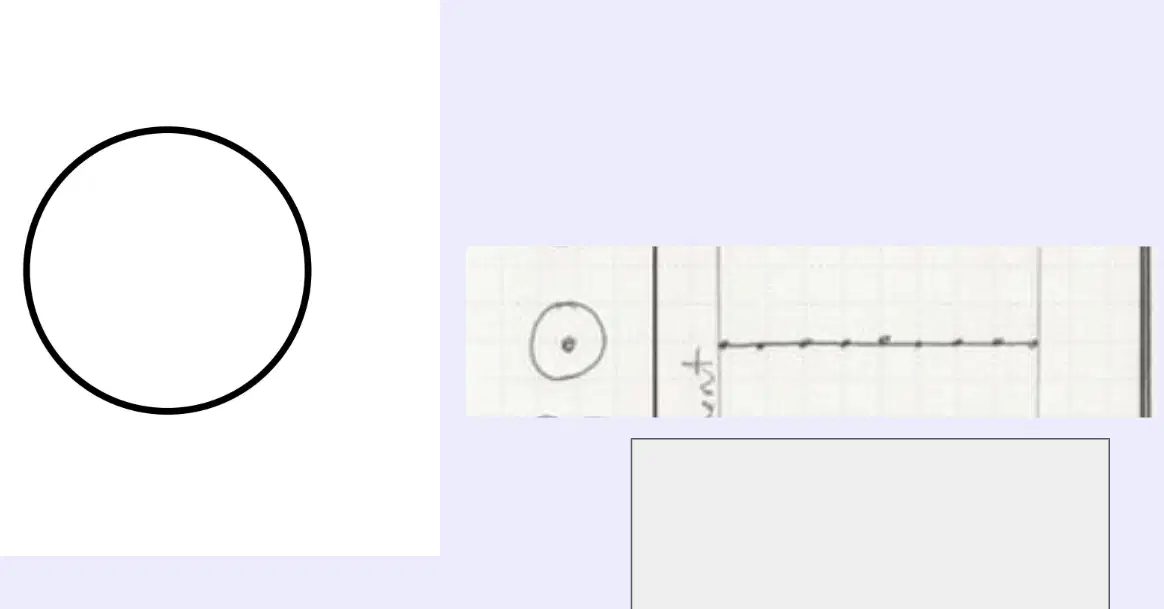
The graph shows a straight horizontal line. What does this most likely represent?
A constant value
An increasing value
A decreasing value
A fluctuating value
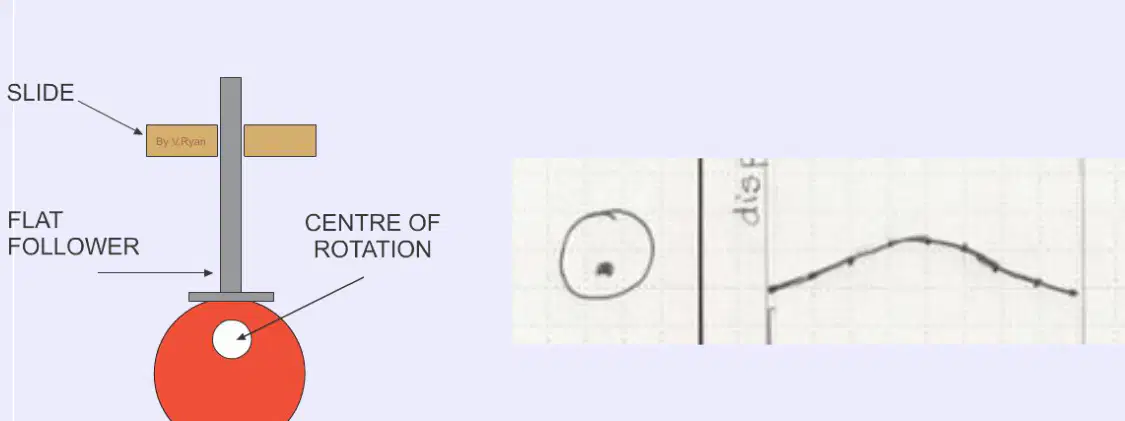
Look at the displacement diagram of the eccentric cam. What does the graph represent?
The graph represents the displacement of the follower as the cam rotates.
The graph represents the speed of the camshaft over time.
The graph shows the temperature variation of the cam.
The graph indicates the pressure applied by the cam.
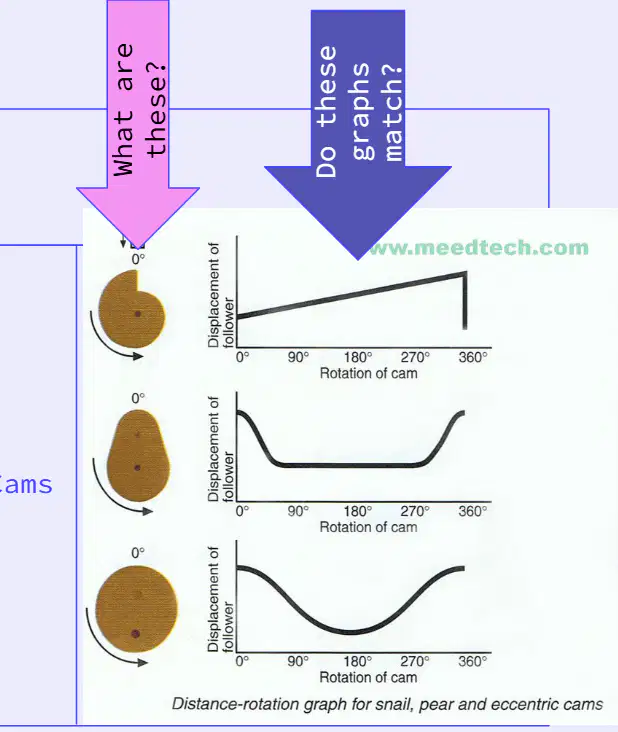
Look at the diagram showing three different cam shapes and their corresponding displacement graphs. Do these graphs match the cam shapes shown?
True
False
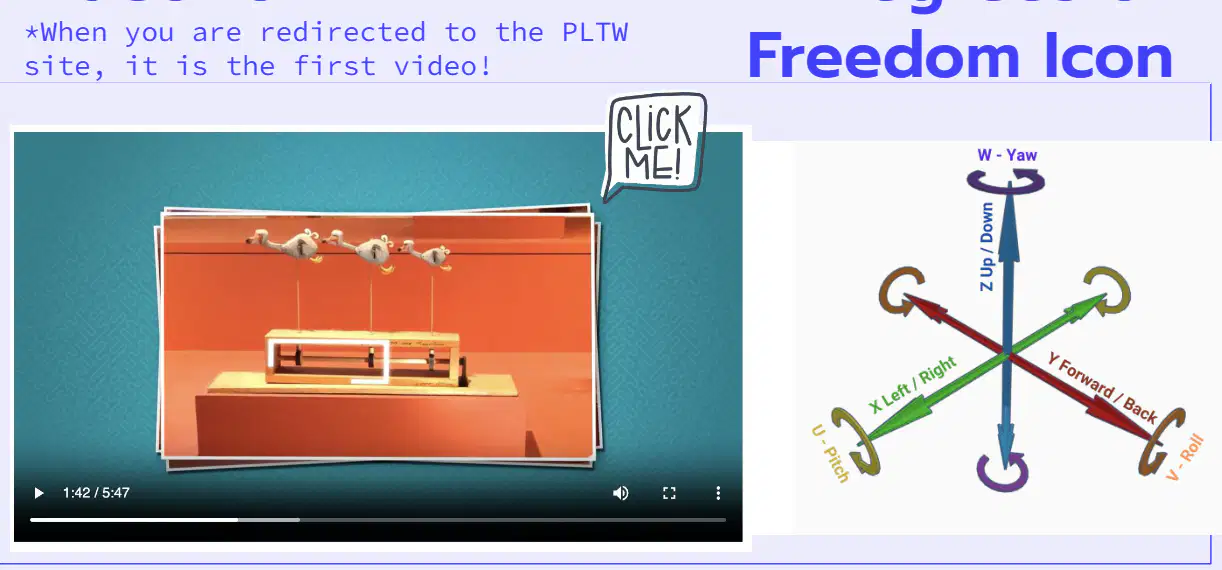
Which axis is associated with the Yaw movement in the Degrees of Freedom Icon?
X Left/Right
Y Forward/Back
Z Up/Down
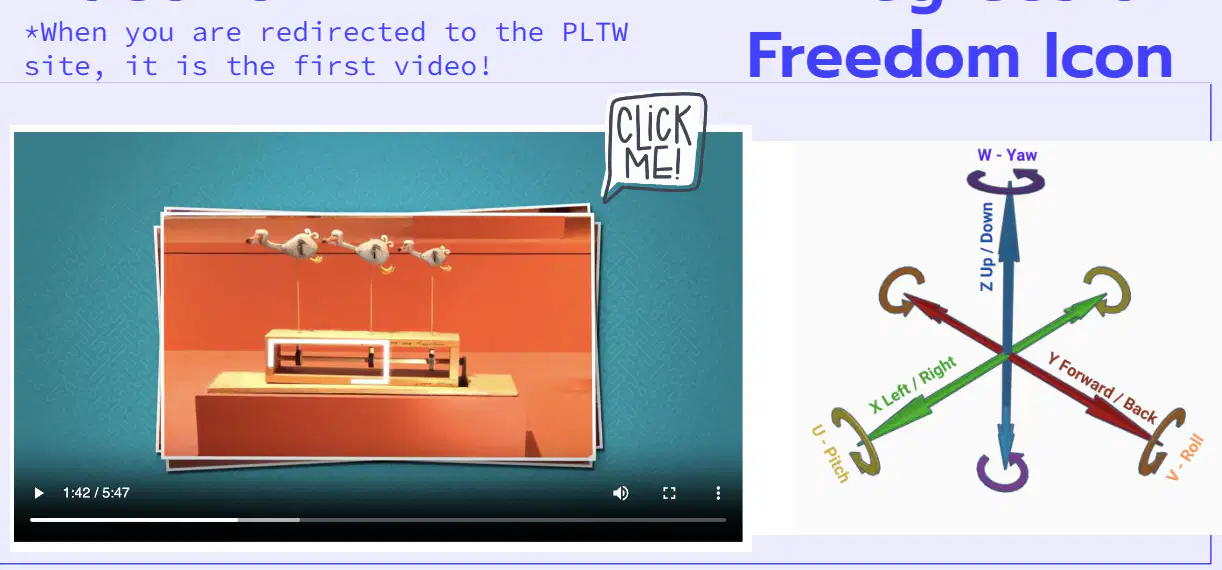
The Pitch movement in the Degrees of Freedom Icon occurs around which axis?
X Left/Right
Y Forward/Back
Z Up/Down
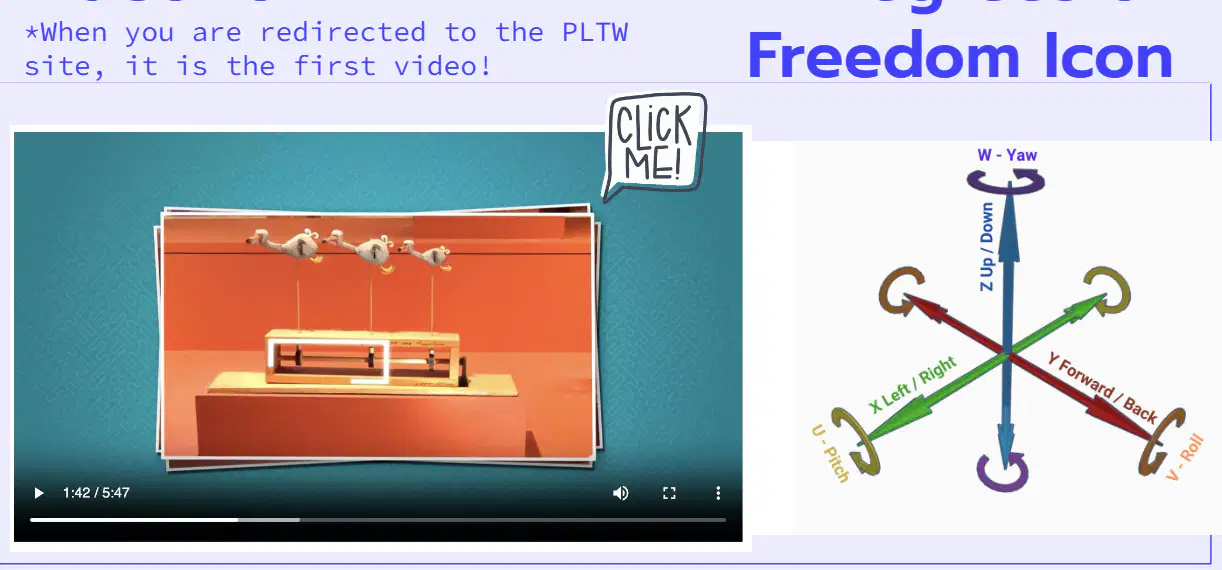
The Roll movement in the Degrees of Freedom Icon occurs around the ______ axis.
Y Forward/Back
X Left/Right
Z Up/Down
W Diagonal

What are the three types of rotational movements shown in the Degrees of Freedom Icon?
Yaw, Pitch, Roll
Slide, Glide, Shift
Twist, Turn, Spin
Lift, Drop, Tilt
What is required to be sketched for the single cam?
A sketch of the cam's profile (motion graph)
A list of cam materials
A description of cam types
A calculation of cam speed
The number relates to the cam profile by representing the number of peaks and valleys in the motion graph. What does this number correspond to?
The number of colors on the cam
The number of peaks and valleys in the cam profile
The speed of the cam rotation
The size of the cam
Translation is ________ movement in one direction. Rotation is movement around ________.
circular; a point
linear; an axis
random; a plane
vertical; a line

