
 Worksheets
Chemistry Post-Test V2
Total questions: 27
Worksheet time: 14mins
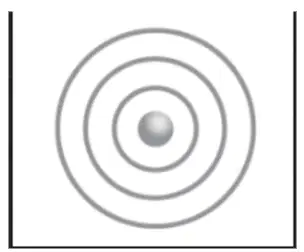
If the valence shell has six electrons, what is the atomic number of the atom?
6
8
10
16
In the model shown, the atom has eight valence electrons. Choose the name of the element the diagram represents and the group to which the element belongs.
The element is argon and it belongs to the halogen group.
The element is neon and it belongs to the halogen group.
The element is neon and it belongs to the noble gas group.
The element is argon and it belongs to the noble gas group.
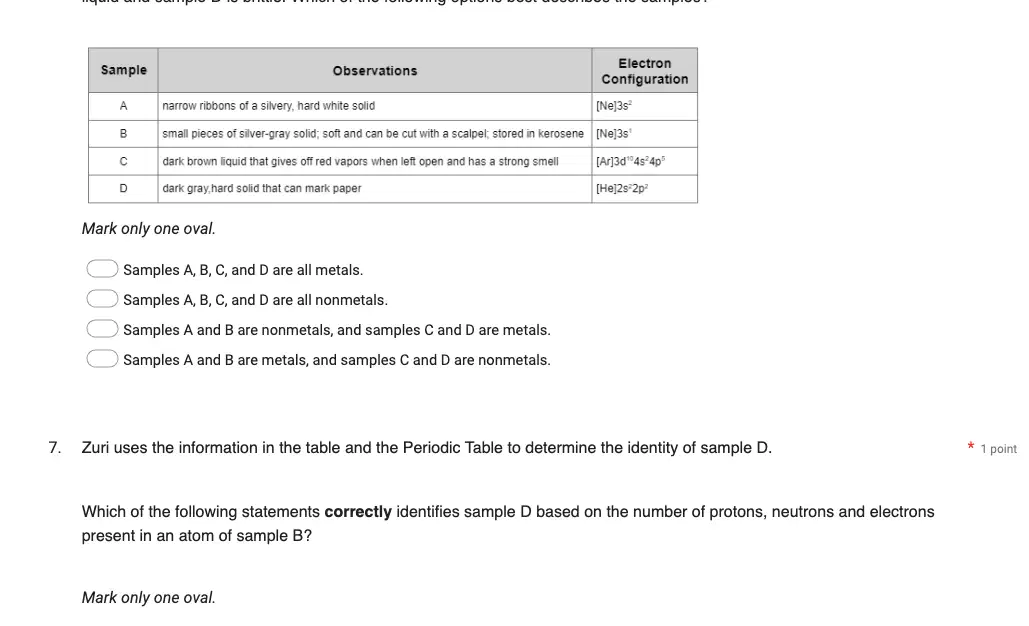
In this Performance Task, you will answer two questions. Zuri has access to the modern periodic table. She has been given samples of four elements to identify. The electron configurations of these four elements are also given to her. She observes the samples and starts to perform some simple tests to help her start identifying the samples. Her notes and observations are in the table. Zuri finds that sample A and B are shiny and can be hammered. Sample A is hard. Sample C and D are dull. Sample C is a liquid and sample D is brittle. Which of the following options best describes the samples?
Samples A, B, C, and D are all metals.
Samples A, B, C, and D are all nonmetals.
Samples A and B are nonmetals, and samples C and D are metals.
Samples A and B are metals, and samples C and D are nonmetals.
Zuri uses the information in the table and the Periodic Table to determine the identity of sample D. Which of the following statements correctly identifies sample D based on the number of protons, neutrons and electrons present in an atom of sample B?
Sample D is argon because there are six protons, six electrons, and six neutrons making its atomic number 18 and mass number 12.
Sample D is carbon because there are six protons, six electrons, and six neutrons making its atomic number 6 and mass number 12.
Sample D is magnesium because there are twelve protons, six electrons, and twelve neutrons making its atomic number 12 and mass number 12.
Sample D is carbon because there are six protons, twelve electrons, and twelve neutrons making its atomic number 6 and mass number 18.
Use the electron dot diagrams of atoms of hydrogen, carbon, and oxygen to answer the question. Molecules of carbon dioxide and water have covalent bonds in their structures. In the molecules, an atom or atoms has/have unused pairs of electrons. From the following, select the one that applies for both carbon dioxide and water molecules.
Both carbon dioxide and water molecules have double bonds in their structures, and each of the oxygen atoms have two pairs of unshared electrons.
Both carbon dioxide and water molecules have single bonds in their structures, and each of the oxygen atoms have two pairs of unshared electrons.
A carbon dioxide molecule has two single bonds and two pairs of unshared electrons. A water molecule has one double bond and two unused electrons.
A carbon dioxide molecule has two double bonds and four pairs of unshared electrons. A molecule of water has two single bonds and has two pairs of unshared electrons.
Use the periodic table and your knowledge of an atom’s nucleus and orbiting electrons to put the elements in the correct order based on the size of the atom’s radius. The radius is measured as the distance from the center of the nucleus to the outside of the electron cloud. What is the correct order of the following elements based on their atomic radius? The order should be from smallest to largest radius.
barium; beryllium; hydrogen; potassium
potassium; beryllium; hydrogen; barium
hydrogen; beryllium; potassium; barium
beryllium; potassium; barium; hydrogen
In this Performance Task, you will answer four questions. In the lab, you conduct two experiments. For your first experiment, you are breaking down cane sugar (sucrose) into simpler compounds by boiling it. You write this equation: C12H22O11 → A + B (breakdown) For your second experiment, you are determining suitable reagents for the complete oxidation of ethanol. You write this equation: C2H5OH → C (oxidation) Your teacher helps you find the percent composition of compounds A, B, and C. To your surprise, they have the same composition as shown in the data table. Element | Percent Composition | Molar Mass Carbon | 40.0% | 12.011 g/mol Hydrogen | 6.7% | 1.008 g/mol Oxygen | the remainder | 15.999 g/mol
CHO
CH2O
CHO2
CH2O2
The empirical formula of A is CH2O. If the ratio of the molar mass of A to the mass according to the empirical formula is 6, how many atoms of carbon, hydrogen and oxygen are there in a molecule of A?
C6H6O6
C6H12O6
C12H6O12
C12H12O6
Consider how many chlorine atoms combine with carbon. How many atoms of sulfur will combine with an atom of carbon?
One
Two
Three
None
In addition to carbon, chlorine combines with other elements to form compounds such as NaCl, CaCl2, and AlCl3. Use the periodic table to predict the charge of the barium ion when it reacts with chlorine. Mark only one oval.
+1
+2
+3
+4
A chemist is required to find an element that has the same number of valence electrons as sulfur. Select the element that the chemist chose and the correct explanation for that choice.
Magnesium, it is in the same group as sulfur
Magnesium, it is in the same period as sulfur
Oxygen, it is in the same group as sulfur
Oxygen, it is in the same period as sulfur
To help finalize her decision, the scientist places the elements in order of greatest to least electron affinity. She knows she needs an element with a strong electron affinity. Which answer correctly lists the element with the smallest electron affinity first and the element with the greatest electron affinity last?
rubidium → calcium → magnesium → oxygen → fluorine
oxygen → fluorine → calcium → magnesium → rubidium
fluorine → oxygen → magnesium → calcium → rubidium
rubidium → magnesium → calcium → fluorine → oxygen
What type of bond does the reactant bromine (Br2) have?
ionic bond
single covalent bond
double covalent bond
triple covalent bond
In this Performance Task, you will answer three questions. Four students are conducting a reaction between aluminum (Al) and bromine (Br2). In order for the reaction to reach completion, the students must use a specific amount of bromine and an excess of aluminum. They carefully measure 25 ml of bromine into an Erlenmeyer flask and quickly place a stopper in the flask while they carry out the other steps of the experiment. The students must use their knowledge of elemental properties, bonding, and reactions to predict the product that is formed during their experiment. They conclude the reaction is a synthesis reaction and the aluminum bonds to bromine to form a single product. The reaction is represented in a balanced equation: 2Al + 3Br2 → 2AlBr3 What is the name and type of bond of the product formed?
Aluminum bromide is the ionic compound formed.
Aluminum bromine is the metallic compound formed.
Tribromine aluminide is the polar covalent compound formed.
Bromine aluminum is the non-polar covalent compound formed.
Four students have submitted their Lewis structure drawings to model the formation of the product. Which student model represents the product formed during the interaction of aluminum and bromine?
Student A
Student B
Student C
Student D
Read the passage and answer the next two questions. A scientist comes across a new solid at low temperatures and wants to determine what type of material it is. She believes it is a nonpolar molecular compound. Following a lab investigation of phase changes of the molecule, the scientist must use minimal temperature increases to identify where on the phase diagram the substance would be since it is volatile. It is important to consider how pressure and temperature play a role. Which of the following tests could be performed to determine if the mystery material is the hypothesized bond type?
Test hardness, since molecular compounds like diamonds are very hard.
Test melting temperature, since molecular compounds have very low melting points.
Test solubility, since molecular compounds are the only ones that dissolve in water.
Test conductivity, since molecular compounds are the only non-conductive compounds.
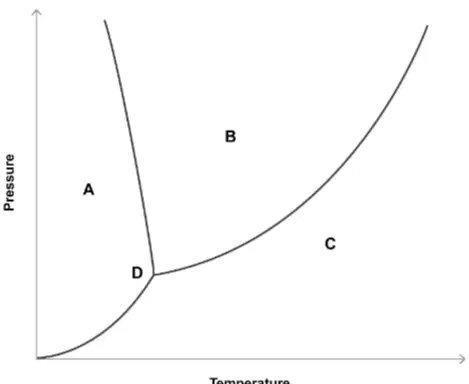
Identify on the phase diagram where the mystery molecule would be at with a slight increase above room temperature.
Point A
Point B
Point C
Point D
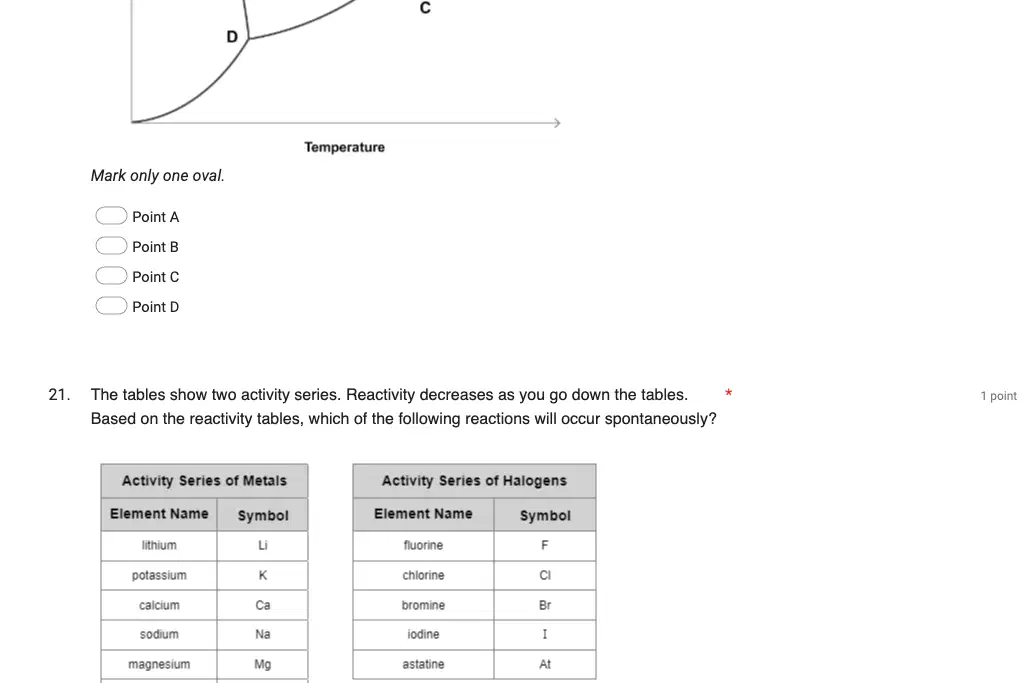
The tables show two activity series. Reactivity decreases as you go down the tables. Based on the reactivity tables, which of the following reactions will occur spontaneously?
Fe(s) + Li2SO4(aq)
Ca(s) + CuCl2(aq)
Ag(s) + AlNO3(aq)
Br2(g) + MgF2(aq)
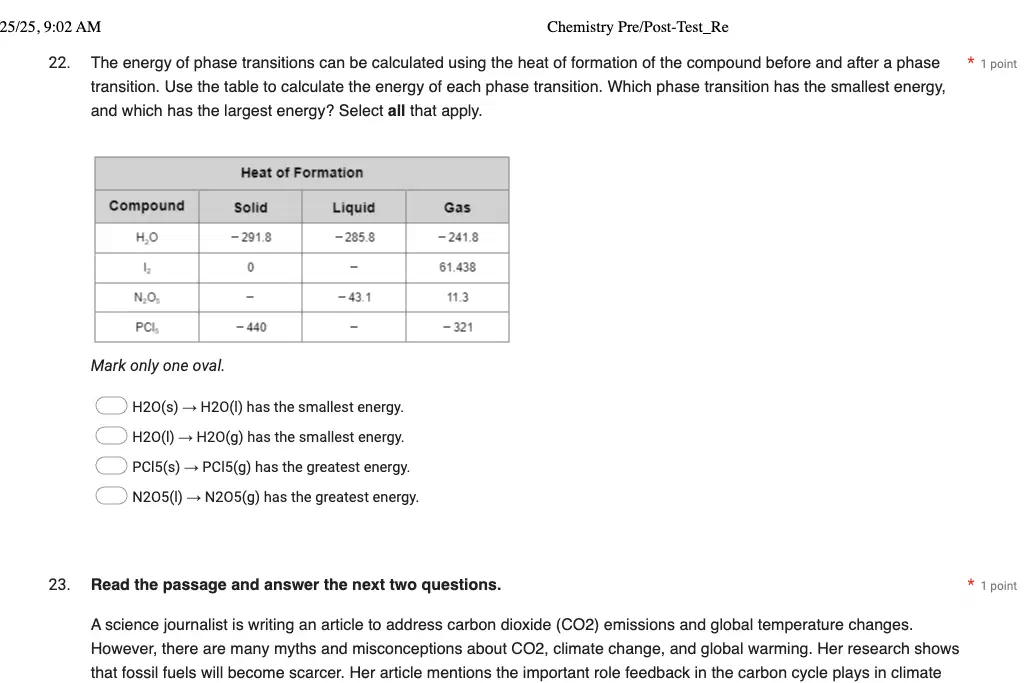
The energy of phase transitions can be calculated using the heat of formation of the compound before and after a phase transition. Use the table to calculate the energy of each phase transition. Which phase transition has the smallest energy, and which has the largest energy? Select all that apply.
H2O(s) → H2O(l) has the smallest energy.
H2O(l) → H2O(g) has the smallest energy.
PCl5(s) → PCl5(g) has the greatest energy.
N2O5(s) → N2O5(g) has the greatest energy.
Read the passage and answer the next two questions. A science journalist is writing an article to address carbon dioxide (CO2) emissions and global temperature changes. However, there are many myths and misconceptions about CO2, climate change, and global warming. Her research shows that fossil fuels will become scarcer. Her article mentions the important role feedback in the carbon cycle plays in climate change. Many scientists believe that changes caused by global warming could alter the world’s natural systems to cause further warming. For example, 30% of the carbon dioxide emitted by humans dissolves in the ocean and rising temperatures are leading to arctic ice melting. Which statement best informs the readers that their experience of the seasons may be affected by global warming?
Climate change focuses on Earth’s average temperature rather than an individual region at a specific time.
The carbon cycle can only continue to cycle carbon through each reservoir if there is enough heat energy from the sun.
Human activity in industrial areas, burning fossil fuels, is the only cause of CO2 levels in the atmosphere from industrial areas.
Regions with trees that have dropped their leaves are the warmest because they are unable to remove CO2 from the atmosphere because no photosynthesis is occurring.
Which of the following is an accurate description of a natural feedback loop that the journalist can include in her article?
As arctic ice melts, the methane trapped in the ice is released; it is then burned and becomes CO2, and that, in turn, accelerates the rate of global warming.
As fossil fuel becomes scarcer, the remaining oil will become more difficult to extract, leading to more greenhouse gas emissions and more warming.
Oceans dissolve some of the CO2 that humans release, but as global temperatures rise, a natural feedback loop will lead to the release of the CO2 stored in the ocean.
As the world heats, more clouds will form, which increases the cloud albedo effect, causing Earth to reflect more sunlight, leading to a temperature increase.
What is the result of an increase in bicarbonate ions if the body is attempting to maintain equilibrium?
Both carbon dioxide and water levels will increase.
Hydrogen ions and carbon dioxide levels will increase.
Water levels will increase, but carbon dioxide will stay the same.
Carbon dioxide levels will increase, but water levels will stay the same.
Compare the change that has occurred between the years 1994 through 2014. What conclusion can be deduced from this data?
The sea-surface temperatures are recorded as having the smallest change in 2014.
The sea-surface temperatures are recorded as having the greatest change in 1997.
The increase in sea-surface temperatures has led to an increase in glacial melting.
The increase in atmospheric carbon dioxide concentrations has also shown a correlating trend in the warming of sea-surface temperatures.
Read the passage and use the diagram to answer the question below. Scientists have shifted attention to focus on yearly studies of global sea-surface temperatures because global sea-surface temperatures have continued to increase since the Industrial Revolution. These temperature changes can lead to ocean acidification. Furthermore, the warmer temperatures result in glacial and ice sheet melting, and the expansion of water’s mass in the ocean can cause sea levels to rise, increasing erosion and adjusting the salinity. Not only do these changes impact marine life, which requires specific conditions in temperature, salinity, and pH to thrive, they also affect the ocean’s ability to regulate global temperatures. Human activity has introduced large levels of carbon dioxide into the atmosphere that will cycle into the ocean. Based on the temperatures from the data, which answer is the best example of a feedback system accelerating global warming?
A) The temperature trends of 1993 led to more forest fires, which caused the release of CO2 into the atmosphere.
B) In 2006, the biodiversity of various species caused mass extinction events.
C) In 1997, the release of frozen methane gas from the ocean into the atmosphere contributed to the greenhouse effect.
D) Lower crop yields of the 2009 season forced agricultural industries to increase the amount of cattle livestock, which produced methane gas.
Read the passage and answer the next two questions. The Big Bang model is the most widely accepted model that describes the origin and the evolution of the universe. The model suggests that the universe began about 14 billion years ago. The universe has since expanded from a small but incredibly dense fireball to the enormous cold and diffuse universe that exists today. During the time period of 380,000 years after the Big Bang, the first neutral atoms were formed. What gave the universe an orange glow?
formation of neutral hydrogen and helium atoms, which allowed photons to travel without being scattered by stars
formation of neutral helium and lithium atoms, which allowed antiquarks to travel without being scattered by plasma
formation of neutral helium and lithium atoms, which allowed antiquarks to travel without being scattered by stars
formation of neutral hydrogen and helium atoms, which allowed photons to travel without being scattered by plasma
A student is asked to predict what would happen to the CO2 levels and pH of seawater in the next decade if hydrogen fuel cells were increasingly used on a global scale. What would the student's prediction be?
The CO2 level will increase, and the pH level will increase.
The CO2 level will decrease, and the pH level will increase.
The CO2 level will increase, and the pH level will decrease.
The CO2 level will decrease, and the pH level will decrease.
The hydrogen fuel cell is a promising replacement option to reduce the emission of greenhouse gases. Besides the hydrogen fuel cell, there are many other carbon-free sources of energy. Which would NOT be a good choice to lower CO2 emissions?
natural gas
wind energy
nuclear energy
geothermal energy

