wayground logo

Free Printable Worksheets

NEW

Font size

S
M
L
XL
Worksheets

Enzymes Y9

Total questions: 27

Worksheet time: 32mins

Name
Class
Date
1.
Enzymes are...
a)
Nucleic Acids
b)
Proteins
c)
Lipids
d)
Carbohydrates
2.
An enzyme speeds up a chemical reaction in the cell, but can only be used once.
a)
True
b)
False
3.
Enzymes speed up a chemical reaction by...
a)
destroying products
b)
lowering activation energy
c)
increasing activation energy
d)
allowing reactions to process at their own speed
4.
Which substrate would this enzyme catalyze?
a)
Δ
b)
σ
c)
d)
μ
5.
Any substrate that is acted upon by an enzyme is called a(n)
a)
substrate
b)
reactant
c)
nucleic acid
d)
both a & b
6.
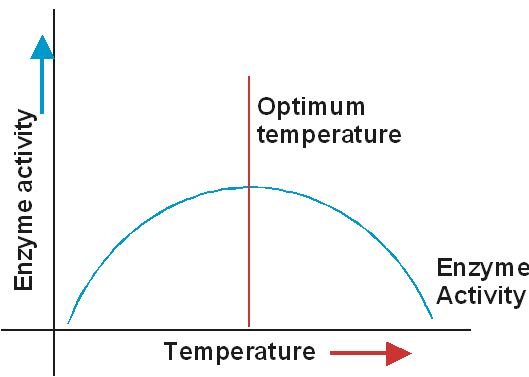
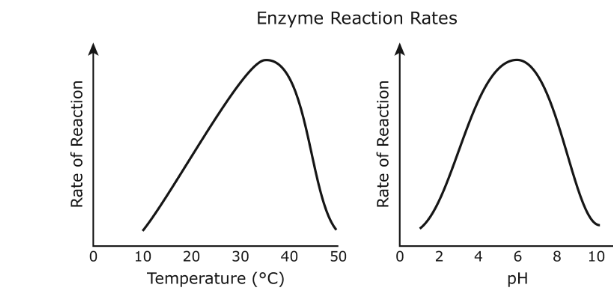
Based on the graph, what temperature does this enzyme work best?
a)
30* C
b)
15* C
c)

35* C

d)

25* C

7.
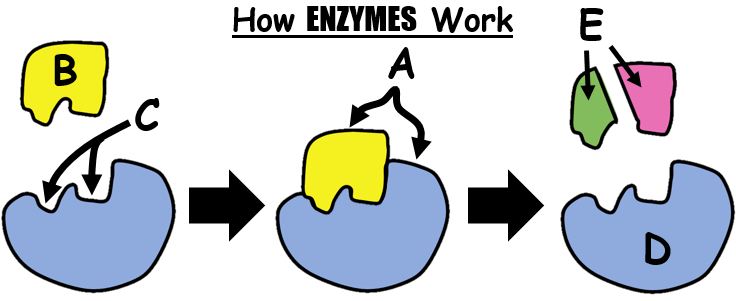
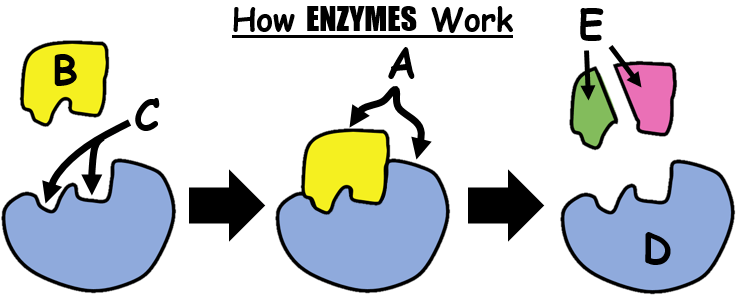
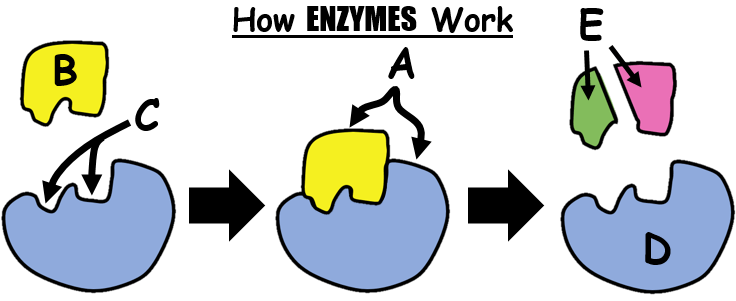
In the diagram, what is letter E?
a)
substrate
b)
enzyme-substrate complex
c)
product
d)
active site
8.
What factors affect an enzyme's reaction rate?
a)
temperature 
b)
pH
c)
substrate concentration
d)
all of these
9.
What is being represented by the letter B in the image?
a)
Substrate
b)
Enzyme
c)
Substrate
d)
Product
10.
If an enzyme becomes over heated what effect, if any, will the heat have on the enzymatic activity? 
a)
The enzyme will not store much chemical energy.
b)
The enzyme will not be able to catalyze reactions.
c)

The enzyme will die and stop working
d)
The enzyme will lose stored genetic information.
11.
What is the purpose  of an enzyme?
a)
give permission for the reaction
b)
raise activation energy
c)
speed up reactions
d)
control how many reactions occur
12.
What 3 letters do enzymes typically end in?
a)
-ose
b)
-ase
c)
-ese
d)
-tic
13.
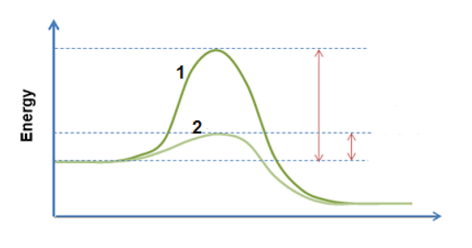
Which line represents an enzyme-catalyzed reaction? 
a)
Line 1
b)
Line 2
14.
What is being represented by the letter A in the image?
a)
Substrate
b)
Enzyme
c)
Product
d)
Complex
15.
In the diagram, what is letter A? 
a)
product
b)
substrate
c)
enzyme-substrate complex
d)
active site
16.
Letter D...
a)
active site
b)
enzyme
c)
substrate
d)
products
17.
Letter C...
a)
active site
b)
enzymes
c)
substrate
d)
products
18.

In a chemical reaction, ________ are what you have at the end

a)

Products

b)

Molecules

c)

Reactants

d)

Substances

19.
At high temperatures enzyme activity declines because of:
a)
Denaturation
b)
Decreased Kinetic Motion
c)
Increased H-Bonding
d)
Dissociation of Ionic Compounds
20.
What happens when enzymes are heated to a high temperature?
a)
The enzymes die.
b)
The shapes of the enzyme are altered or denatured
c)
The enzymes' amino acid sequence changes.
d)
The enzymes remain the same
21.

The graphs show the reaction rate for an enzyme across a range of temperatures and pH.


Based on these data, this enzyme functions best as what temperature and pH?

a)

Temperature of 27oC and a pH of 4

b)

Temperature of 37oC and a pH of 6

c)

Temperature of 40oC and a pH of 8

d)

Temperature of 50oC and a pH of 10

22.

If the experiment is repeated at pH 11, the observed activity level of the enzyme will most likely be

a)

between the levels observed at pH 5 and pH 7.

b)

lower than the level at pH 9

c)

the same as the level at pH 7

d)

greater than the level at pH 9

23.

During which time interval is the reaction rate lowest?

a)

0-1 minute

b)

1-2 minutes

c)

2-3 minutes

d)

3-4 minutes

e)

4-5 minutes

24.

What are the products in this chemical reaction?

a)
b)
25.

Which of the following is NOT a function of enzymes?

a)

Acting as biological catalysts

b)

Lowering activation energy

c)

Speeding up chemical reactions

d)

Being consumed in reactions

26.

What happens to an enzyme when it is exposed to a pH level far from its optimal range?

a)

It remains unchanged

b)

It changes its substrate

c)

It denatures and loses function

d)

It becomes more active

27.

In an enzyme-catalyzed reaction, what is the role of the active site?

a)

To release energy

b)

To change the enzyme's shape

c)

To increase the temperature

d)

To bind with the substrate