
 Worksheets
(Savvas 10.1 and 10.2) Radioactivity & Rate of Decay
Total questions: 22
Worksheet time: 22mins
Describe radioactivity.
Radioactivity is the spontaneous emission of radiation from the nucleus of an unstable atom.
Radioactivity is the process of absorbing energy from the environment.
Radioactivity is the emission of light from stable atoms.
Radioactivity is the movement of electrons in an atom's outer shell.
A radioisotope is any atom that contains an unstable _______________.
nucleus
electron
proton
neutron
Identify the two events that take place during beta decay. (Mark two answers.)
A proton decomposes into a neutron and an electron.
A neutron decomposes into a proton and an electron.
An electron is emitted from the nucleus.
A neutron is emitted from the nucleus.
Why are beta particles more penetrating than alpha particles?
Because beta particles have less mass and charge than alpha particles
Because beta particles move slower than alpha particles
Because beta particles are larger than alpha particles
Because beta particles are positively charged
A gamma ray is
a type of visible light.
a form of electromagnetic radiation with high energy.
a sound wave.
a particle with mass.
Gamma rays travel through space at what speed?
The speed of sound
The speed of light
Slower than light
Faster than light
One potential danger of radon gas is that prolonged exposure to it can lead to lung cancer.
True
False
Name two devices that are used to detect nuclear radiation.
Geiger counter, Film Badge
Thermometer, Barometer
Voltmeter, Ammeter
Microscope, Telescope

How many neutrons does this isotope of magnesium have?
37
25
12
13
How many protons does this isotope of magnesium have?
37
25
12
13
How many electrons does this isotope of magnesium have?
37
25
12
13
A half-life is
the time it takes for half of a radioactive substance to decay.
the time it takes for a substance to double in amount.
the time it takes for a substance to completely decay.
the time it takes for a substance to change state.
How much of the original sample of a radioisotope is unchanged after two half-lives?
All of the original sample is changed.
One quarter of the original sample is unchanged.
Half of the original sample is unchanged.
Three quarters of the original sample is unchanged.
Plants and animals continue to absorb carbon from the atmosphere after they die.
True
False
After the third half-life, how much of the sample is unchanged?
1/6
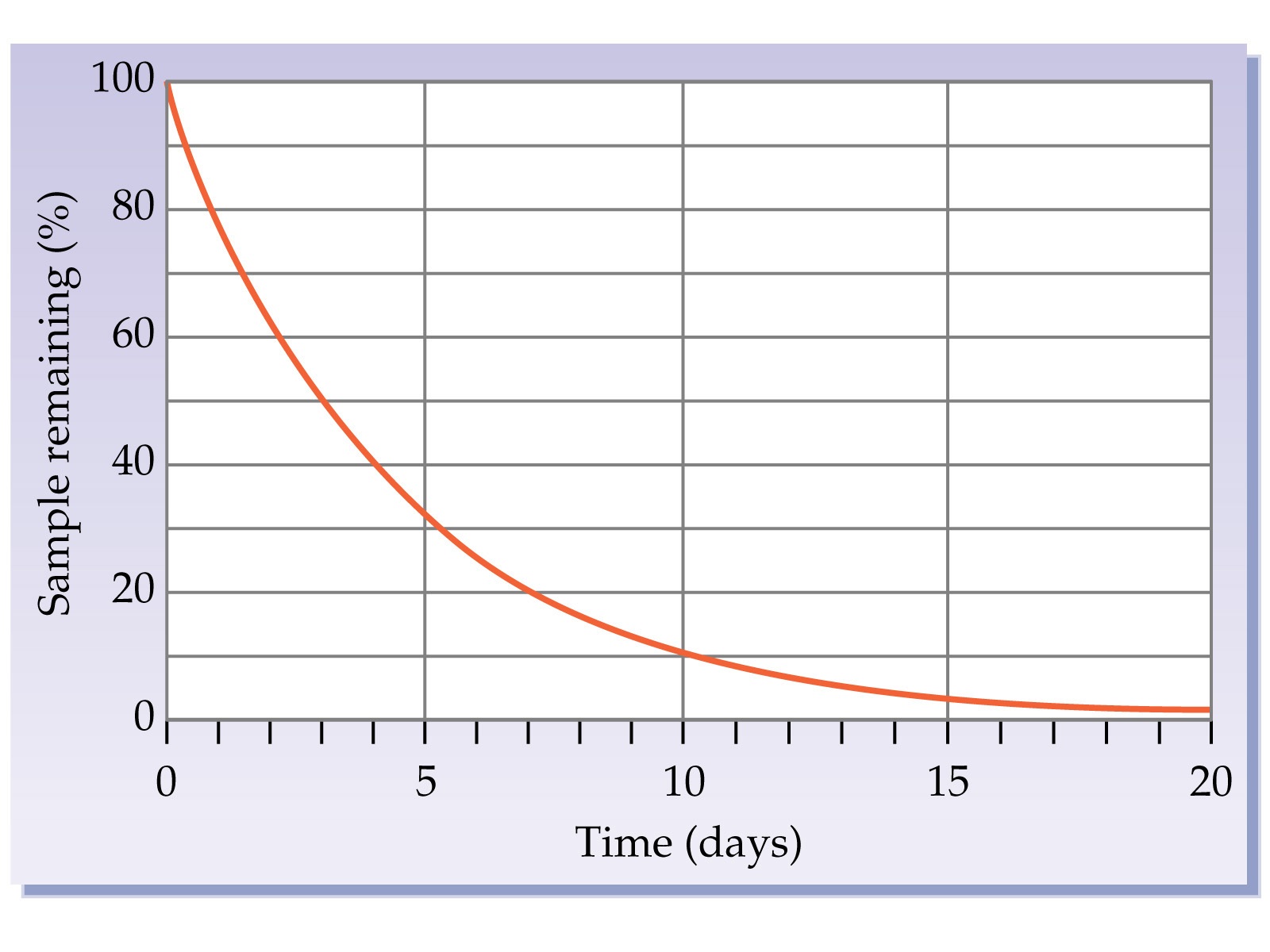
What is the half life of this isotope?
3 days
5 days
8 days
10 days
146C --> 0-1e + ________
Which type of radiation has the highest penetrating power? Several centimeters thick of lead or several meters thick of concrete cannot stop all of it.
Which type of nuclear radiation has the lowest penetrating power? This radiation can only penetrate 0.05 mm into the body and can be stopped by a piece of paper or clothing.
An alpha particle is made of
two protons and two neutrons
one proton and one neutron
two neutrons
two protons

