
 Worksheets
well log final
Total questions: 51
Worksheet time: 26mins
For a gas-bearing sandstone formation, which correction factor should be applied to the porosity calculated using Wyllie's time-average equation?
Multiply porosity by 0.5
Multiply porosity by 0.7
Multiply porosity by 0.9
Divide porosity by 1.2
Multiply porosity by 0.3
According to Archie's law, the formation resistivity factor FR is expressed as:
FR=фm*Rw
FR=Rt/Rw
FR=a/фm
FR=Swn*Ro
FR=ф*Rw/Rt
PEF is more sensitive than density to presence of barite in mud
True
False
Which of the following logs SHOULD NOT be run in the presence of an OBM
PEF
Neutron
Density
None
How does the NMR log's T2 distribution improve porosity estimation in a heterogeneous carbonate reservoir compared to density or neutron logs?
It measures resistivity variations, providing more accurate lithology data
It distinguishes between total and effective porosity, capturing BWI and FFI
It calculates acoustic velocity, improving porosity in fractured zones
It detects gamma ray emissions, refining porosity in shaly zones
It estimates borehole rugosity, correcting porosity measurements
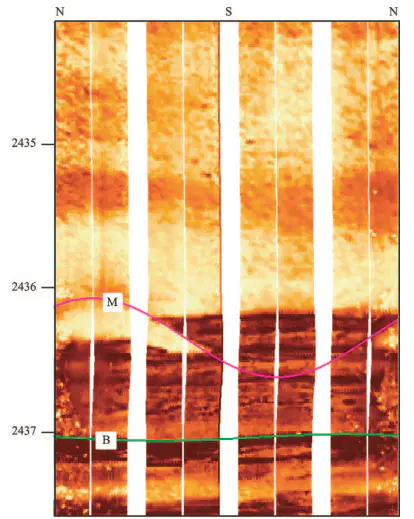
What does M represent?
M is the open fracture
M is the plane
M is the cemented fracture
M is the small-scale fault
Conductive feature
How does the presence of gas in a formation affect the neutron porosity log?
Increases porosity due to higher hydrogen concentration
Decreases porosity due to lower hydrogen concentration
No effect, as gas has the same hydrogen index as water
Causes erratic readings due to neutron scattering
Increases porosity only in carbonate formations
Which type of formation is typically associated with low gamma ray readings in Spectral Gamma Ray Logs?
Sandstone
Shale
Limestone
Coal
Which technique is used to measure the acoustic properties of a formation?
Sonic logging
Nuclear magnetic resonance logging
Dielectric logging
Acoustic impedance logging
Which of the following logs is most affected by borehole salinity?
Neutron log
Gamma ray log
Density log
Caliper log
SP log
A Pickett plot (log-log plot of resistivity vs. porosity) is primarily used to:
Determine (m) and water resistivity (Rw)
Calculate hydrocarbon saturation (Sh) using Archie's equation
Identify the position of the free water level (FWL)
Differentiate between gas and oil zones
Estimate permeability from core data
Which gamma-ray interaction mechanism is primarily utilized in density logging, and in what energy range does it predominantly occur?
Pair Production (>10 MeV)
Photoelectric Absorption (<100 keV)
Nuclear Absorption (200 keV-500 keV)
Elastic Scattering (>1 MeV)
Compton Scattering (75 keV to 10 MeV)
A combination of neutron and density logs can be utilized to detect the presence of irreducible water saturation in a hydrocarbon-bearing sand
True
False
Which of the following would normally have the greatest resistivity?
Shale
Solid granite
Fractured dolomite
Sandstone
In the SP log, what does a positive deflection usually indicate in freshwater mud systems?
Shale
Gas zone
Permeable sandstone
Tight carbonate
Oil-bearing limestone
Which technique is used to determine the resistivity of a formation by measuring the electromagnetic response to induced currents?
Induction logging
Dielectric logging
Sonic logging
Nuclear logging
What is the primary objective of image logging?
Assessing formation pressure
Evaluating borehole stability
Structural analysis
Measuring formation permeability
What is the term used to describe the time it takes for the protons to return to their original state after excitation?
Relaxation time
Acquisition time
Pulse sequence
Spin echo
In mudlog interpretation, what does the following stands for?GYTAN SDY TR CALCITE
Granular yellowish-tan sandy trace calcite
Grayish-tan silty trace calcite
Grayish-tan sandy trace calcite
Greenish-yellow tertiary calcareous sands
Graded yellowish-tan shale with calcite veins
What does a resistivity log primarily indicate?
Formation pressure
Porosity
Lithology
Fluid saturation
Which formula correctly expresses the relationship between Young's modulus (E), shear modulus (G), and Poisson's ratio (μ)?
G=3(1-2μ)E
μ=E2G-1μ=2GE-1
E=G(1+μ)
G=2(1+μ)E
G=μE
What log type is best for identifying lithology boundaries?
Caliper
Neutron
Gamma ray
Sonic
Induction
How is the neutron porosity log (NPOR) used to estimate porosity in a sandstone reservoir, and what is a key limitation in its interpretation?
It measures gamma ray emissions to calculate porosity, limited by borehole rugosity
It detects hydrogen content to estimate porosity. limited by gas effects
It calculates acoustic transit time for porosity, limited by fracture presence
It measures formation resistivity for porosity. limited by fluid salinity
It estimates bulk density for porosity, limited by clay content
From which of the following logs Rxo can be identified
MSFL
ILD
LLD
RHOB
DRHO
What usually is the chemical source for Neutron log?
A mixture of americium and beryllium
Pure uranium core sealed in a lead container
Cesium-137 mixed with sodium chloride
A combination of gamma-emitting isotopes
Natural hydrogen stored in pressurized chambers
A photoelectric factor (PEF) log measures a value of 5.1. Which lithology is most likely present?
Sandstone
Shale
Limestone
Dolomite
Anhydrite
In well logging, what is the main application of the sonic log?
To measure the formation's resistivity to electrical current
To estimate the formation's mechanical properties and porosity
To detect the presence of hydrocarbons through fluorescence
To measure the formation's natural radioactivity
To determine the well's temperature profile
Which sonic tool configuration uses two transmitters and four receivers to automatically compensate for borehole size variations and tool misalignment?
Single-Receiver System
Dual-Receiver System
Borehole Compensated Tool
Long-Spacing Sonic Tool
Piezoelectric Transmitter Array
Apply the time-average equation to calculate porosity from acoustic transit time. Question: Using the time-average equation, what is the porosity of a sandstone formation with a transit time (AtAt) of 70 usec/ft? Assume Atma=55.5Atma=55.5 usec/ft (sandstone) and Atf=189 usec/ft (fluid).
8%
22%
15%
18%
11%
Which log is most reliable in air-filled boreholes for resistivity measurement?
Laterolog
Induction log
Microresistivity log
Neutron log
Gamma ray log
Which technique involves analyzing the petrophysical properties of rock samples obtained from the reservoir?
Well logging
Core analysis
Formation testing
Image logging
What information can be inferred from borehole imaging data?
Casing integrity
Fluid composition
Rock porosity and permeability
Only borehole diameter
What is the typical unit of measurement for resistivity log readings?
Ohm-meters
Millivolts
Microcuries
Percent
In log interpretaion which of the following act as insulators
All of the above
hydrocarbons
rocks
fresh water
formation
What is Zonation?
Identifying the mineral composition of the formation
The process of measuring resistivity variations in a well
Determining the porosity and permeability of formation layers
Classifying formation pressure into distinct groups
Defining intervals of similar lithologic and fluid properties
Which parameter in Archie's equation adjusts for pore complexity?
a (tortuosity factor)
m (cementation exponent)
n (saturation exponent)
Rt (true resistivity)
Rw (formation water resistivity)
In advanced well logging, what is the significance of the shear wave anisotropy measured by a dipole sonic tool?
It indicates the formation's natural radioactivity and clay content
It measures the electrical conductivity of the formation fluids It provides
It provides insights into formation stress and fracture orientation
It estimates the bulk density of the formation
It determines the borehole diameter and rugosity
A density log records a bulk density of 2.32 g/cm' in a sandstone formation. Assuming a matrix density of 2.65 g/cm3 and fluid density of 0.1 g/cm3 (gas), what| is the porosity?
15%
5%
20%
25%
30%
In the context of nuclear magnetic resonance (NMR) logging, what does the T2 relaxation time distribution primarily indicate about the formation?
The formation's natural gamma ray emission level
The electrical resistivity of the formation fluids
The pore size distribution and fluid mobility
The acoustic impedance of the formation
The thermal gradient within the formation
What is the difference between the Free-fluid (Coates) and SDR model
Coates uses a resistivity index, while SDR uses acoustic velocity
Coates uses a ratio of FFI to BVI, SDR uses the geometric mean of T2
Coates is used only for shaly sands, whereas SDR applies to carbonate formations
Coates calculates permeability directly, while SDR estimates porosity
Coates applies a pressure correction factor, SDR does not
How does the NMR log’s T2 distribution improve porosity estimation in a heterogeneous carbonate reservoir compared to density or neutron logs?
It measures resistivity variations
It distinguishes between total and effective porosity (BVI/FFI)
It calculates acoustic velocity
It detects gamma ray emissions
It estimates borehole rugosity
When resistivity logs are used in a water-bearing zone, what is the relationship between the resistivity of the uninvaded zone (Rt), invaded zone (Ri), and flushed zone (Rxo)?
Rt = Ri = Rxo
Rxo > Ri > Rt
Rt > Ri > Rxo
Rt > Rxo > Ri
Ri > Rxo > Rt
Which of the following logs is least affected by borehole washouts?
Gamma ray
Density
PEF
Neutron
Caliper
A gamma ray log shows a consistent reading of 130 API in a certain zone. What does this most likely indicate?
Clean sandstone
Shale formation
Salt dome
Fractured carbonate
Brine-filled zone
What is the typical unit of measurement for SP log readings?
Millivolts
Ohm-meters
Microcuries
API
Percent
What does the DPHI log measure?
Density
Porosity
Fluid saturation
Permeability
Formation pressure
What is the primary use of borehole imaging in subsurface evaluation?
Determining formation fluid types and viscosities
Mapping subsurface fractures, bedding, and sedimentary features
Measuring the porosity and permeability of reservoir rocks
Assessing borehole temperature and pressure gradients
Identifying casing wear and corrosion in well completions
Which log is most reliable in air-filled boreholes for resistivity measurement?
Microresistivity log
Laterolog
Induction log
Gamma ray log
Neutron log
Which of the following minerals will have a measurable impact on the neutron log in the presence of otherwise clean sands?
barrium and phosphorous
illite and chlorite
calcium and chlorite
bromium and uranium
There are known effects of gas on logging tool responses. Which of the following statements is correct?
Sonic log porosities are reduced by gas
Neutron log porosities are increased by gas
Neutron log porosities are decreased by gas
Density log porosities are not affected by gas
All of the above
What is the primary role of ultra-violet light in mud logging?
Measuring gas content in cuttings
Detecting oil through fluorescence
Determining mud weight
Identifying formation pressure
Enhancing core sample visibility

