
Font size
 Worksheets
South Carolina Oyster Reefs Worksheet
Total questions: 19
Worksheet time: 28mins
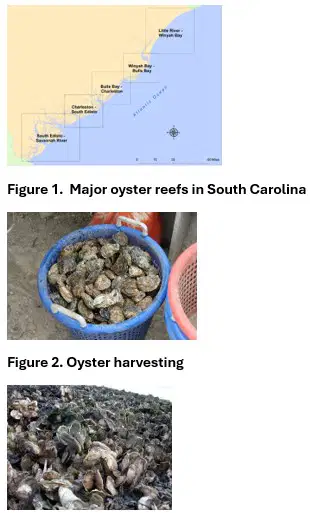
How are Eastern Oysters usually found in nature?
Living in clusters along the coast.
Living by themselves away from the coast.
Living by themself in dry areas.
Living in clusters away from the coast.
South Carolina boasts a long and beautiful coastline, stretching for a remarkable 187 miles. That's a pretty long drive! If you were to travel the entire coastline at a steady speed of 60 miles per hour, it would take you almost three and a half hours. This coastline is not just a scenic wonder, but also a treasure trove of natural resources, including the famous oyster reefs.
Oysters, particularly the Eastern Oyster (Crassostrea virginica), play a crucial role in keeping South Carolina's marine environment healthy. They act like natural filters, cleaning the water and providing a habitat for other marine life. But oysters are not just important for the environment; they are also a delicious and popular food source for people.
The process of collecting oysters for human consumption is called "oyster harvesting." This activity has a significant economic impact on South Carolina, as it provides jobs and contributes to the state's economy.
Based on the information you have, which of the following is the least likely to be a potential threat to oyster reefs.
Increased demand from restaurants that serve oysters.
Ocean water Pollution from different sources.
Human settlements being built away from the coast.
Natural disasters that affect the coast.

How has the population of South Carolina changed recently:
It has increased significantly
It has increased slightly
It has decreased slightly
It has decreased significantly
Based on the information obtained so far, which of the following would be the best claim to explain a possible relationship between human population growth and oyster reef development.
The increase in population in South Carolina has decreased the demand for oysters thus helping their reefs grow faster.
The increase in population in South Carolina has had no effect on the demand for Oysters because people don’t eat them anymore.
The increase in population has increased the demand for oysters, making it necessary to protect them from overharvesting.
The decrease in population in South Carolina has caused oysters to disappear from the coast of South Carolina.
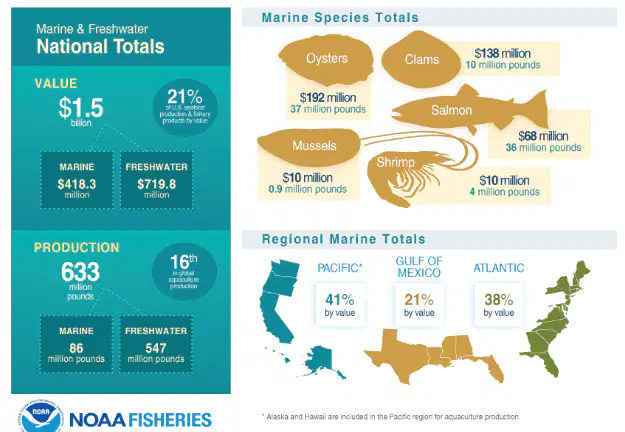
Oysters ______ to be an economically important species in the United States. The data shows that oysters are among the ______ marine species produced through aquaculture. This indicates that oyster demand is _____ in the USA, and humans are ______ them at high rates.
Seem, bottom, high, consuming
Do not seem, top, low, consuming
Do not seem, bottom, low, not consuming
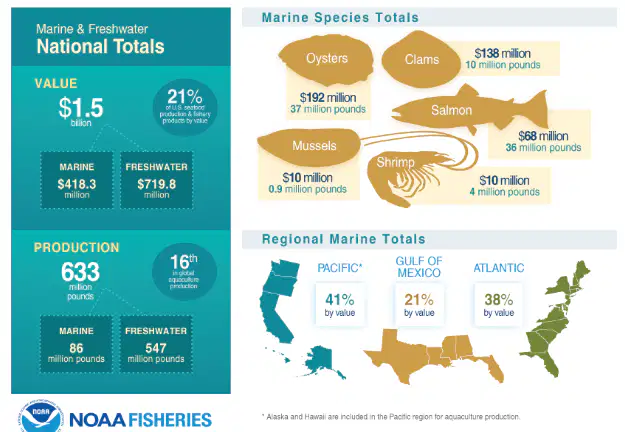
The data presented in the infographic suggests that the consumption of oyster reefs occurs _______ than other marine species. Given that South Carolina is one of the States with a coastline, it can be inferred that South Carolina _________ oysters for human consumption. An increase in population in the State of South Carolina will most likely require _______ harvesting of oysters.
Slower, does not produce, more
Faster, produces, less
Faster, Produces, more
Slower, does not produce, less
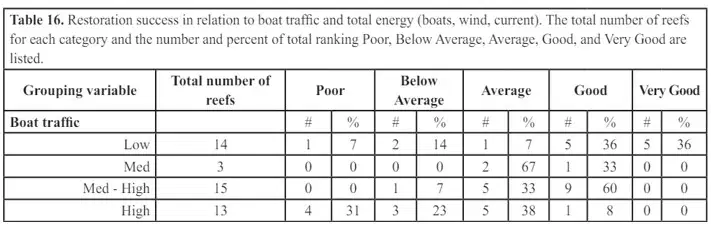
The Department of Natural resources has studied the effects that boating and the waves created as the boat moves through the water have on oyster reef quality, and the results of their study are shown in the table below. The Table Shows the results of assessing oyster reef health in contrast with boat traffic observed in that area. Which of the following has the lowest percentage of “good” oyster reef?
low traffic
medium traffic
medium-high traffic
high traffic
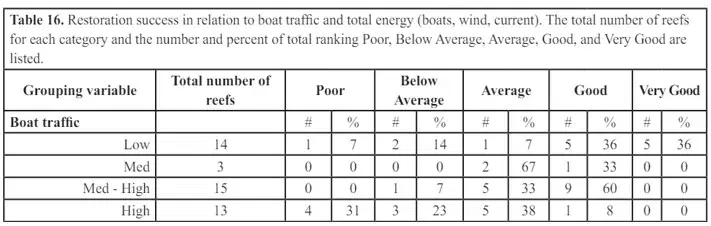
Comparing the areas with low boat traffic vs the ones with high boat traffic. Which of the following best describes the cause-and-effect relationship between boat traffic and oyster reef quality?
Higher boat traffic is correlated to lower reef quality
Lower boat traffic is correlated to lower reef quality.
There is no difference in reef quality between low and high boat traffic areas.
Most of the reefs located around areas with low boat traffic are below average quality.
Based on what you have identified about the population growth of South Carolina, which of the following claims best explains the relationship between human population growth and its effect on our marine natural resources?
Increased population has the potential to increase boat traffic which can cause the quality of oyster reefs to worsen.
Increased population has the potential to increase boat traffic which can cause an improvement in oyster reef quality.
Increased population has the potential to decrease boat traffic which can negatively impact oyster reefs.
Increased population is very unlikely to have any effect on oyster reef quality.
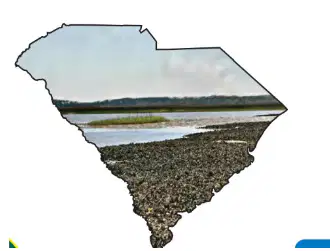
Which of the following is a scientific question that can be asked to explore the connection between the destruction of oyster reefs and its impacts on other earth natural systems?
How do oyster reefs put other earth systems at risk in the State of South Carolina?
How do oyster reef destruction increase human population growth in South Carolina?
How does oyster reef destruction affect water quality in South Carolina’s Coast?
How does the loss of quality in oyster reefs affect South Carolina’s Economy?
Given the statement “Oyster reef destruction has a direct impact on South Carolina’s sea water quality” From the list, select 3 of the statements that can serve as evidence to support that claim.
Coastal development leads to the loss of natural habitats and water pollution from runoff that contain sediments and contaminants.
Healthy oyster reefs can filter large volumes of water, removing excess nutrients and sediments, which helps keep the water clear and clean.
It's important to consider the connections between human actions and environmental health
Understanding these relationships can guide us towards more sustainable practices that protect both human interests and the natural world.
Increased boat traffic can directly damage oyster reefs, and overfishing reduces the oyster population that is essential for maintaining reefs.
After an interview with a Murrells Inlet Seafood restaurant owners they claimed "After reading several magazine articles, "we have realized that the impact of reef destruction on water quality is minimal, and harvesting for human consumption justifies the impact" Why can’t this claim not be used as scientific evidence? (Select the 3 that apply)
The claim does not include the names of the restaurant owners
The claim in not based on scientific data; thus, the source may not be reliable
The claim is based on personal opinions rater than scientific data or research
The claim was made by individuals that may be biases since they benefit from oyster harvesting
The claim does not consider the impact of oyster reef destruction at all
Which of the following is a claim that can be used to refute the claim made by the restaurant owners using scientific evidence?
Several surveys made by the Myrtle Beach Chamber of Commerce have shown that oyster reefs are nice to look at and make the coastal area more attractive to tourists.
Scientific studies show that oyster reefs significantly improve water quality by filtering out pollutants, which is essential for the health of marine ecosystems.
Data from social media on the types of seafood that people prefer show that the economic benefit of harvesting oysters is not as important as the overall health of the marine environment.
Many people believe that oyster reefs are important, even if there isn't much evidence to support this.
Oysters start their life cycle as larvae. Oyster larvae need to adhere to a solid structure to successfully grow. This solid structure is called a “substrate”. The preferred substrate for oyster larvae to adhere to is another oyster shell. The larvae remain attached to the host oyster shell so it can form its own shell and complete its life cycle. (Anderson and Keith, 2014).
Scientists from SCDNR have determined There are plenty of oyster larvae, but there is a shortage of solid surfaces for them to attach to. Thus, the restoration of oysters mainly involves making more substrate available to them. Given that The top choice for juvenile oyster attachment is other oyster shells, which is why restoration projects typically involve replanting recycled oyster shells, a technique known as “Oyster Shell Planting.” (SCDNR, 2020).
Based on the passage, what is the main reason for using recycled oyster shells in restoration projects?
The main reason for using recycled oyster shells in restoration projects is that oyster larvae prefer to attach to other oyster shells, which helps them grow and complete their life cycle.
Recycled oyster shells are used because they are less expensive than artificial materials.
Recycled oyster shells are used because they prevent water pollution.
Recycled oyster shells are used because they are easier to transport than other materials.
Oysters start their life cycle as larvae. Oyster larvae need to adhere to a solid structure to successfully grow. This solid structure is called a “substrate”. The preferred substrate for oyster larvae to adhere to is another oyster shell. The larvae remain attached to the host oyster shell so it can form its own shell and complete its life cycle. (Anderson and Keith, 2014).
Scientists from SCDNR have determined There are plenty of oyster larvae, but there is a shortage of solid surfaces for them to attach to. Thus, the restoration of oysters mainly involves making more substrate available to them. Given that The top choice for juvenile oyster attachment is other oyster shells, which is why restoration projects typically involve replanting recycled oyster shells, a technique known as “Oyster Shell Planting.” (SCDNR, 2020).
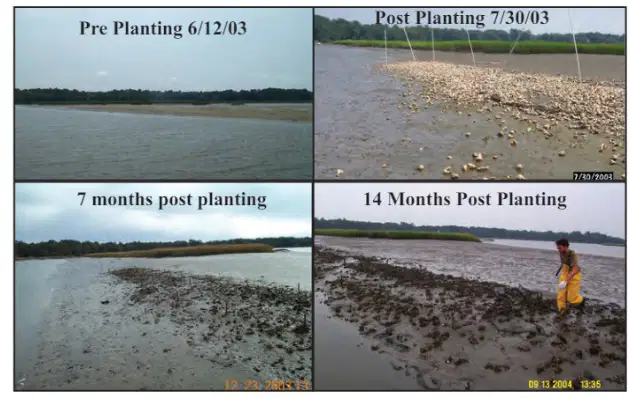
The image below shows the results of an oyster shell planting project in Charleston’s Leadenwah Creek. This project’s success was assessed as “above average”.
Which of the following is the most likely question that was asked to determine if the planting was successful or not at helping oyster populations recover?
How many oysters were harvested for humans to eat?
How was the weather in Charleston like the day before planting the oyster shells?
What percentage of the oyster shells planted have oysters growing attached to them?
What percentage of the oyster shells planted were recycled after the oysters were harvested?
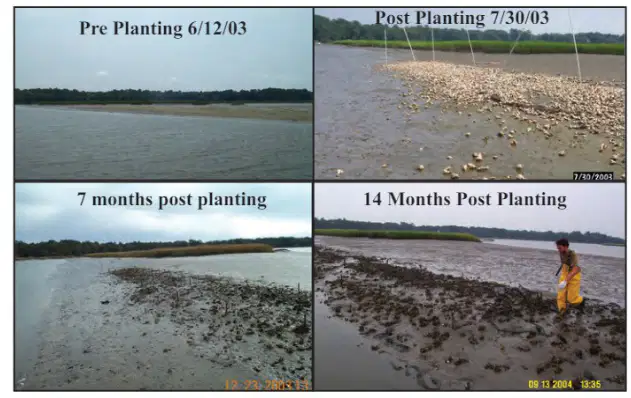
Which of the following is an observation that can be made from the image to determine the project was successful?
There are less oysters for 14 months post planting than 7 months post planting.
There is a good percentage of oysters that remain at the site 14 months post planting.
There are very few oysters remaining at the site for 7 months post planting.
The creek where the oyster shells were planted has more water now.
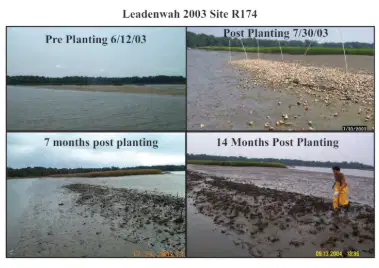
Based on the results of the oyster shell planting project in Charleston’s Leadenwah Creek, it is (a) that oyster replanting is a good strategy to restore oyster reefs.
Unlikely
Which of the following would be the best next step to further test how effective oyster replanting is?
Perform oyster shell planting projects in other creeks to compare the results.
Harvest the oysters and see if they grow back without replanting.
Changing the temperature of the soil to see if they survive.
No further tests will be needed. This project proves the effectiveness of oyster shell planting.
According to SCDNR, Oyster reefs restoration projects have become less effective due to two main reasons: 1. Oyster shells are less available and sometimes need to be brought to South Carolina from other states. (SCDNR, 2020). 2. Boat activity has increased, and the waves that boats make when they move through the water (wake) cause the loss of shells that have been planted. (SCDNR, 2020). Based on this information, choose 3 possible solutions that can help with this problem from the list. Take into consideration their benefits and their drawbacks.
A. Oyster Shell recycling programs that motivate residents (including restaurants) to give their empty shells back so they can be planted.
B. Artificial oyster shells being made in a lab using other natural resources in the area.
C. Creating “no wake zones” which are areas where boats must reduce their speed to create smaller waves that won’t affect the shells.
D. Educational programs that help make citizens more aware of the ecology of oyster reefs and their importance.
E. Bringing oyster shells from overseas and using them to create more resilient reefs that are used to rough conditions in other areas of the planet.

