
 Worksheets
Voice Production and Qualities Review
Total questions: 23
Worksheet time: 7mins
What is the function of a resonator in voice production?
To control breathing
To amplify volume and create a richer tone
To produce sound
To filter air
The lips, teeth, and tongue are examples of which of the following?
Resonators
Articulators
Diaphragms
Vocal folds
Which of the following is NOT involved in the first stage of creating breath and voice production?
Lungs
Diaphragm
Heart
Larynx
What can affect the quality of your breath and voice?
Height
Posture
Movement
Light
True or False: Breath production and control cannot be improved by doing regular breathing exercises.
True
False

Which part of the body is labeled as #1 in the diagram?
Larynx
Vocal folds
Diaphragm
Trachea

Which part of the body is labeled as #2 in the diagram?
Larynx
Vocal folds
Diaphragm
Trachea
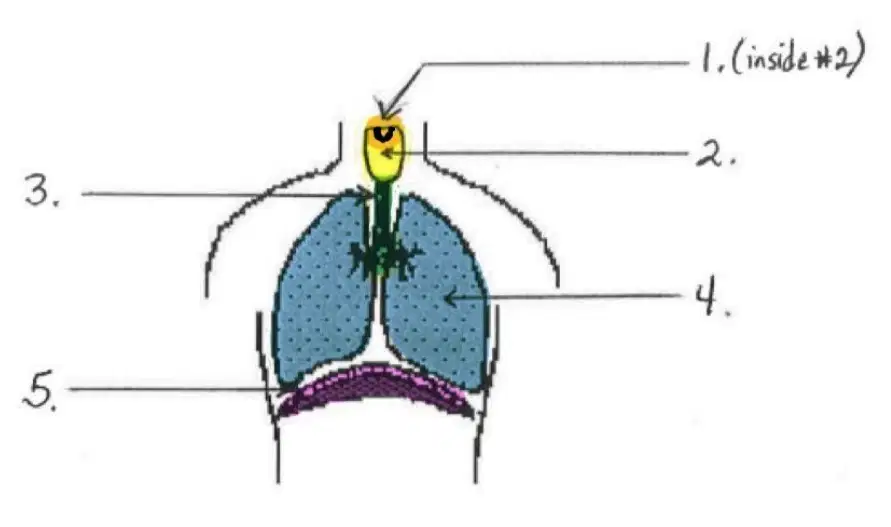
Which part of the body is labeled as #3 in the diagram?
Larynx
Vocal folds
Diaphragm
Trachea
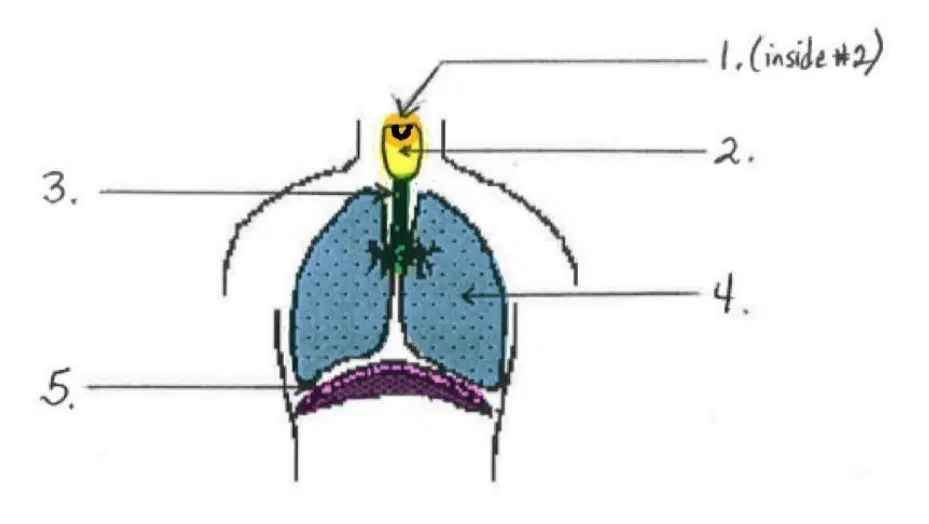
Which part of the body is labeled as #4 in the diagram?
Lungs
Vocal folds
Diaphragm
Trachea
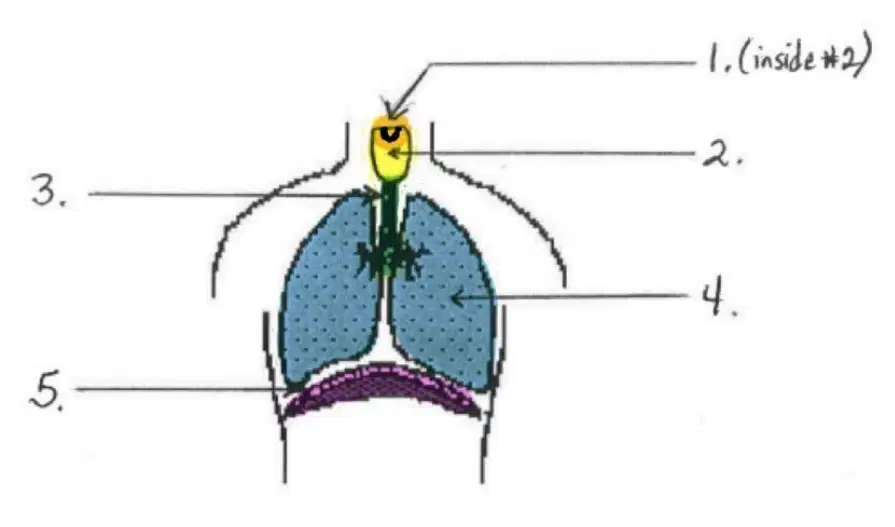
Which part of the body is labeled as #5 in the diagram?
Larynx
Vocal folds
Diaphragm
Trachea
What is the primary role of the vocal folds?
To control breathing
To produce sound
To filter air
To amplify sound
Which of the following is the muscle that first activates when you want to speak?
Larynx
Diaphragm
Vocal folds
Trachea
What is the role of the trachea in voice production?
To produce sound
To provide a passage for airflow
To control breathing
To amplify sound
Which part(s) of the body is responsible for amplifying the volume of the voice?
Resonators
Articulators
Diaphragm
Trachea
Regularly using your voice incorrectly can cause damage to your vocal folds. (circle one)
TRUE
FALSE
If you were told that you were "crushing your instrument," what should you do to fix this problem?
take it to the repair shop
take deeper breaths
hold your breath
fix your posture
Which of the following words is NOT part of the definition of breath support?
flexible
healthy
monotone
strong
Match the vocal quality "volume" with its definition.
How quiet or loud your voice is in the room
The speed at which you speak
Warmth and fullness of the voice
Movement of pitches throughout a spoken phrase
Match the vocal skill "resonance" with its definition.
The clarity and correctness of the speech sounds
The ability to fill the room with your voice so the audience can hear you well
The ability to deliver dialogue at an appropriate speed
The ability to produce a pleasing, rich vocal tone
Match the vocal skill "pacing" with its definition.
The clarity and correctness of the speech sounds
The ability to fill the room with your voice so the audience can hear you well
The ability to deliver dialogue at an appropriate speed
The ability to produce a pleasing, rich vocal tone
What is the definition of an "accent?"
The range of notes from high to low your voice makes
Vocal patterns native to your first language that show where you're from
The warmth and fullness of the voice
How connected your words are
What do the articulators do?
Turn muddy sound into speech sounds
Amplify the volume of your voice
Vibrate to create vocal sounds
Expand and contract to hold air
Define the vocal quality of "pitch."
The clarity of your speech sounds
How loud or soft your voice is in a room
The speed at which you speak
The range of notes from high to low the voice makes

