
 Worksheets
Levels of Organization: Ecology Intro
Total questions: 13
Worksheet time: 7mins
Write a description of the following level of organization in ecology and provide an example for each. Level: Organism
Description: All ecosystems on Earth. Example: The biosphere.
Description: A group of different species living together. Example: A forest.
Description: An individual living being. Example: A single fox.
Description: A community and its non-living environment. Example: A pond ecosystem.
Write a description of the following level of organization in ecology and provide an example for each. Level: Population
Description: A group of the same type of organism living together in the same area. Example: A group of foxes.
Description: Different species interacting in the same area. Example: Foxes, rabbits, and birds in a forest.
Description: All living and non-living things in a particular area. Example: A forest ecosystem.
Description: A single organism in its environment. Example: A fox in a field.
Write a description of the following level of organization in ecology and provide an example for each. Level: Community
Description: A single organism and its role in the environment. Example: An oak tree in a park.
Description: All the different species that live and interact in a place. Example: Foxes, rabbits, trees, and birds in a forest.
Description: All the abiotic and biotic factors in a region. Example: A pond with water, fish, plants, and rocks.
Description: A group of the same species living together. Example: A herd of deer in a meadow.
Write a description of the following level of organization in ecology and provide an example for each. Level: Ecosystem
Description: Includes all living and non-living things in an area. Example: Sunlight, water, rocks, plants, and animals in a forest.
Description: Includes only the animal species in an area. Example: Wolves in a forest.
Description: Includes only the non-living things in an area. Example: Rocks and water in a desert.
Description: Includes only an individual organism. Example: A single oak tree in a park.
Write a description of the following level of organization in ecology and provide an example for each. Level: Biosphere
Description: The collection of all lakes on a continent. Example: The Great Lakes.
Description: The region of the ocean where light does not penetrate. Example: Deep ocean trenches.
Description: The area occupied by a single species. Example: The territory of a wolf pack.
Description: The part of the Earth where all life exists. Example: The Earth.
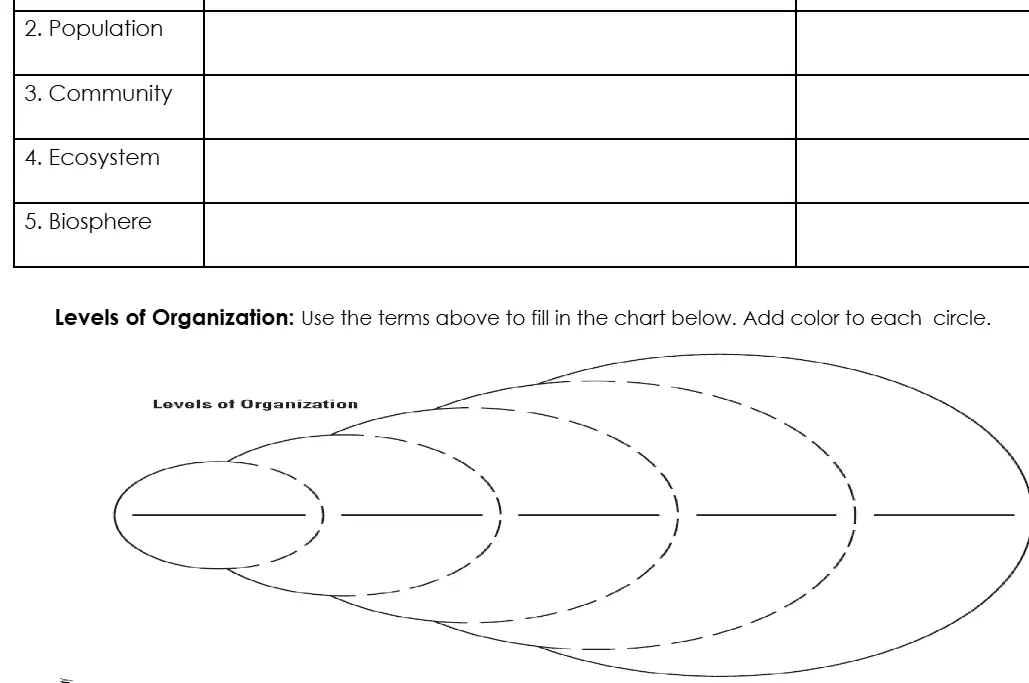
Levels of Organization: Use the terms Organism, Population, Community, Ecosystem, and Biosphere to complete the chart below. Add color to each circle.
From smallest to largest: Organism, Population, Community, Ecosystem, Biosphere.
From smallest to largest: Population, Organism, Community, Ecosystem, Biosphere.
From smallest to largest: Organism, Community, Population, Ecosystem, Biosphere.
From smallest to largest: Organism, Population, Ecosystem, Community, Biosphere.
An (1) ________________ is a unique living being, like a single fox in a forest.
Population
Ecosystem
Individual
Community
When you have a group of the same type of organism living together in the same area, like a group of foxes, it is called a (2) ________________.
Habitat
Community
Ecosystem
Population
All the different species that live and interact in a place, such as foxes, rabbits, trees, and birds, form a (3) ________________.
Population
Community
Habitat
Ecosystem
But when you also include non-living things, such as sunlight, water, and rocks, along with all living beings, you have an (4) ________________.
Ecosystem
Habitat
Organism
Population
When we observe large areas that share similar climates and ecosystems, such as the rainforest or the tundra, we call it a (5) ________________.
Organism
Biome
Habitat
Population
Each of these areas can have different levels of (6) ________________, which is the variety of living beings found there.
Erosion
Photosynthesis
Biodiversity
Evaporation
Sometimes, a type of organism is especially important for the balance of its ecosystem. This is called a (7) ________________.
Keystone Species
Dominant Predator
Primary Consumer
Invasive Species

