
Font size
 Worksheets
Stoichiometry
Total questions: 12
Worksheet time: 16mins
How many HCl molecules do you need to balance this equation?
Mg + __HCl → MgCl2 + H2
1
2
3
4
How many Hydrogen are in 4H2O?
6
8
2
4
When a log burns, the ash left behind weighs less than the log. Does the log follow the Law of Conservation of Mass?
a. No, burning is an exception to the Law of Conservation of Mass.
b. No, since burning is a chemical change it does not follow the Law of Conservation of Mass.
c. Yes, the wood rearranges its protons so that the masses are the same before and after the reaction and burning follows the Law of Conservation of Mass.
d. Yes, wood chemically combines with the oxygen in the air to produce ash, water and CO2 gas which escapes into the air so it seems like less but if you kept the gas and water and weighed it, the mass would be the same.
Methane (natural gas) is a fossil fuel that can be burned to heat our homes. The reactants in this chemical equation are methane and oxygen. The products are water and carbon dioxide. The following word equation can be used to describe this reaction:
Methane + oxygen→ water + carbon dioxide
Which of the following is true about the mass of the reactants and the products?
a. the mass of the methane and oxygen will be less than the mass of the water and carbon dioxide.
b. the mass of the methane and oxygen will be greater than the mass of the water and carbon dioxide.
c. the mass of the methane and oxygen will be equal to the mass of the water and carbon dioxide.
d. it is not possible to determine the masses without more information.
The formula below represents the chemical reaction between the elements hydrogen and oxygen when the compound water is formed.
2H2 + O2 → 2H2O
This equation supports the law of conservation of mass because
a. the total number of hydrogen and oxygen atoms in the reactants and products is twelve.
b. the mass of hydrogen in the reactants is equal to the mass of the water in the product
c. the same number of atoms of the elements hydrogen and oxygen are in the reactants as are in the products.
d. atoms of the elements hydrogen and oxygen react to form molecules of the compound water.
According to the Law of Conservation of Mass, what is conserved during a chemical reaction?
a. Only molecules are conserved during a chemical reaction.
b. Only atoms are conserved during a chemical reaction.
c. Only mass is conserved during a chemical reaction.
d. Atoms and mass are conserved during a chemical reaction.
e. Atoms and molecules are conserved during a chemical reaction.
What are the reactants in the equation below:
NaCl + AgNO3 → NaNO3 + AgCl
a. AgNO3 and AgCl
b. NaCl and AgCl
c. NaCl and AgNO3
d. NaNO3 and AgCl
A chemical equation is balanced when the
a. Subscripts of the reactants equal the subscripts of the products.
b. Coefficients of the reactants equal the coefficients of the products.
c. Same number of each kind of atom appears in the reactants and in the products
d. Products and reactants are the same chemicals.
Which of the following reactions is correctly balanced based on the law of conservation of matter?


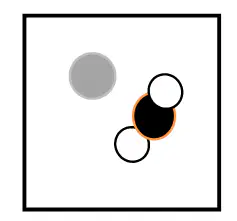
Given the reactants shown above, which of the choices shown below could be possible products?


Balance the equation and interpret the representative masses of the reactants and products.
Write the balanced equation and also the masses of the chemical reaction.
__H2 (g) + O2 (g) → __H2O (g)
(a)
Balance the equation and interpret the representative masses of the reactants and products.
Write the balanced equation and also the masses of the chemical reaction.
C2H4 (g) + _O2 (g) → _CO2 (g) + _H2O (g)
(a)

