
 Worksheets
4.1 Capacitators
Total questions: 24
Worksheet time: 23mins
Which of the following is symbol of capacitor ?


A capacitor is a pair of (a) separated by an (b) . If a (c) is placed across the plates they acquire (d) charges.
What are the units of capacitance? (Two possible answers)
JC-1
CV-1
C
F
A dielectric is an (a) material. This (b) the value of capacitance. At A level the dielectric is usually (c) or a vacuum.
A capacitor is a device that stores charge and energy.
True
False
The equivalent capacitance of three capacitors with capacitance C1, C2 and C3 connected in parallel is
C=C1+C2+C3
C1=C11+C21+C31
C=C11+C21+C31
C=C1C2C3
The equivalent capacitance of three capacitors with capacitance C1, C2 and C3 connected in series is
C=C1+C2+C3
C1=C11+C21+C31
C=C11+C21+C31
C1=C11×C21×C31
With respect to the capacitor, which relationship is true? •
C = Q×V
V = C×Q
V = Q/C
Q = C/V
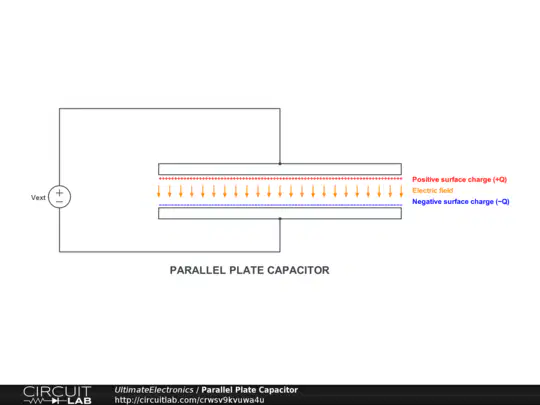
Which of the following is true about a fully charged capacitor
the charge on the two plates is equal but opposite
the p.d across supply is the same as the p.d across the capacitor plates
no charge flows between the plates
all of the above is true
C=Yϵ0X
What do the symbols X and Y represent?
X is d, the distance between the plates
Y is A, the area of the plates.
X is A, the area of the plates.
Y is d, the distance between the plates
X is V, the p.d across the plates.
Y is E, the electric field between the plates
X is the electric field between the plates
Y is V, the p.d across the plates.
Put the correct equations under the correct headings
21QV
21CV2
21 CQ2
CV
Q0e−RCt
Q0(1−e−RCt)

Capacitors charge and discharge in a __________ manner.
Linear
Constant
Square
Exponential
The capacitance C is charged through a resistor R. The time constant of the charging circuit is given by
C/R
1/RC
RC
R/C
Which of the following depends on charging and discharging rate of a capacitor?
Time constant
Current
Power
Voltage
The time constant can be found for CHARGING a capacitor when the capacitor is (a) charged.
The time constant when DISCHARGING a capacitor is found when the capacitor is (b) charged.

This circuit is used for charging and discharging a capacitor.
What is the purpose of the cell?
To provide a pd to charge the capacitor.
To switch between the charging and discharging circuit
To provide a pathway to allow the charge to dissipate
Slows down the flow of charge to allow measurements to be taken over time
This circuit is used for charging and discharging a capacitor.
What is the purpose of the resistor?
To provide a pd to charge the capacitor.
To switch between the charging and discharging circuit
To provide a pathway to allow the charge to dissipate
Slows down the flow of charge to allow measurements to be taken over time
This circuit is used for charging and discharging a capacitor.
What is the purpose of the switch?
To provide a pd to charge the capacitor.
To switch between the charging and discharging circuit
To provide a pathway to allow the charge to dissipate
Slows down the flow of charge to allow measurements to be taken over time
This circuit is used for charging and discharging a capacitor.
What is the purpose of the discharging circuit with no voltage supply?
To provide a pd to charge the capacitor.
To switch between the charging and discharging circuit
To provide a pathway to allow the charge to dissipate
Slows down the flow of charge to allow measurements to be taken over time

