
 Worksheets
ESS1-2 Basics
Total questions: 32
Worksheet time: 28mins
When Earth spins, it turns around an imaginary line called a(n)
rotation
axis
orbit
ellipse
Which planet is an inner planet?
Uranus
Venus
Saturn
Neptune
Which list shows the correct order of planets from the sun?
Mercury, Venus, Earth, Mars, Asteroid Belt, Jupiter, Saturn, Uranus, Neptune
Mercury, Venus, Earth, Mars, Kuiper Belt, Jupiter, Saturn, Uranus, Neptune, Asteroid Belt
Mars, Venus, Earth, Saturn, Mercury, Pluto, Ceres, Kepler 442-B
Just a big black hole
What do Jupiter, Saturn, Uranus, and Neptune have in common?
They all have rocky surfaces.
They all appear to be similar to Earth.
They all are gas planets.
They all appear to be made of rock and ice.
Why does the sun seem to change position in the sky?
Earth's rotation
Earth's orbit
The sun's rotation
The sun's orbit

Chris is learning about Earth's movement in science class. He records some information in a chart about Earth's movement.
What information in Chris's chart is in the WRONG row of the table?
Causes day and night
Cause shadows to change
Causes change in seasons
Causes sunrise and sunset
Choose the correct order of the first 4 planets
Mercury, Earth, Venus, Mars
Mars, Earth, Venus, Mercury
Mercury, Venus, Earth, Mars
Mercury, Mars, Venus, Pluto
Which planet is farthest from the sun?
Pluto
Saturn
Uranus
Neptune
Which planet is the largest?
Jupiter
Saturn
Neptune
Pluto

Mercury, Venus, Earth, Mars are...
none of above
planets re
outer planets
inner planets
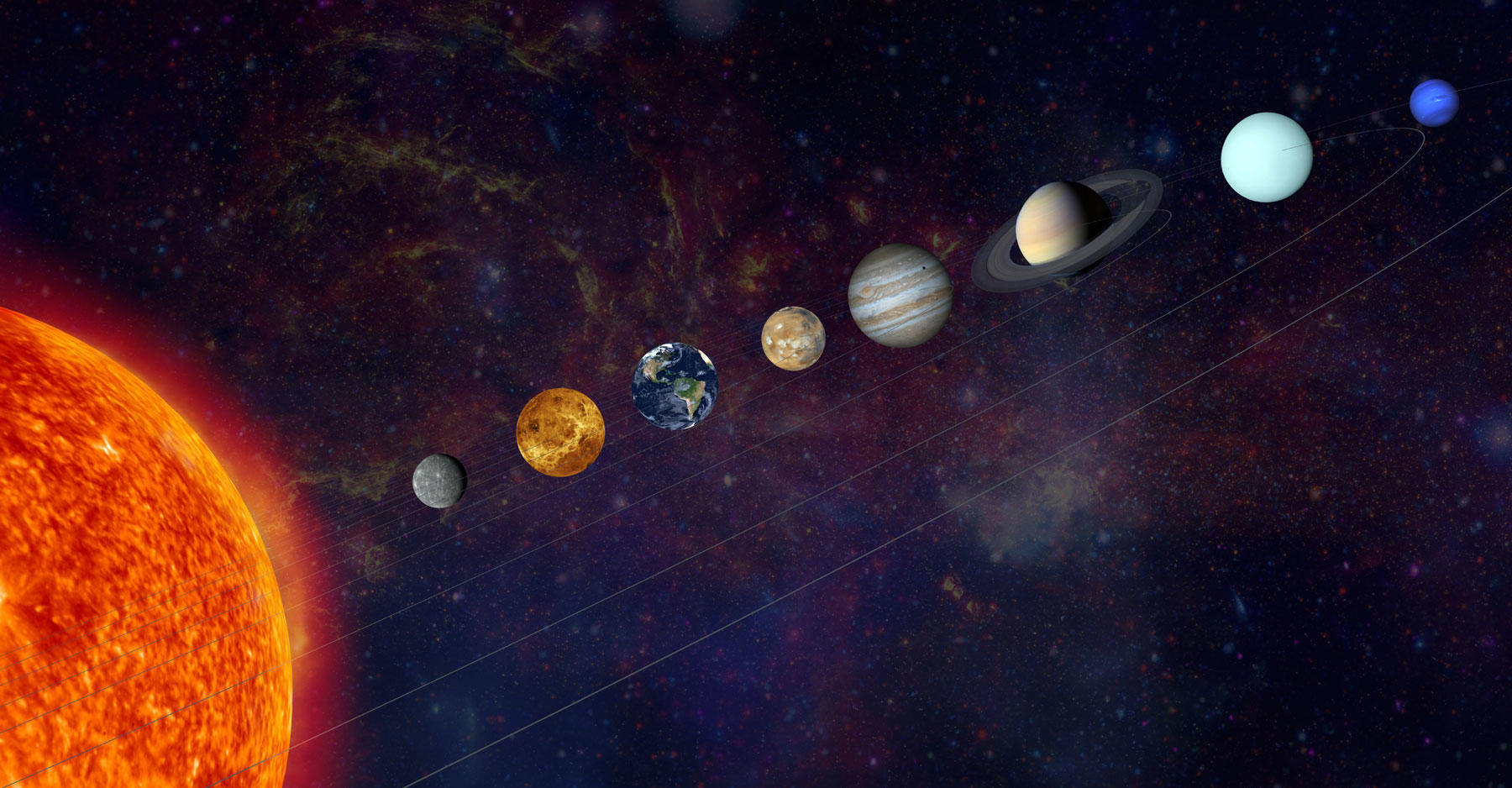
The planets are all equally distanced from each other.
The force of gravitational attraction between the Sun and Venus could be increased by reducing which of the following?
The distance between the Sun and Venus
The period of rotation of the Sun
The mass of the Sun and Venus
The speed of the orbit of Venus
Which of the following is a complete list of the inner planets?
Venus, Earth, Mars, Jupiter
Mercury, Venus, Earth, Mars
Jupiter, Saturn, Uranus, Neptune
Mercury, Venus, Earth, Jupiter
Which of the following BEST describes the shape of each planets orbit?
circle
elliptical
sphere
rectangular

Why do all planets orbit the sun?
The sun is very large and has a weak gravitational pull, so the planets stay close to it
The sun is smaller than the planets and has a large gravitational pull that attracts the planets
The sun is large and has a large gravitational pull that makes the planets orbit it
The sun orbits the planets because it needs to keep them warm
How does gravity affect objects located on or near the surface of the Earth?
They drift away.
They experience gravitational pull.
They lose mass.
They push each other away.
What happens to the gravitational force when the mass of an object increases?
It decreases
It remains the same
It increases
It disappears
What is the relationship between the Sun's mass and its gravitational force?
Less mass, more force
More mass, less force
More mass, more force
Less mass, less force
Which two things affect gravity?
Mass and distance
Weight and distance
Weight and mass
Which two objects would have a stronger gravitational attraction?


Which would create the strongest gravity?
Two large planets close together
Two large planets far apart
Two small planets close together
Two small planets far apart
The more distance between two objects, the __________ gravity they will have.
more
less
same
no
a kind of cloud, from which solar systems are formed ( the inward pull of gravity is balanced by the outward push of gas pressure in the cloud.)
solar plane
solar panel
solar nebula
solar gravity
What is the effect of gravity on objects?
Gravity makes objects float in the air.
Gravity pulls objects towards each other.
Gravity has no effect on objects.
Gravity pushes objects away from each other.
Which planet is an example of a gas giant?
Mercury
Saturn
Mars
Earth

Does this picture show the accurate distance between the planets to scale?
Yes
No

