
Font size
 Worksheets
Exams Day
Total questions: 40
Worksheet time: 1hrs 3mins
Petunjuk: Bacalah teks berikut dan jawablah pertanyaannya.
Teks 1: “Why Students Should Wear Uniforms”
Uniforms create equality among students. When students wear uniforms, it minimizes social conflicts based on clothing. It also promotes discipline and school identity. Uniforms reduce the pressure to wear expensive clothes and allow students to focus more on learning than fashion.
What is the purpose of the text?
To entertain the reader
To describe school uniforms
To tell a story about uniforms
To argue in favor of school uniforms
Petunjuk: Bacalah teks berikut dan jawablah pertanyaannya.
Teks 1: “Why Students Should Wear Uniforms”
Uniforms create equality among students. When students wear uniforms, it minimizes social conflicts based on clothing. It also promotes discipline and school identity. Uniforms reduce the pressure to wear expensive clothes and allow students to focus more on learning than fashion.
What is the main idea of the text?
Uniforms are old-fashioned.
Students should not wear uniforms.
Wearing uniforms promotes equality and discipline.
Students look the same.
Petunjuk: Bacalah teks berikut dan jawablah pertanyaannya.
Teks 1: “Why Students Should Wear Uniforms”
Uniforms create equality among students. When students wear uniforms, it minimizes social conflicts based on clothing. It also promotes discipline and school identity. Uniforms reduce the pressure to wear expensive clothes and allow students to focus more on learning than fashion.
One benefit of uniforms mentioned in the text is:
Expression of freedom
Discipline and school identity
Expression of freedom
Fashion trends
Petunjuk: Bacalah teks berikut dan jawablah pertanyaannya.
Teks 1: “Why Students Should Wear Uniforms”
Uniforms create equality among students. When students wear uniforms, it minimizes social conflicts based on clothing. It also promotes discipline and school identity. Uniforms reduce the pressure to wear expensive clothes and allow students to focus more on learning than fashion.
The word minimizes in the text is closest in meaning to:
Reduces
Adds
Increases
Shows
Teks 2: “The Importance of Reading”
Reading is essential for personal growth. It helps people gain knowledge and develop imagination. People who read more tend to have better writing and speaking skills. Reading also improves concentration and focus.
What is the main argument of the text?
Reading is important for personal development
Reading is boring
Reading helps us sleep
Reading is not necessary
Teks 2: “The Importance of Reading”
Reading is essential for personal growth. It helps people gain knowledge and develop imagination. People who read more tend to have better writing and speaking skills. Reading also improves concentration and focus.
What skills does reading improve?
Listening and acting
Drawing and dancing
Cooking and swimming
Writing and speaking
Teks 2: “The Importance of Reading”
Reading is essential for personal growth. It helps people gain knowledge and develop imagination. People who read more tend to have better writing and speaking skills. Reading also improves concentration and focus.
Why do people who read have better imagination?
They watch less TV
Books inspire them
They dream more
They avoid speaking
The purpose of analytical exposition text is:
To convince the reader about something
To explain how to do something
To describe a process
To narrate a story
Which of these is NOT part of an analytical exposition?
Thesis
Dialogue
Reiteration
Arguments
Teks 3: “Why We Should Save Electricity”
Saving electricity helps protect the environment. It reduces the use of fossil fuels, which produce harmful gases. Saving energy also saves money. Small actions like turning off unused lights make a big difference.
The main point of the text is:
Saving electricity benefits the environment and our finances
We should use more electricity
We should use more electricity
We should pay more for electricity
Teks 3: “Why We Should Save Electricity”
Saving electricity helps protect the environment. It reduces the use of fossil fuels, which produce harmful gases. Saving energy also saves money. Small actions like turning off unused lights make a big difference.
Which is NOT mentioned in the text as a benefit of saving electricity?
Increasing electricity bills
Saving money
Reducing fossil fuel usage
Protecting the environment
Teks 3: “Why We Should Save Electricity”
Saving electricity helps protect the environment. It reduces the use of fossil fuels, which produce harmful gases. Saving energy also saves money. Small actions like turning off unused lights make a big difference.
What action is suggested in the text?
Playing video games longer
Using more air conditioners
Turning off unused lights
Buying more gadgets
What is the function of the "reiteration" in an analytical exposition?
Introduce the topic
Present facts
Repeat and strengthen the thesis
Tell a story
The text structure of an analytical exposition is:
Orientation – Complication – Resolution
Thesis – Arguments – Reiteration
Introduction – Body – Conclusion
Identification – Description
Teks 4: “Online Learning is Effective”
Online learning allows students to access materials anytime and anywhere. It supports independent study and saves travel time. Though it requires discipline, online learning is a flexible and effective education method.
What is the writer's opinion?
Online learning is effective
Online learning is boring
Online learning wastes time
Online learning must be avoided
Teks 4: “Online Learning is Effective”
Online learning allows students to access materials anytime and anywhere. It supports independent study and saves travel time. Though it requires discipline, online learning is a flexible and effective education method.
According to the text, what is a requirement for successful online learning?
Fancy gadgets
Discipline
Good internet
A strict teacher
Teks 4: “Online Learning is Effective”
Online learning allows students to access materials anytime and anywhere. It supports independent study and saves travel time. Though it requires discipline, online learning is a flexible and effective education method.
Why is online learning considered flexible?
It has less homework
You don’t have to study
You can learn at any time and place
You can sleep in class
Teks 4: “Online Learning is Effective”
Online learning allows students to access materials anytime and anywhere. It supports independent study and saves travel time. Though it requires discipline, online learning is a flexible and effective education method.
“It supports independent study.” What does “independent” mean?
Studying with others
Studying with help
Studying alone and managing yourself
Studying in a group
Teks 4: “Online Learning is Effective”
Online learning allows students to access materials anytime and anywhere. It supports independent study and saves travel time. Though it requires discipline, online learning is a flexible and effective education method.
What type of text is "Online Learning is Effective"?
Recount
Explanation
Descriptive
Analytical Exposition
She ___ to school every day.
go
goes
going
gone
He never ___ late.
is
are
am
be
Do you ___ English every day?
learning
learn
learns
learned
The children ___ cartoons every morning.
watch
watches
watching
watched
They ___ soccer every weekend.
plays
played
play
playing
My brother ___ to music in his room.
listens
listen
listening
listened
Tina: Hi, Sinta. What do you usually do on the weekend?
Sinta: I usually stay at home and help my mom. Sometimes I watch movies or read books.
Tina: Do you go out with your friends?
Sinta: Not very often. I prefer staying at home.
Tina: That's cool. I often go to the park with my little brother.
Question:
What does Sinta usually do on the weekend?
She always goes out with her friends.
She plays football in the park.
She stays at home and helps her mom.
She never watches movies.
Rina: What time do you get up in the morning, Ana?
Ana: I usually get up at 5 a.m. because I help my mom prepare breakfast.
Rina: Wow, that’s early!
Ana: Yes, but I like it. After that, I take a shower and get ready for school.
Rina: Do you walk to school?
Ana: No, my dad drives me.
Question:
Why does Ana get up early?
To go jogging
To help her mom
To clean her room
To study for exams
Tari: Where do your parents work, Fira?
Fira: My father works in a bank, and my mother teaches English at a junior high school.
Tari: Wow, your mom must be great at English.
Fira: Yes, she often helps me with my English homework.
Question:
What is Fira’s mother's profession?
A banker
A nurse
An English teacher
A librarian
Lina: I don’t eat meat.
Sari: Oh, so you ___ a vegetarian?
are
is
was
am
Dina: What time does the library open?
Receptionist: It ___ at 8 a.m.
opens
open
opened
opening
Mother: Do you help your sister at home?
Dina: Yes, I ___ her with the dishes.
helping
helps
help
helped
Ali: What does your father do?
Budi: He ___ a doctor at the city hospital.
is
are
was
be
Andy: What do your parents do?
Mira: My father is a mechanic and my mother ___ a florist.
are
am
is
does
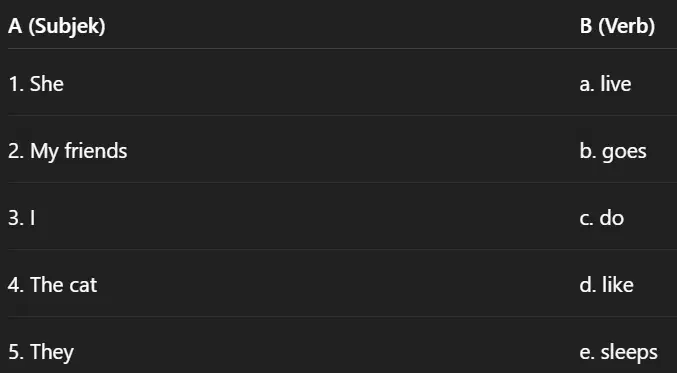
Instruksi: Cocokkan subjek di Kolom A dengan kata kerja yang tepat di Kolom B.
1=B 2=C 3=A 4=E 5=D
1=B 2=A 3=C 4=E 5=D
1=B 2=A 3=C 4=D 5=E
1=A 2=B 3=C 4=E 5=D
Petunjuk: Benda apa yang dimaksud?
“I am in the kitchen. People use me every morning. I make loud sounds and give you energy. What am I?”

Refrigerator
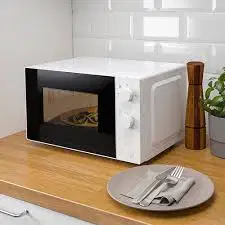
Microwave

Blender

Coffee maker
Susunlah kalimat berikut menjadi kalimat benar :
[breakfast] – [always] – [I] – [eat] – [morning] – [in] – [the]
in the morning i always eat breakfast
I eat always breakfast in the morning
I breakfast always eat in the morning
I always eat breakfast in the morning
Who Am I?
Clue:
I don’t eat meat.
I usually eat vegetables and fruits.
I never go to fast food restaurants.
I am a...
Chef
Vegetarian
waiter
farmer
Pilih kalimat yang pola atau artinya tidak sesuai dengan yang lain:
I play football every Sunday.
He watches TV at night.
She is eating lunch now.
We go to school by bus.
Deskripsi:
I don’t talk, but I tell stories.
People read me in their free time.
I have pages and words.
What am I?

A Book

A Phone
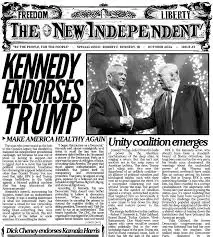
A Newspaper

A blog
My father usually (a) me to school.

