
 Worksheets
Lab Review 2
Total questions: 128
Worksheet time: 2hrs 14mins
What are the inputs (what goes in) of cellular respiration?
amino acids
carbon dioxide and water
glucose (sugar) and oxygen
adenosine triphosphate
What are the products (what is made) of cellular respiration?
Carbon dioxide, water, and ATP energy
Water, glucose, and ATP energy
Carbon dioxide, glucose, and ATP energy
Oxygen, glucose, and ATP energy
Which organelle is responsible for cellular respiration?
nucleus
mitochondria
chloroplast
endoplasmic reticulum
What is the main purpose of cellular respiration?
To break down glucose molecules
To release carbon dioxide
To produce energy for the cell
What is the energy currency of cells produced during cellular respiration?
ATP
NADH
GTP
ADP
What is photosynthesis?
The process by which green plants and some other organisms use sunlight to synthesize water with the help of chlorophyll pigment, carbon dioxide, and oxygen.
The process by which green plants and some other organisms use sunlight to synthesize oxygen with the help of chlorophyll pigment, carbon dioxide, and water.
The process by which green plants and some other organisms use moonlight to synthesize foods with the help of chlorophyll pigment, carbon dioxide, and water.
The process by which green plants and some other organisms use sunlight to synthesize foods with the help of chlorophyll pigment, carbon dioxide, and water.
What are the two main reactants required for photosynthesis?
oxygen and sunlight
glucose and chlorophyll
nitrogen and carbon dioxide
carbon dioxide and water
Which pigment is responsible for capturing sunlight in photosynthesis?
melanin
hemoglobin
carotene
chlorophyll
What is the role of chlorophyll in photosynthesis?
Chlorophyll provides structural support to plants.
Chlorophyll absorbs carbon dioxide and releases oxygen.
Chlorophyll captures light energy and converts it into chemical energy.
Chlorophyll helps in the process of cell division.
Cofactors involved in the electron transport chain
NADH2, FADH
NADH, FADH
H, O2
NADH, FADH2
What macromolecule is the enzyme ATP synthase?
protein
carbohydrate
lipid
nucleic acid
Cells can generate as many as 36 to 38 molecule of a ATP from the metabolism of one molecule of glucose. Which cellular process results in this amount of ATP production?
Anaerobic cellular respiration
protein synthesis
aerobic cellular respiration
photosynthesis
Which of these statements best explains the process of energy conversion that takes place in the mitochondria?
Energy is required for carbon dioxide molecules to form six-carbon sugar molecules.
water molecules and radiant energy are necessary for anaerobic respiration to take place
oxygen molecules release energy in the form of heat during combustion reactions
The energy in the bonds of glucose molecules is transferred to the phosphate bonds in ATP.
Cellular respiration involves an energy conversion. Which of the following represents the energy conversion that occurs during cellular respiration ?
Light energy to chemical energy
light energy to light energy
chemical energy to light energy
chemical energy to chemical energy

A sprig of an Elodea plant was placed in a test tube and placed under a light source for several hours. After several hours, small bubbles appeared.
Which product is an example of the gas bubbles in the above reaction?
carbon dioxide
hydrogen
nitrogen
oxygen
The physical separation of mixtures of liquid components into individual components is..
chromatography
opacity
latent
trace evidence
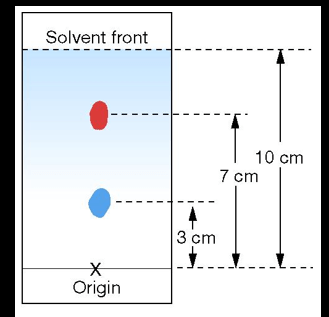

In paper chromatography the paper is the _________ phase.
stationary
mobile
solubility
migratory
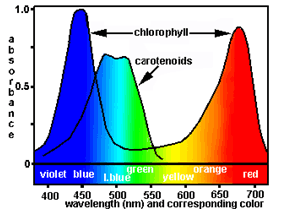
________________ are red, orange, or yellow fat-soluble pigments found in all chloroplasts.
carotenoids
chlorophyll a
chlorophyll b
chlorophyll c
Rf values are important because
are variable for a molecule in a given solvent.
are unique for a molecule in a given solvent.
What technique are you going to use to extract pigments from the spinach and transfer them to the chromatography paper?
ethanol extraction
boiling spinach leaves in water
rubbing over the spinach leaf with a coin
gel electrophoresis
Which of the following equations represents the overall chemical reaction for photosynthesis?
6O2+ 6H2O → C6H12O6+ 6O2
C6H12O6 + 6H2O→ 6O2+ 6O2
6CO2+ 6H2O→ C6H12O6+ 6O2
6O2 + 6H2O→ C6H12O6 + 6CO2

Protein Synthesis, Photosynthesis, and other Biosynthetic pathways.
Anabolic Pathways
Catabolic Pathways
The breakdown of glucose molecules to release energy.
Anabolic Pathways
Catabolic Pathways
Independent Assortment and Crossing Over do what for the genetic variation of a species?
increase the variation
decrease the variation
have no effect on the variation
If a normal somatic cell has 40 chromosomes, how many would you expect to see after Mitosis?
40
80
20
0

The 4 haploid cells are made during-
mitosis I
meiosis I
mitosis II
meiosis II
When does crossing over occuring during meiosis?
Prophase I
Prophase II
Metaphase I
Metaphase II


Which row indicates the correct process for each event indicated
1
2
3
4
Down syndrome is a genetic disorder caused by the presence of an extra chromosome in the body cells of humans. This extra chromosome occurs in a gamete as a result of:
an error in the process of cloning
an error in meiotic cell division
a gene mutation
replication of a single chromosome during mitosis

One difference between cell division in plant cells and animal cells (zoom in the picture)
centrioles form in plant cells but not in animal cells
plants form a cell plate between daughter cells but animal do not
a double nucleus forms in the animal cell but not in the plant cell
more cytoplasm form in the animal cells than in plant cells

Which part of the structure is represented by arrow 2:
centriole
centrosome
centromere
chromatid

Which part of the structure is represented by arrow 4:
chromatid
chromosome
autosome
allele
Which of the following distinguishes prophase 1 of meiosis from prophase of mitosis?
homologous chromosomes
pair up
spindle forms
nuclear membrane breaks down
chromosomes become visible

Which of the following phases is the cell labeled “4” above currently in?
interphase
prophase
metaphase
anaphase
telophase

which of the following phases is the cell marked 5 currently in?
prophase
anaphase
telophase
metaphase
cytokinesis
Place the images in the correct order showing how a cell progresses through mitosis...


place the steps of the cell cycle in order in the table.
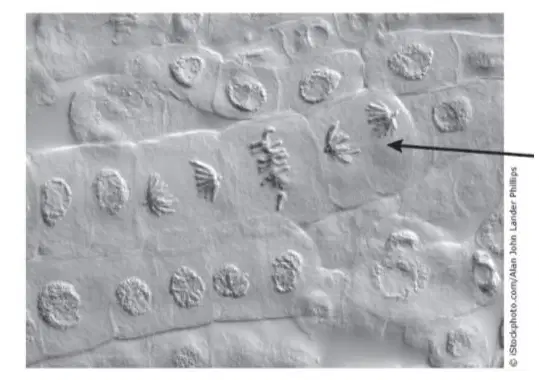
A photomicrograph of onion root tip cells is shown.
Which phase of mitosis is occurring in the cell indicated by the arrow?
Prophase
Metaphase
Anaphase
Telophase

Oncogenes are mutated forms of genes. Oncogenes can transform a cell into a tumor cell. Some tumor cells are benign, while others are malignant. How does the presence of an oncogene lead to the formation of a tumor?
ATP Production is inhibited.
Cell division is unregulated.
Somatic cell growth is inhibited.
Antibody Activity is unregulated.

Select all of the following that are blood types
A
B
AC
AB
O
What are the two possible Genotypes for a person who has blood type A
IA IA
IB IB
IA iO
A

A father has type O blood, the mother has type AB blood. What percent of their offspring will have type O blood?
100%
25%
50%
0%
A mother is heterozygous for type B blood. What is her genotype?
IB IB
IA iO
IB iO
IA IB
A woman inherited IB from one parent and io from the other. She is (a) for Type (b) blood.


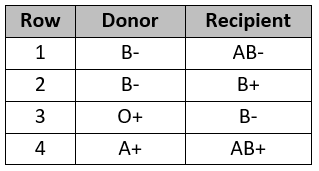
Row 1
Row 2
Row 3
Row 4

Which sample is O+


The trait this pedigree traces is recessive because it skips a generation and individuals can be carriers. What is the most likely genotype for person III-3?
GG
Gg
gg

If this pedigree shows a recessive disorder, what MUST the genotype of individual 4 be?
HH
Hh
hh


DNA is needed in living things to:
Code for proteins
Direct all cell activities
Pass on genes to offspring
All the above
What is transformation?
The use of viruses to transform or genetically
engineer cells.
The measure of how well cells are transformed in a new phenotype.
The insertion of a foreign plasmid into a bacterial cell which results in new acquired traits.
Genetic engineering or transformation of mammalian cells.
Bacterial media containing ampicillin is inoculated with the E coli bacteria that contains ampicillin resistant gene. The bacteria will;
Grow on the agar plate
Will not grow on the agar plate.
will only grow after the plate has been incubated at 45C
will only grow after the plate has been placed on ice.

Bacterial DNA that is often circular or in the shape of a ring is called a:
Clone
Plasmid
Fragment
Recombinant DNA

What was added to the PCR tube in the correct sequence?
extracted DNA, primer 1, primer 2, nucleotides, DNA polymerase
primer 1, primer 2, extracted DNA, nucleotides, DNA polymerase
DNA polymerase, nucleotides, primer 1, primer 2, extracted DNA
nucleotides, DNA polymerase, extracted DNA, primer 1, primer 2

What is competency for a cell?
The insertion of a formed plasmid into the cell.
The chemical process of switching the gene.
Super coiled molecules formed in the plasmid of the cell.
Change in the structure and permeability of the cell membrane.
Cells are made competent by;
The incubation of the bacteria at 95C
A process that uses calcium chloride.
A process that uses GFP
A process that uses polymerases
Heat shock
Trap the plasmids inside the cell.
Enlarges the pores of the cell.
Provides for the death of the cell.
Increases the disintegration of the cell wall.
LB containing ampicillin (2nd plate) is inoculated with the E. coli bacteria that contains ampicillin resistant gene. The bacteria will;
Grow on the agar plate
Will not grow on the agar plate.
will only grow after the plate has been incubated at 45C
will only grow after the plate has been placed in a warm water bath for 2 minutes.

Observe the results above. What gene is present in the engineered plasmid?
kanamycin resistant gene
ampicillin resistant gene
tetracycline resistant gene
No plasmid is necessary to grow on plate 3.

Which of the following is the best explanation for the fragment pattern for individual X ?
She has only one member of this chromosome pair.
She has only one living parent.
She is homozygous for this particular DNA fragment.
She is the mother’s child but has a different father than the other children.

In a transformation experiment, a sample of E. coli bacteria was mixed with a plasmid containing the gene for resistance to the antibiotic ampicillin (ampr). Plasmid was not added to a second sample. Samples were plated on nutrient agar plates, some of which were supplemented with the antibiotic ampicillin. The shaded area represents extensive growth of bacteria; dots represent individual colonies of bacteria.
Plates that have only ampicillin-resistant bacteria growing include which of the following?
I only
III only
IV only
I and III

Which of the following best explains why there is no growth on plate II?
The initial E. coli culture was not ampicillin-resistant.
The transformation procedure killed the bacteria.
Nutrient agar inhibits E. coli growth.
The bacteria on the plate were transformed.

Which of the following statements best explains why there are fewer colonies on plate IV than on plate III?
Plate IV is the positive control.
Not all E. coli cells are successfully transformed.
The bacteria on plate III did not mutate.
The plasmid inhibits E. coli growth.

What is the purpose of PCR?
To produce millions of copies of the DNA genome
To produce millions of copies of a specific region of DNA
To add nucleotides to a DNA sequence
To watch polymerase work.

What does PCR stand for?
Polymerase Cytoplasmic Reaction
Polymerase Chromosomal Reaction
Polymerase Chain Reaction
Probably Cannot React

What happens in the denature step of PCR?
The DNA nucleotides are broken apart.
The base-pairing rules for DNA are reversed.
The double-stranded DNA is separated into two single strands of DNA.
The DNA is returned to its natural setting.

At what temperature does the denature step of PCR occur?
94-96° C
50-65° C
72° C
Any temperature

At what temperature does the anneal step of PCR occur?
94-96° C
40-60° C
72° C
Any temperature

At what temperature does the extension step of PCR occur?
94-96°C
50-65°C
72°C
Any temperature

Which is NOT as use of PCR?
Cloning
Paternity Testing
Genotyping
DNA Profiling
Protein synthesis
What is the purpose of x-tract buffer in PCR (Polymerase Chain Reaction) procedure?
To amplify DNA fragments
To increase the specificity of DNA amplification
To facilitate denaturation of DNA
Help extract DNA from cheek cells
What is the purpose of the Heat Block step at 10 minutes @ 95 degrees Celsius in PCR (Polymerase Chain Reaction) procedure?
To cool down the reaction mixture before the next step
break open cells - release DNA into solution
To activate the DNA polymerase enzyme
To denature the DNA into single strands
What is the function of Taq DNA Polymerase in the PCR (Polymerase Chain Reaction) procedure?
Initiates the PCR reaction by denaturing the DNA template
Adds primers to the DNA template for replication
Facilitates the annealing of primers to the DNA template
Catalyzes building complimentary strand during DNA synthesis (+ has a high heat capacity)
What is the function of PCR Buffer with Mg(^2) in the PCR (Polymerase Chain Reaction) procedure?
Enhances enzyme activity and optimizes stability of primer template
Maintains the optimal pH for enzyme activity
Provides the necessary nucleotides for DNA synthesis
Facilitates the annealing of primers to the DNA template
What is the function of Gel loading dye in the PCR Master Mix?
Provides additional charge to DNA molecules for better separation
Stains the DNA to be seen for gel electrophoresis
Adjusts the pH of the gel matrix
Cuts the DNA to make bands
What is the function of PTC Primer Mix in PCR (Polymerase Chain Reaction) procedure?
Increases the specificity of RNA amplification
Facilitates denaturation of DNA strands
Enhances the stability of the DNA template
Contains complementary sequences to the target region for amplification
What is the function of denaturation in PCR (Polymerase Chain Reaction) procedure
Breaks hydrogen bonds to form single-stranded genes
Increases the stability of the DNA template
Facilitates the annealing of primers to the DNA template
Finishes the PCR reaction by bonding with the DNA template
What is the function of annealing in PCR (Polymerase Chain Reaction) procedure?
Increases the temperature to denature the DNA template
Promotes the elongation of the DNA strand
Decreases temperature so primers attach to the template
Facilitates the binding of DNA polymerase to the template strand
What is the purpose of conducting 30 cycles in the PCR (Polymerase Chain Reaction) procedure?
To ensure complete denaturation of the DNA template
To optimize the binding of primers to the DNA template
To amplify the DNA to billions of copies
To stabilize the DNA strands for subsequent analysis
Match the following:
Temperature of Denaturing
95° C
Temperature of Annealing
55° C
Temperature of Extension
72° C
Label the components of a PCR reaction
Helicase
Primase
dNTPs
MgCl2
Buffer
Target sequence
Primers
Thermocycler
Taq polymerase
Human DNA polymerase
Plasmid makes bacteria resistant to ampicillin and able to synthesize the green glow protein. Which plate will have highest percent of growth?
Plate with nutrients and no ampicillin present
Plate with ampicillin and nutrient present
In fruit flies, eye color is a sex linked trait. Red (R) is dominant to white (r). What is the sex and eye color of flies with the following genotype: X R X r ?
male with white eyes
female with red eyes
male with red eyes
female with white eyes
In fruit flies, eye color is a sex linked trait. Red (R) is dominant to white (r). What is the sex and eye color of flies with the following genotype: X R Y ?
male with white eyes
female with white eyes
male with red eyes
female with red eyes
In fruit flies, eye color is a sex linked trait. Red is dominant to white. What is the sex and eye color of flies with the following genotype: X R X R ?
male with red eyes
female with red eyes
male with white eyes
female with white eyes
Discuss the importance of using a DNA ladder in gel electrophoresis.
It helps in staining the DNA
It provides a reference for estimating the size of DNA fragments
It speeds up the electrophoresis process
It prevents DNA degradation
What is the role of Chelex in isolating DNA?

Which restriction enzymes from above make blunt cuts? (2)
Alul
HaeIII
BamHI
HindIII
EcoRI
Label the correct steps of the LYTIC CYCLE.
Label the Virus with the correct parts.
What is the purpose of labeling microcentrifuge tubes with "0.1", "0.01", and "0.001" in the experiment described?
To indicate the volume of PBS added
To indicate the dilution factor of the samples you are preparing
To indicate the concentration of the patient sample
To indicate the temperature at which the experiment should be conducted
What is the main objective of performing a viral plaque assay in Module I?
To determine the pH level of the sample
To measure the size of bacteria
To quantify the amount of virus in a sample
To test the effectiveness of antibiotics


