
 Worksheets
Chapter 7 Part 1 Plants Test
Total questions: 23
Worksheet time: 12mins
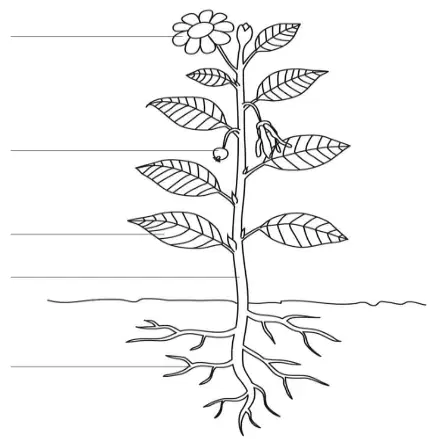
Use the word bank to label the diagram below. Write each word from the word bank in the blanks on the left side of the picture.
Top to bottom: flower, leaf, stem, seed, root
Top to bottom: leaf, flower, root, stem, seed
Top to bottom: root, stem, leaf, flower, seed
Top to bottom: seed, root, stem, leaf, flower
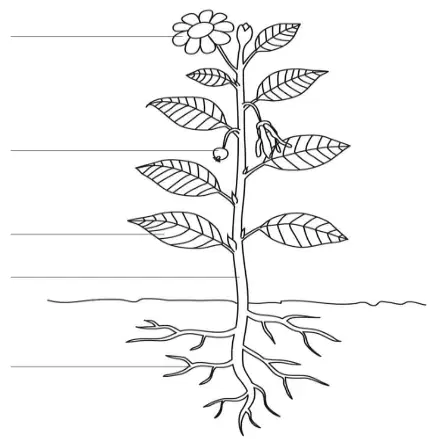
Choose the part of the plant that makes sugar (food) for the plant.
Root
Stem
Leaf
Flower
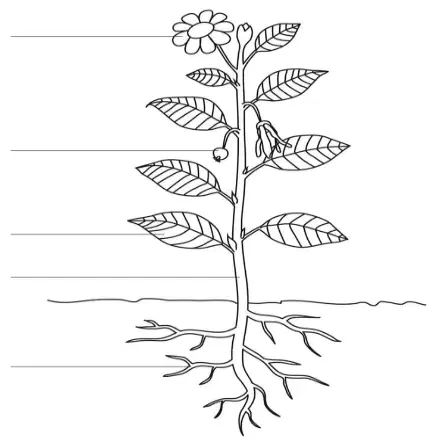
Choose the part of the plant that absorbs water and nutrients for the plant.
Root
Stem
Leaf
Flower
Sometimes plants have external parts that help protect the plant. Which of the choices below would protect the plant.
Leaf
Spine
Bark
Flower
Thorn
Which part of the plant attracts animals so that the animal will eat it and spread the seeds?
Flower
Fruit
Stem
Leaves
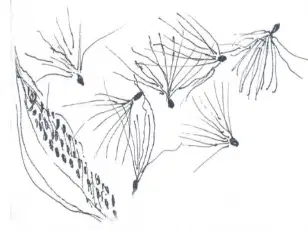
Milkweed is a plant that grows in fields. Milkweed has large seed pods. The pods have a lot of small brown seeds. The picture below shows milkweed seeds coming out of their pod. Each seed is attached to some fuzzy white material. This material is very light. It helps the seed travel in the wind. What is the function of milkweed seeds?
to protect plants from insects and birds
to grow into new plants that may be far away
to attract bees so that the plant can reproduce
to catch food that is moving through the air.
Many types of trees grow a thick layer of bark. This bark helps trees to live in a number of different ways. Which of these is a way that bark helps trees to live?
It catches light from the Sun.
It protects trees from animals that want to eat them.
It makes loud noises to scare away birds.
Plants have internal tubes inside the stem and leaves. These tubes help the plant survive. What do the tubes move inside the plant?
A. Water
B. Food (sugar)
C. sunlight
D. soil
Mrs. Smith’s class did an experiment with celery. First they added red food coloring to the water. Then, they put a cut piece of celery in a cup with red water. After 2 days the tops of some of the leaves turned red. What could the students in this class conclude based on this experiment?
Leaves turn red before a plant dies.
The celery stalk had internal tubes that moved the red coloring to the leaves.
The external parts of the celery make it tough to chew and keep predators from eating it.
The leaves helped make food for the celery through a process called photosynthesis.
What is the function of this flower?
To attract pollinators.
To have seeds spread long distances
To make food for the plant for survival
To bring water and nutrients to the plant from the soil
The arrow in the picture points to the plant part whose main function is to (a) .
transport water and minerals from the leaves and stem.
make food.
drain extra water from the leaves.
take water and minerals from the soil.
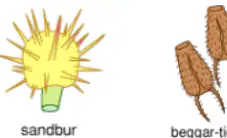
These seeds have special adaptations that help with seed dispersal. How are these seeds most likely spread?
wind
water
animals
fire
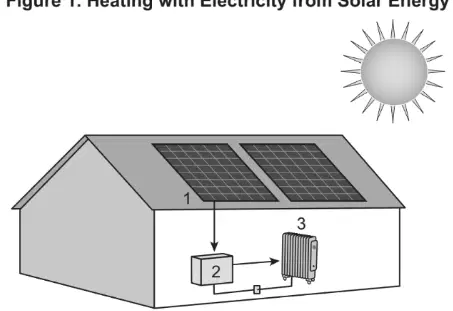
Which energy conversion happens in Step 1?
Solar energy is converted to light energy.
Heat energy is converted to solar energy.
Electrical energy is converted to heat energy.
Solar energy is converted to electrical energy.
Jon measured the air temperature around a rock before and after he struck it many times with the steel rod. The temperature before striking was 18°C, and the temperature after striking was 19°C. Which statement best explains why the temperature of the air increased?
Light energy from the Sun reflected off the steel rod.
Heat energy transferred to the surrounding air when the objects collided.
Motion energy stored in the rock was released into the air when the rock was hit.
Heat energy stored in the steel rod was released into the air after the rod hit the rock.
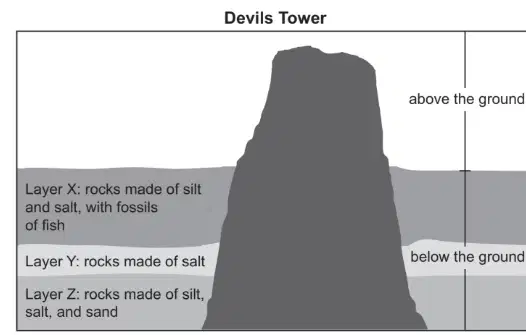
Devils Tower is a landform in Wyoming that was buried underground for millions of years. About 5 million years ago, several processes occurred that resulted in Devils Tower being partly below the ground and partly above the ground, as shown in the figure. Which statement best explains one of the layers of rock around the landform?
Layer Y was once lava.
Layer Z was once an ocean.
Layer X is the oldest layer.
Layer X was once under the ocean.
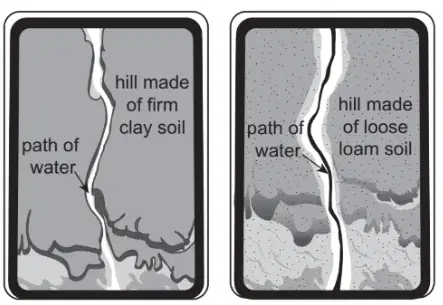
A teacher models how rainfall causes erosion on hillsides. She places two plastic containers on a table. She builds a hill made of firm clay soil in one container. She then builds a hill made of loose loam soil in the other container. She pours water onto the top of each model hill. The setup is shown in the diagram.
Loose soil erodes faster because it absorbs more water.
Firm soil erodes more slowly because water flows into the soil more slowly.
Loose soil erodes faster because soil particles float on the surface of the water.
Firm soil erodes more slowly because it is difficult for water to break soil particles apart.
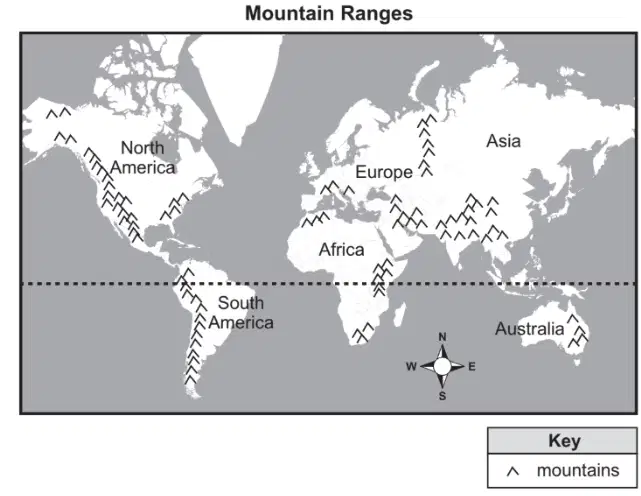
The locations of mountain ranges are shown on the map. Which pattern describes the locations of the mountain ranges shown on the map?
Most mountain ranges are found along ocean and continent boundaries.
Most mountain ranges are found on islands.
Most mountain ranges are found where two oceans meet.
Most mountain ranges are found near the equator.
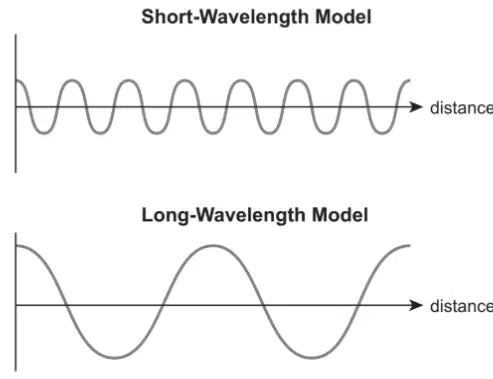
Which statement best describes the relationship between the two waves in the models?
The amplitude of the long-wavelength wave is the same as the amplitude of the short-wavelength wave.
The amplitude of the long-wavelength wave is higher than the amplitude of the short-wavelength wave.
The amplitude of the long-wavelength wave is lower than the amplitude of the short-wavelength wave.
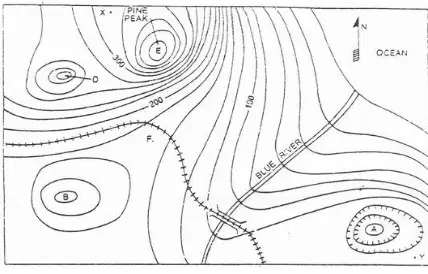
In which direction is the Blue River flowing?
Northwest
Southwest
Northeast
Southeast
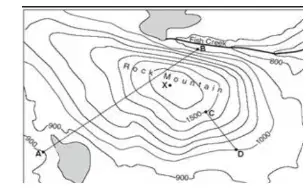
What do the shaded sections on this topographic map represent?
Burned forest area
Water (lakes)
Deep valleys
Cities
Mandy bought a bag of yellow apples. Why do the apples appear to be yellow?
Yellow light is being refracted by the apples, and all other colors are reflected.
Yellow light is being absorbed by the apples, and all after colors are refracted.
Yellow light is being reflected by the apples, and all other colors are absorbed.
The apples are not yellow, it is an optical illusion. The apples are red.
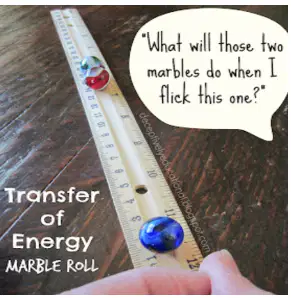
A student is about to thump the marble closest to his fingers. What will most likely happen to the 3 marbles?
The marble he thumps will stop when it hits the other 2 marbles and the other 2 marbles will remain in place.
The marble he thumps will transfer some of its energy to the other two marbles, and all 3 marbles will roll.
All of the marbles will roll back to him because the two marbles are stationary.
The marble he thumps will bounce backwards and the other marbles will remain stationery.
Amy was getting dressed for school but she could not decide whether to wear her white shirt or the black one. She checked the weather forecast and found out it would be 9 degrees during her soccer practice. Which shirt should Amy wear?
She should wear her white shirt because it will absorb more heat and keep her warm.
She should wear her black shirt because it will absorb more heat and keep her warm.
She should wear her white shirt because it will reflect more heat and she will be cooler.
She should wear her black shirt because it will reflect more heat and she will be cooler.

