
 Worksheets
Quiz on Landmark Supreme Court Cases
Total questions: 16
Worksheet time: 8mins
What was the main issue addressed in the Brown vs. Board of Education case?
Taxation without representation
Segregation in public schools
Women's suffrage
Labor union rights
What does the term "de facto" mean as used in the context of segregation?
By law
In practice
By choice
In theory
Which organization sponsored the cases that reached the Supreme Court, including Brown vs. Board of Education?
United Nations
National Association for the Advancement of Colored People (N.A.A.C.P.)
American Civil Liberties Union
World Health Organization
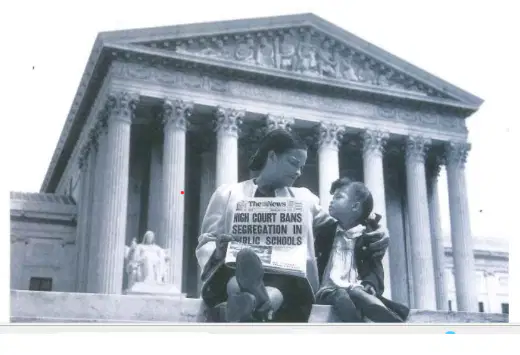
What was the significance of the Supreme Court ruling in Plessy vs. Ferguson?
It legalized "separate but equal" facilities
It abolished slavery
It granted women the right to vote
It established the income tax
What was Thurgood Marshall's father's role during the Civil War?
He was a general in the Union Army.
He joined the Union Army and took the name of a freed man.
He was a Confederate soldier.
He was a politician advocating for the South.
What was Thurgood Marshall's reputation as a young boy?
A boy who was always trusted.
A boy who was known for his kindness.
A boy who couldn't be trusted to get along with white folks.
A boy who excelled in academics.
Where did Thurgood Marshall decide to study law?
Harvard University
Lincoln University
Howard University Law School
Yale University
What did Thurgood Marshall do after graduation?
He became a teacher.
He worked as a doctor.
He began to do some work for the N.A.A.C.P.
He joined the military.
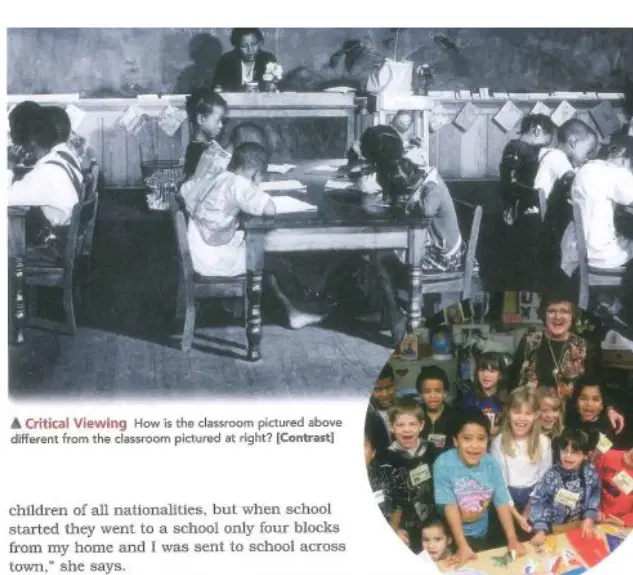
The classroom pictured above is different from the classroom pictured at right because:
It has more students.
It has different furniture.
It is outdoors while the other is indoors.
It is decorated for a holiday.
Who was the chief counsel of the N.A.A.C.P. in 1940?
Dr. Kenneth B. Clark
Earl Warren
Thurgood Marshall
Brooks Hays
What was argued in the Brown vs. Board of Education case?
Segregation was beneficial for education
Segregation violated the Fourteenth Amendment
Segregation was a state right
Segregation improved school quality
What did Dr. Kenneth B. Clark's studies show about African-American children?
They felt superior to white children
They felt equal to white children
They felt inferior to white children
They were unaffected by segregation
What did the Supreme Court state in its ruling on May 17, 1954?
Segregation was constitutional
Segregation was a state issue
Segregation deprived African-Americans of equal opportunities
Segregation was beneficial for society
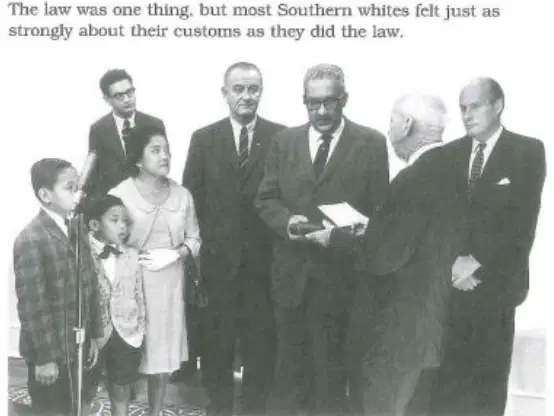
Who was appointed as an associate justice of the U.S. Supreme Court in 1967?
Lewis H. Latimer
Meta Vaux Warrick
Thurgood Marshall
Kenneth B. Clark
What was the major struggle mentioned in the context of achieving equality?
Legal battles
Economic disparity
Hearts and minds of people
Political campaigns
What did Linda Brown realize as she grew older about the case her father was involved in?
It was a minor legal issue
It changed the complexion of the history of the country
It was not significant
It was only important locally

