

Wayground logo

Free Printable Worksheets

Font size

S
M
L
XL
Worksheets

Star and Big Bang Review

Total questions: 45

Worksheet time: 24mins
Name
Class
Date
1.
What is Hubble's Law and how does it relate to the expansion of the universe?
a)
Hubble's Law states that galaxies are moving towards us, indicating a universe that is getting smaller
b)
Hubble's Law states that galaxies are moving away from us, indicating a universe that is expanding
c)
Hubble's Law states that galaxies are stationary, indicating a static universe
d)
Hubble's Law states that galaxies are moving in random directions, indicating a chaotic universe
2.
The most commonly held theory of the origin of the universe claims that it formed as the result of a violent event that rapidly sent all matter in existence flying outward from a single point. This theory is supported by which of the following observations?
a)
All of the galaxies in the universe appear to be moving away from one another.
b)
All of the objects in the universe are approximately the same age.
c)
The temperature in all parts of the universe is relatively consistent.
d)
All elements are evenly distributed in all parts of the universe.
3.
Which of the following observations about hydrogen and helium provides the best evidence to support the big bang theory?
a)
The composition of gases in stars and in the universe is ¾ hydrogen and ¼ helium.
b)
Within the cores of stars, atoms of hydrogen are fused into atoms of helium.
c)
Hydrogen and helium are only found in the form of a gas in the universe.
d)
One atom of helium has twice the atomic mass of one atom of hydrogen.
4.
Cosmic microwave background radiation is the term used for the microwave radiation observed everywhere in the universe. The existence of this radiation is used as evidence to support the big bang theory because, in our current understanding, this radiation is–
a)
energy left over from the rapid expansion of matter.
b)
the result of high speed collisions of atoms.
c)
an indication that the universe is getting hotter.
d)
proof that the size of the universe is decreasing.
5.
What is the best description of the big bang?
a)
A massive explosion that created everything in the universe
b)
Two planets collided, creating the Sun and other planets.
c)
A rapid expansion of a densely packed, small area that expanded into the universe that we know today
d)
An explanation of how the universe is expanding and how big it is
6.
What does it mean if a galaxy gives off light that has been shifted toward the red end of the electromagnetic spectrum?
a)
The galaxy is moving away from Earth.
b)
The galaxy is much older than Earth.
c)
The galaxy is very hot and has not cooled down.
d)
The remnants of an explosion are between the galaxy and Earth.
7.
What is one piece of evidence that supports the big bang theory?
a)
The universe is cooling down
b)
The rotation and revolution of the Earth
c)
That the universe formed over 13 billion years ago
d)
A weak signal of cosmic microwave background radiation
8.
The temperature of the universe is....
a)
gradually decreasing
b)
gradually increasing
c)
rapidly increasing
d)
rapidly decreasing
e)
constant throughout the known history of the universe
9.
Which of the following is true about galaxies?
a)
Galaxies are moving away from each other
b)
Galaxies are moving toward each other
c)
Galaxies never move relative to each other
d)
Galaxies move in a random pattern
10.
When an object in the sky is "red-shifted" its wavelength is ______________ and its frequency is ___________
a)
increased, decreased
b)
increased, constant
c)
increased, increased
d)
deceased, decreased
11.
When an object in the sky is "blue-shifted" its wavelength is ______________ and its frequency is ___________
a)
decreased, increased
b)
increased, decreased
c)
increased, increased
d)
decreased, constant
12.

What does the cosmic microwave background radiation tell us about the early universe?

a)

It was composed mostly of dark matter

b)

It was filled with heavy elements

c)

It was hot and dense

d)

It was extremely cold and static

13.

How does the abundance of light elements like hydrogen and helium support the big bang theory?

a)

They are constantly being created in supernovae

b)

Their proportions match predictions from the big bang nucleosynthesis

c)

They are evenly distributed throughout the universe

d)

They are only found in the cores of stars
14.

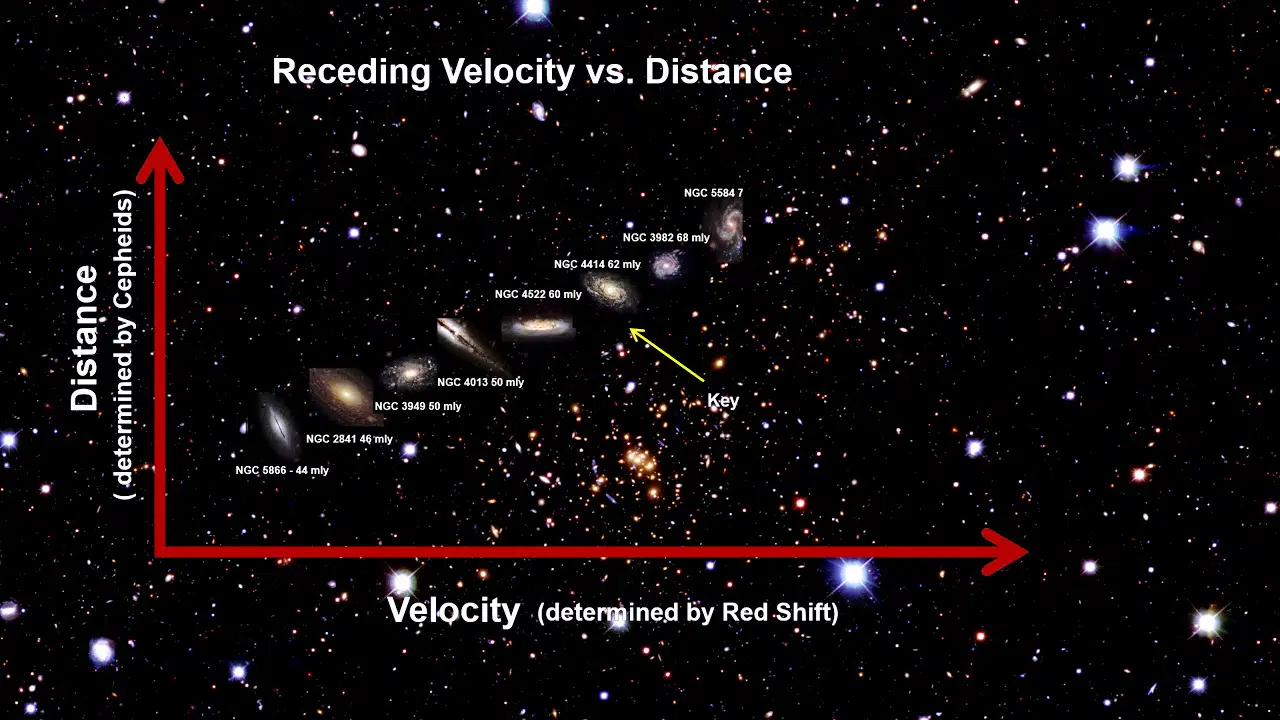
According to Hubble's Law...

a)

Most galaxies are moving towards the Earth

b)

Galaxies further away from the Earth are moving away at a faster rate

c)

Galaxies are blueshifted

d)

Only galaxies close to the Earth are redshifted

15.

The CMB (Cosmic Background Radiation) is:

a)

the remaining energy from the big bang.

b)

incredibly cool.

c)

a cloud of light

d)

only located in certain places in the universe.

16.
Most of the stars in the universe are...
a)
Main sequence stars
b)
White dwarfs
c)
Blue giants
d)
Red supergiants
e)
Red giants
17.
What factor(s) affect the color of the star
a)
Temperature
b)
Size
c)
Luminosity
d)
Magnitude
18.
Which type of star has a low temperature but a high luminosity?
a)
Red supergiants
b)
White giant
c)
Blue giant
d)
Main sequence
e)
Red giants
19.
Describe the process that leads to the formation of a black hole.
a)
A star expands and cools to from a black hole
b)
A massive star collapses under its own gravity after a supernove
c)
A star loses it's outer layers and becomes a black hole
d)
A neutron star gains mass and becomes a black hole
20.
What star type has the highest density and the smallest size?
a)
Red giant
b)
White dwarf
c)
Neutron star
d)
Yellow dwarf
e)
Blue supergiant
21.
What state of matter makes up most of the sun?
a)
Solid
b)
Liquid
c)
Gas
d)
Plasma
22.
What state of matter makes up most of the sun?
a)
Solid
b)
Liquid
c)
Gas
d)
Plasma
23.
What is the sun's current classification in terms of its life cycle?
a)
Yellow Dwarf
b)
Red Giant
c)
White Dwarf
d)
Blue Giant
24.
After its current state, our sun will transition into a __________
a)
red giant star
b)
yellow dwarf star
c)
black hole
d)
blue giant star
e)
white dwarf star
25.
What process in the sun creates Helium from Hydrogen?
a)
Nuclear Decay
b)
Nuclear Fusion
c)
Nuclear Explosions
d)
Nuclear Fission
26.
The energy from the sun that reaches Earth is the result of which of the following processes, repeated many times in the core of the sun?
a)
The nuclei of two atoms are combined to form a single atom with a larger nucleus.
b)
Molecules are rearranged to form new substances with new properties.
c)
Compounds are broken down into smaller, less complex substances.
d)
An atomic nucleus spontaneously splits into two separate atoms with less mass.
27.
Scientist have predicted the length of the life span of the Sun. It is already halfway through the life cycle. How much longer do they think the Sun will continue to burn?
a)
10 billion years
b)
5 billion years
c)
5 million years
d)
10 million years
28.
How long does it take light from the closest star to reach Earth?
a)
8 minutes
b)
3 hours
c)
149 minutes
d)
4.2 years
29.
Complete the following Rock layers : Earth ::_____ : the Sun
a)
Light layers
b)
Force of gravity
c)
Temperature layers
d)
Gas layers
30.
What process produces the light and heat of the Sun?
a)
nuclear fusion reactions, in which hydrogen is changed into helium
b)
nuclear fusion reactions, in which hydrogen is destroyed
c)
nuclear fission reactions, in which nitrogen is changed into oxygen
d)
nuclear fission reactions, in which helium is changed into hydrogen
31.
A star's life cycle is determined by its _____________
a)
initial mass
b)
radiation
c)
convection zone
d)
gravity field
32.
The sun's atmosphere contains which of the two following components?
a)
Corona
b)
Photosphere
c)
Nucleus
d)
Core
e)
Stratosphere
33.
70% of the sun is ____________, 28% of the sun is __________
a)
Hydrogen, Helium
b)
Helium, Hydrogn
c)
Nitrogen, Oxygen
d)
Hydrogen, Water
e)
Helium, Carbon
34.
Solar flares may be used to predict which of the following?
a)
A decrease in the production of helium in the sun’s core
b)
A rapid and dramatic change in the overall mass of the sun
c)
The depletion of all of the sun’s fuel in the near future
d)
An increase in radiation from the sun reaching the earth
35.
Which of the following best describes the transfer of energy from the sun to Earth?
a)
Electromagnetic waves travel in the absence of a medium.
b)
Light energy is redirected by passing through denser matter.
c)
Differences in density result in the movement of a fluid.
d)
Matter carries heat energy from one location to another.
36.
What is "solar wind"
a)
Wind created by the sun's atmosphere
b)
Stream of charged particles from the sun's upper atmosphere
c)
Gamma waves released from the sun's core
d)
Visible light reflected off light in the solar system
37.
Approximately how old is the sun
a)
4.5 billion years old
b)
2 billion years old
c)
3.5 billion years old
d)
5.2 billion years old
e)
6.5 billion years old
38.

What is the primary factor that determines the color of a star?

a)

Its size

b)

Its distance from Earth

c)

Its temperature

d)

Its age

39.

Which layer of the sun is visible during a solar eclipse?

a)

The core

b)

The photosphere

c)

The corona

d)

The chromosphere

40.

What is the primary source of the sun's magnetic field?

a)

The sun's core

b)

The sun's radiation zone

c)

The sun's convection zone

d)

The sun's rotation

41.
Which star is the coldest?
a)
Yellow Star
b)
Red Star
c)
Orange Star
d)
Blue Star
42.

Would the surface temperature of a red supergiant be higher or lower than a white dwarf?

a)

Higher

b)

Lower

43.

Which star has the highest temperature?

a)

A

b)

B

c)

C

d)

D

44.

According to Hubble's Law...

a)

Most galaxies are moving towards the Earth

b)

Galaxies further away from the Earth are moving away at a faster rate

c)

Galaxies are blueshifted

d)

Only galaxies close to the Earth are redshifted

45.

What is the primary evidence for the expansion of the universe?

a)

The presence of black holes.

b)

The redshift of light from distant galaxies.

c)

The blue shift of light from nearby stars.

d)

The rotation of galaxies.
