
 Worksheets
Cladograms, Classification, Domains and Kingdoms
Total questions: 25
Worksheet time: 25mins
The list below describes an organism.
- Unicellular
- Prokaryotic
- Lives in very harsh environments
- Lacks peptidoglycan
Based on this list, in which domain should the organism be classified?
Eubacteria
Protista
Archaebacteria
Animalia
The Florida panther was once considered to be a subspecies of cougars. Current scientists, however, have studied the Florida panther and removed the subspecies classification. Which of the following would explain why the classification of the Florida panther changed?
New genetic evidence suggests a much closer relationship between the Florida panther
and other cougars.
Advanced technologies have shown a large difference in cell structure between the
Florida panther and other cougars
Study of their embryos shows major differences in the development of the Florida panther
fetus when compared to other cougars
Shared physiological features between the Florida panther and other cougars were also
found in newly discovered organisms in the world

Use the figures to answer the question. Figure 1 represents the percentage similarity in
sequences of nucleotides from a homologous gene. Figure 2 represents a cladogram formed
using evolutionary evidence like the information from Figure 1.
Baboons have a percentage similar to 97.2% to human genes. Where on the cladogram would
you place the baboons?
A
B
C
D

The diagram shows the evolutionary relationship between various species.
Which species is most closely related to the sheep?
dog
bats
deer
armadillos

A student identified four organisms in a sample of pond water and was able to identify
characteristics shown in the table.
Based on the observations of the student, which organism demonstrates the characteristics
of the taxonomic group for bacteria?
Organism 1
Organism 2
Organism 3
Organism 4
A student is having a difficult time comparing and contrasting the characteristics of the
Kingdoms Fungi and Plantae. Which question below would lead the student to discovering a
difference between the two kingdoms?
Which organisms are eukaryotic?
Which organisms have a cell wall?
How does each organism obtain energy?
How does each organism store its genetic information?
Which two taxons are used for binomial nomenclature?
Genus & Species
Kingdom & Phylum
Class & Order
Family & Genus

Which organism has jaws but not legs?
Tuna
Lamprey
Salamander
Turtle
Which kingdom has organisms whose cells contain Chitin?
Fungi
Protista
Animalia
Plantae
Which kingdom contains organisms whose cells contain chloroplasts and cellulose?
Plantae
Eubacteria
Protista
Archaebacteria
Select the option with the correctly written scientific name (binomial nomenclature) for the Asian elephant.
Elephas maximus
Elephas Maximus
elephas maximus
elephas Maximus

The diagram shows some characteristics of the four eukaryotic kingdoms. Which of these is the animal kingdom?
Kingdom 1
Kingdom 2
Kingdom 3
Kingdom 4
The absence of a distinct nucleus and most other cellular organelles is characteristic of cells in which of the
following groups?
Domain Archaea only
Domain Bacteria only
Domain Eukarya only
Domains Archaea and Bacteria
The characteristics listed describe organisms found what domain?
organelles
DNA in nucleus
contains four kingdoms
autotrophs and heterotrophs
Bacteria
Fungi
Archaea
Eukarya
Which of these is one of the main reasons why viruses are not classified as living organisms?
viruses contain DNA or RNA
viruses can evolve
viruses are not made of cells
viruses are single-celled
Protista are there own kingdom because they have characteristics of
Just plants
Plants and animals
Fungi
Plants, animals or fungi
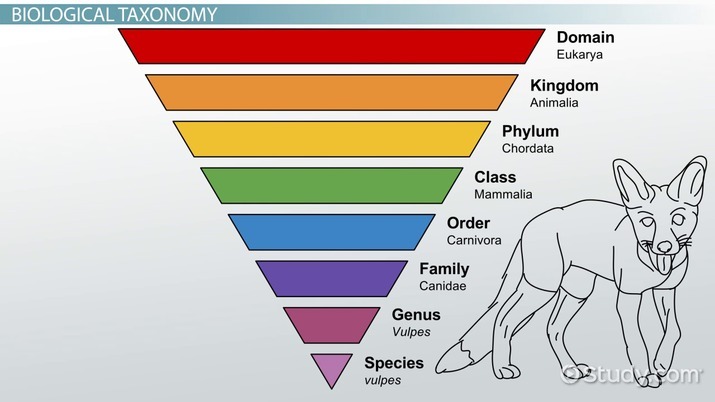
The most exclusive taxa is _____; the most inclusive taxa is _____
Domain; Species
Genus; Species
Family; Class
Species; Domain

What is the alligator and T. rex's common ancestor?
Point A
Point B
Point C
Point D

The diagram below represents possible genetic relationships between groups of organisms.
Which statement is a valid conclusion that can be drawn from the diagram?
Insects are more complex than mammals.
Earthworms and sea stars have a common ancestor.
Snails appeared on Earth before corals.
Sponges were the last new species to appear on Earth.

Which letter represents the most recent common ancestor of sponges and mushrooms?
A
B
C
D
E

Which trait should "A" represent on this cladogram?
eyes
feet
lips
hat

According to the diagram, what was the last common ancestor of organisms 2 and 3?
A
B
C
D

Using the cladogram, which two organisms are more closely related Lizards and Newts OR Lampreys and Sharks
Newts and Lizards
Lampreys and Sharks

Which trait(s) do conifers have?
vascular tissue only
vascular tissue and seeds
vascular tissue, seeds and flowers
seeds only
Select the option that lists the system of classification in order of largest (most inclusive) to smallest (most exclusive)
Domain, Kingdoms, Phyla, Class, Order, Family, Genus, Species
Kingdoms, Phyla, Class, Order, Family, Genus, Species, Domain
Species, Genus, Family, Order, Class, Phyla, Kingdom, Domain
Kingdoms, Domain, Phyla, Class, Order, Family, Species, Genus

