wayground logo

Free Printable Worksheets

Font size

S
M
L
XL
Worksheets

Thermodynamics Review

Total questions: 24

Worksheet time: 21mins

Name
Class
Date
1.
Which of the following shows an energy transformation from chemical energy to electrical to light energy?
a)
A bolt of lightning lights the night sky.
b)
A candle glows brightly in the dark.
c)
A fire in a fireplace lights up a room.
d)
A battery causes a flashlight to shine.
2.
What energy transformations take place when a battery-operated radio is in use?
a)
Electrical to chemical to light
b)
Sound to chemical to mechanical
c)
Chemical to electrical to sound
d)
Light to electrical to thermal
3.

Which of the following energy transformations takes place as someone skids to a stop across the ground?

a)

None of these

b)

Thermal Energy to Sound Energy

c)

Sound Energy to Kinetic Energy

d)

Kinetic Energy to Thermal Energy

4.

What energy transformations occur when propane gas is used to lift the balloon?

a)

Mechanical -> light -> chemical

b)

Chemical -> mechanical -> thermal

c)

Thermal -> chemical -> light

d)

Chemical -> thermal -> mechanical

5.

Match the following

a)

Electrical Energy

1.

Electrical Outlet

b)

Chemical Energy

2.

Battery

c)

Mechanical Energy

3.

Movement

d)

Thermal Energy

4.

Heat

6.
The SI unit of heat and energy is the __________.
a)
calorie
b)
heat
c)
joule
d)
watt
7.
ΔH value in an endothermic reaction is a positive number.
a)
True
b)
False
8.
What type of reaction is shown in the reaction pathway?
a)
endothermic reaction
b)
exothermic reaction
9.
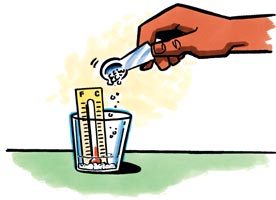
Endothermic reactions feel
a)
warm
b)
cold
10.

The enthalpy change is a negative (-) value, what side of the equation will the energy value be on.

a)

Reactants

b)

Products

11.
 _?_  is the amount of energy required to raise the temperature of 1 gram of any substance 1oC.
a)
Specific heat
b)
A calorie
c)
Thermal energy
d)
Conduction
12.
What type of reaction is shown in the reaction pathway?
a)

endothermic reaction

b)

exothermic reaction

13.

In the Image, will the heat (-890.4 KJ KJ) be a product or a reactant?

a)

Product

b)

Reactant

14.

In the Image, will the heat (+177.8 KJ) be a product or a reactant?

a)

Product

b)

Reactant

15.
Enthalpy is energy absorbed or relased during a chemical reaction as
a)
light.
b)
heat.
c)
sound.
d)
pressure.
16.
In an endothermic reaction, heat is ...
a)
taken in or absorbed
b)
given out or released 
17.

The potential energy diagram of a reaction is shown. Which statement below is correct relating to this reaction?

a)

#1 represents the enthalpy change for this exothermic reaction.

b)

#2 represents the enthalpy change for this endothermic reaction.

c)

#3 represents the enthalpy change for this endothermic reaction.

d)

#4 represents the enthalpy change for this exothermic reaction.

18.
In an endothermic reaction the system is releasing energy.
a)
True
b)
False
19.

What is the Heat of Reaction ΔH\Delta H  for this reaction?

a)

-200 KJ

b)

200 KJ

c)

400 KJ

d)

-300 KJ

20.

What type of reaction is this?

a)

Exothermic

b)

Endothermic

c)

Energy Producing

d)

No way to tell

21.
If ΔH is positive, heat would be shown on the _____ side of the thermochemical equation.
a)
Reactant
b)
Product
22.

Exothermic reactions feel...

a)

Hot

b)

Cold

23.

How do you calculate ΔH?

a)

ΔH = products-reactants

b)

ΔH = reactants-products

24.

How do you calculate ΔT?

a)

ΔT = final temperature- initial temperature

b)

ΔT = initial temperature-final temperature