
NEW
Font size
 Worksheets
Unit 5 Study Guide
Total questions: 26
Worksheet time: 13mins
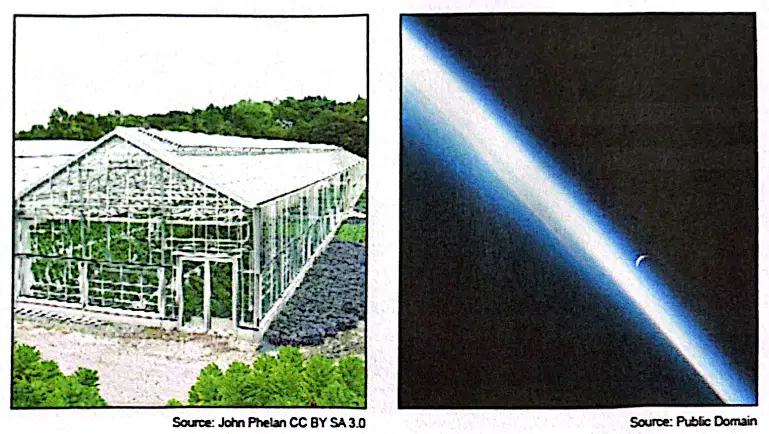
The pictures show a greenhouse and Earth's atmosphere. How are a greenhouse and Earth's atmosphere most alike?
Both contain large amounts of carbon dioxide.
Both lower the temperature to be suitable for life.
Both trap heat inside and prevent it from escaping.
Both prevent harmful radiation from reaching Earth.
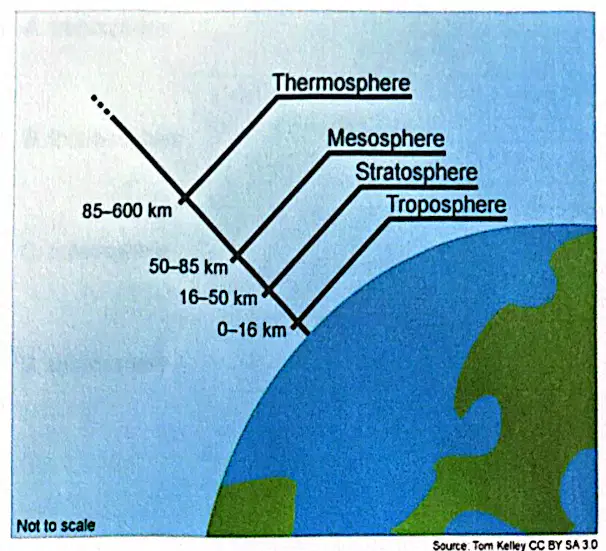
Chantal is creating a diagram showing the layers of Earth's atmosphere. She wants to show the location of the ozone layer on her diagram. Where should Chantal place the label for the ozone layer?
in the troposphere
in the stratosphere
in the mesosphere
in the thermosphere
Where does most of Earth's weather occur?
troposphere
thermosphere
mesosphere
stratosphere
Which of the following is NOT a protection provided by the layers of Earth's atmosphere?
the reduction of the Sun's harmful rays reaching living organisms on Earth
the burning of objects from space before they reach the surface of Earth
the maintenance of a stable temperature suitable for life on Earth
the creation of seasons that allow temperature changes on Earth
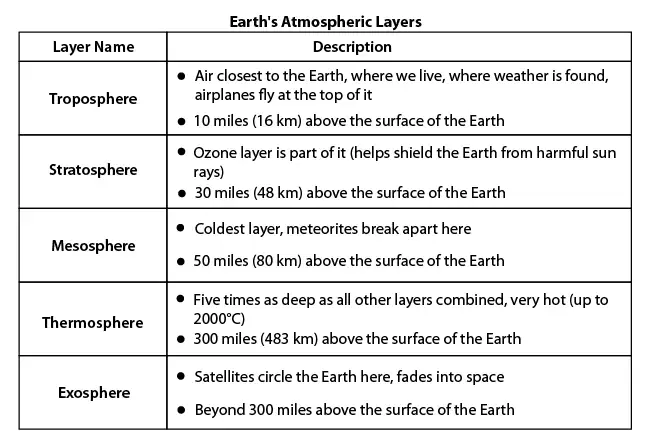
The table shows some data about each of Earth's atmospheric layers. Which atmospheric layer is MOST LIKELY exposed to the least amount of damaging ultraviolet (UV) rays from the Sun?
Stratosphere
Thermosphere
Mesosphere
Troposphere
Which two layers of the atmosphere are characterized by decreasing temperatures with increasing altitude?
stratosphere, thermosphere
troposphere, mesosphere
stratosphere, mesosphere
troposphere, thermosphere
What would most likely happen if Earth did not have an atmosphere?
Humans and animals would not survive because the oxygen level would increase, but plants would survive because the carbon dioxide level would remain the same.
Humans and animals would survive because they would have more oxygen to breathe, and plants would survive because the carbon dioxide level would increase.
Humans and animals would survive because the oxygen level would remain the same, but plants would not survive because the level of carbon dioxide would decrease.
Humans and animals would not survive because they would not have oxygen to breathe, and plants would not survive without the carbon dioxide provided by humans and animals.
Ben is boiling water to make pasta. He leaves his metal stirring spoon in the boiling water for a few minutes. What will most likely happen to the temperature of the metal spoon?
The temperature of the metal spoon will increase because cold energy from the spoon will transfer to the water.
The temperature of the metal spoon will decrease because heat energy from the spoon will transfer to the water.
The temperature of the metal spoon will increase because heat energy from the boiling water will transfer to the spoon.
The temperature of the metal spoon will decrease because cold energy from the boiling water will transfer to the spoon.
Which of the following is correct when convection occurs in the atmosphere?
Cool air rises and warm air sinks.
Cool air sinks and warm air rises.
Cool and warm air sink.
Cool and warm air rise.
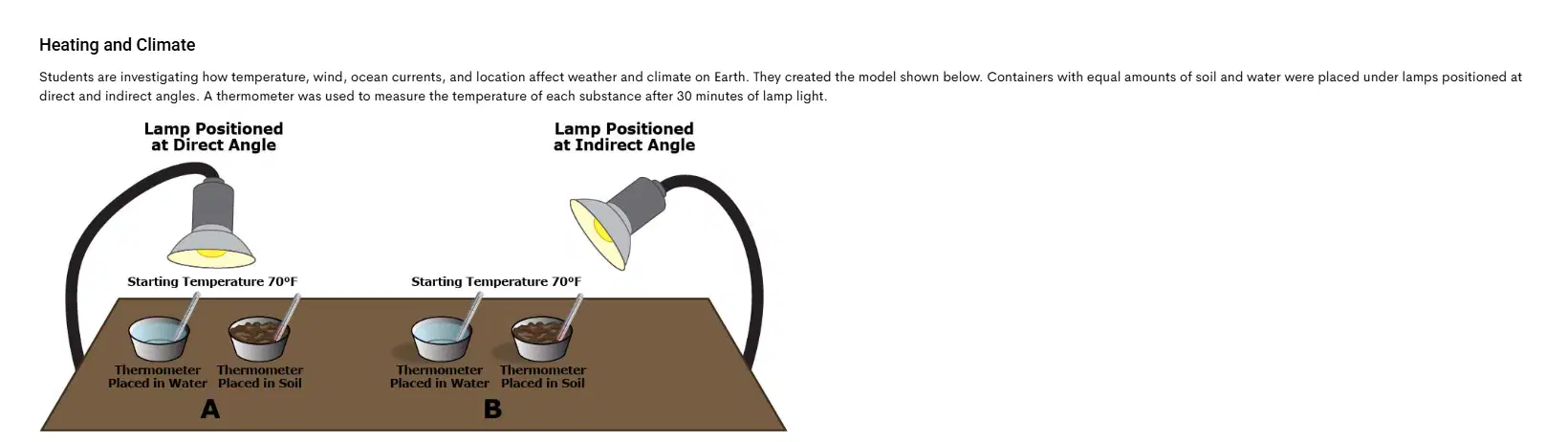
Choose the question that CANNOT be answered by gathering data from the model.
How does the Sun's angle affect heat energy received by Earth's land masses?
How does Earth's rotation affect ocean circulation?
How does heat absorption differ on land compared to water?
How does direct sunlight warm water compared to indirect sunlight?
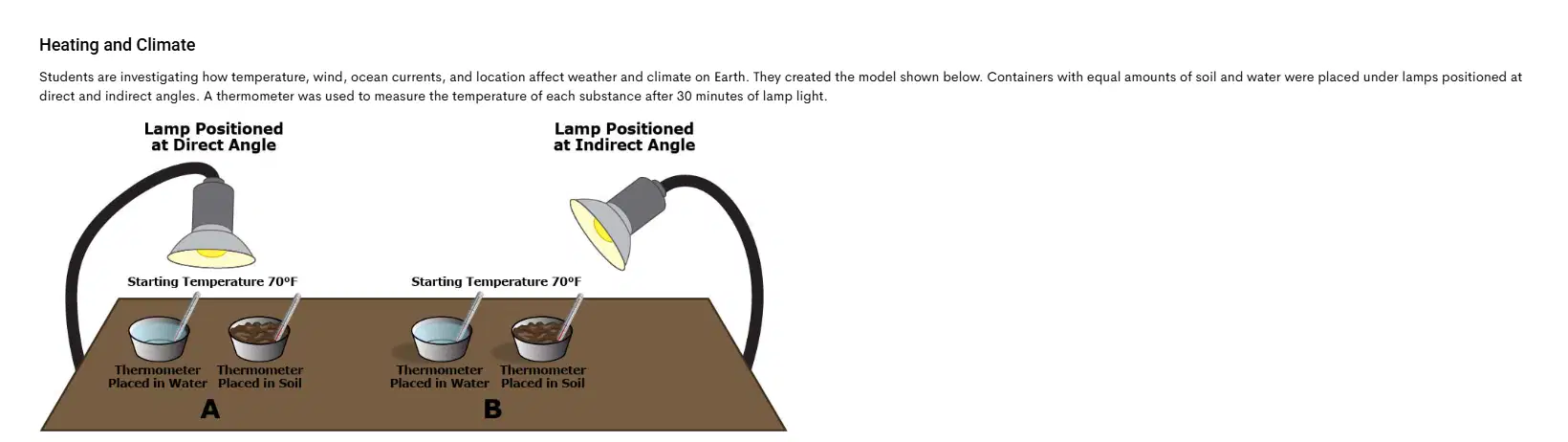
Choose the phrase that BEST describes what the results of this model will explain.
how different amounts of rainfall affect regional climates
how different amounts of vegetation affect regional climates
how cloud cover on land and water affects regional climates
how the distribution of land and water affects regional climates
Temperatures at the poles
are slightly lower than at the equator, creating seasons.
are the same as at the equator, creating ocean currents.
are much higher than at the equator, causing rain to form.
are much lower than at the equator, causing winds to form.
Sunlight does not reach Earth's surface equally. This results in uneven heating of Earth's surface and the formation of wind. Why does the uneven heating of Earth's surface produce wind?
It causes condensation in the atmosphere.
It causes pressure differences in the atmosphere.
It causes differences in the level of water vapor in the atmosphere.
It causes cooler air to rise, creating a partial vacuum near Earth's surface.
What produces areas of different pressures, where air moves from an area of high pressure to an area of low pressure, creating wind?
the uneven heating of Earth by the Sun's energy
the even heating of Earth by the Sun's energy
the rotating of Earth as it orbits the Sun
the tilt of Earth on its axis as it orbits the Sun
Which of the following is one of the reasons a sea breeze occurs during the day?
The land cools faster than the water.
The land cools slower than the water.
The land warms faster than the water.
The land warms slower than the water.
What is a result of the wind convection cells in Earth's atmosphere?
precipitation
changes in seasons
hurricanes and tornadoes
the global distribution of heat
Why are winds that move toward the poles deflected to the right in the Northern Hemisphere and to the left in the Southern Hemisphere?
because of interaction with the jet streams
because of interaction with polar easterlies
because of the greenhouse effect
because of the Coriolis Effect
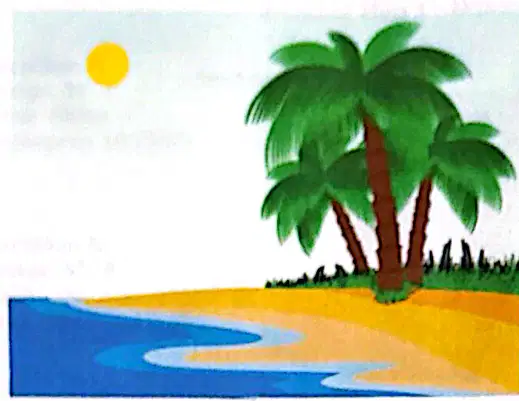
The picture shows a beach on a sunny day.
How does the temperature of the air cause a breeze to blow toward the land?
The warmer air over the land rises, and the cooler air over the water falls and moves toward the land.
The cooler air over the land rises, and the warmer air over the water falls and moves toward the land.
The warmer air over the water rises, and the cooler air over the land falls and moves toward the land.
The cooler air over the water rises, and the warmer air over the land falls and moves toward the land.
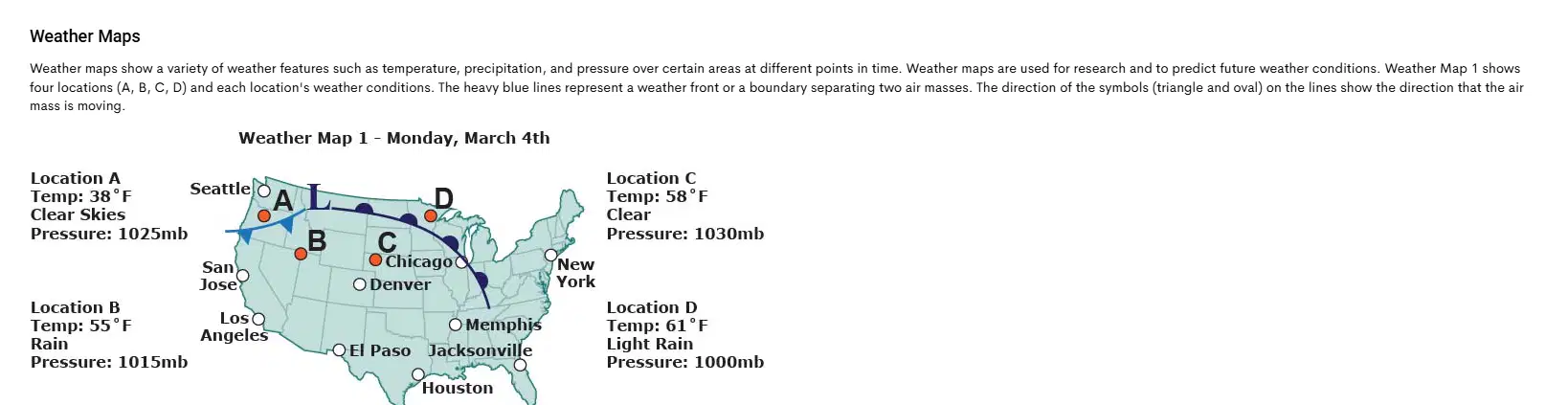
Select the statement that describes the movement of air masses on the weather map for Monday, March 4th.
Air masses move from areas of low pressure to areas of high pressure.
Air masses move from areas of low pressure to areas of low pressure.
Air masses move from areas of high pressure to areas of low pressure.
Air masses move from areas of high pressure to areas of high pressure.
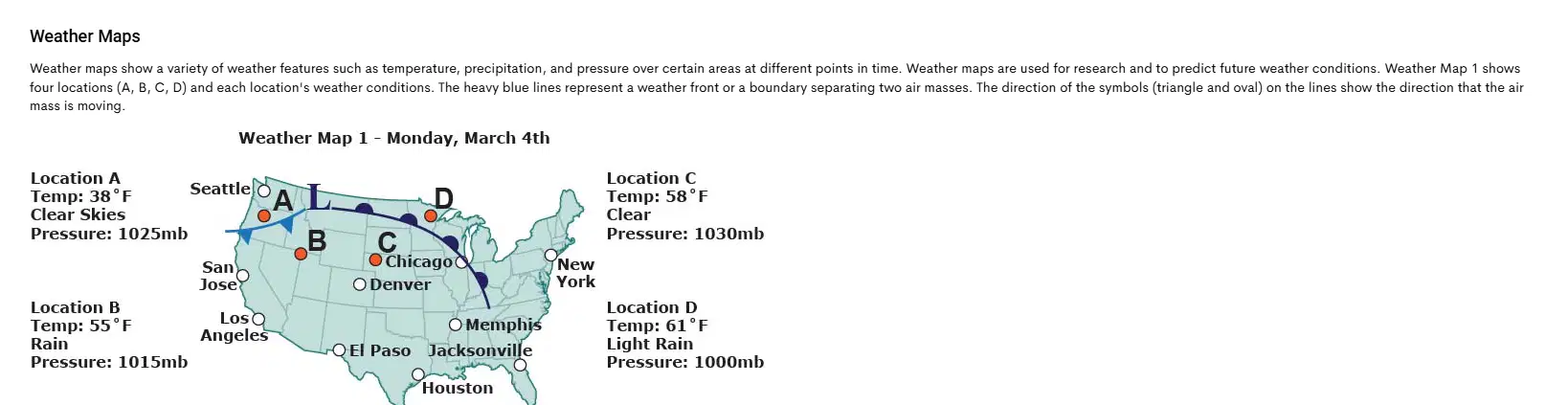
Weather can be predicted using the characteristics and behavior of moving air masses. The map below shows information for Tuesday, March 5th. Select the statement that describes what the weather conditions are likely to be at Location E.
cloudy, rain with low pressure
cloudy, rain with high pressure
clear, dry day with low pressure
partly cloudy, dry day with high pressure
What weather MOST LIKELY results when warm, wet air from the ocean hits cool, dry air over land?
decreased wind speeds
decreased precipitation
thunderstorms
tsunamis
Tornadoes in the United States are most likely to form during which seasons?
summer and winter because the temperatures are mild during these seasons
spring and fall because the temperatures are the most extreme during these seasons
spring and summer because the Sun is warming the ground and the weather is transitioning
fall and winter because the ground is decreasing in temperature and the weather is transitioning
Which situation would most likely result in a thunderstorm?
A warm air mass collides with a cool air mass.
A warm air mass collides with a warm air mass.
A warm air mass rapidly increases in altitude.
A warm air mass rapidly decreases in altitude.
How do weather fronts affect the formation of tornadoes?
Tornadoes can form when one weather front moves in a circle.
Tornadoes can form when one weather front reverses direction.
Tornadoes can form when two weather fronts pass one another.
Tornadoes can form when two weather fronts move into one other.
Where does the energy that powers a hurricane originate?
from funnel clouds
outside a stationary front
outside subliming water
from warm and moist air
What characteristic do thunderstorms, hurricanes, and tornadoes all share?
They all form over dry and hot desert regions.
They are all easily predicted by weather forecasters.
They are all formed when warm and moist air rapidly rises.
They always cause severe damage to land and property.

