
Font size
 Worksheets
S2 18 week exam
Total questions: 50
Worksheet time: 1hrs 1mins


A charge of 9.88*10-6 C exerts a repelling force of 1645 N on a second charge of 2.30*10-6 C. Calculate the distance between the two charges.
0.204 m
1.24*10-4 m
0.011 m
1.38*10-14
A potential difference of 24 V is applied to a 150 resistor. How much current flows through the resistor?
0.15 A
3600 A
6.25 A
0.16 A

This is an example of a _______ circuit
open
series
parallel
square

This is an example of a ______ circuit
Series
Parallel
Open
Dihexihedral
What is not needed in order to create a working circuit?
battery (power source)
lightbulb
current
closed circuit
What is the voltage of a circuit with 4 ohms of resistance and 3 amps of current?
12 V
21 V
4/3 V
3/4 V
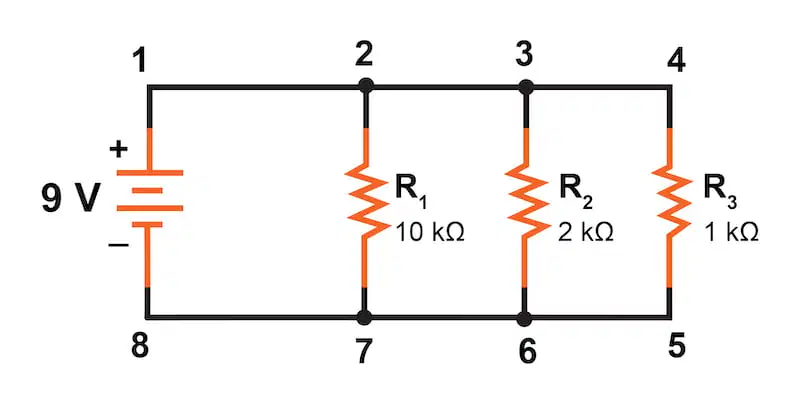
Which resistor will have the greatest potential difference?
p.d. = energy transferred per charge
R1
R2
R3
All have same voltage
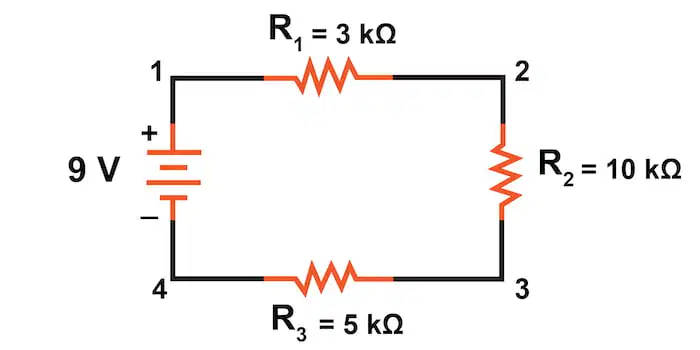
What is the total resistance of the circuit in kilo-ohms
18 kΩ
36 kΩ
35 kΩ
0.5 kΩ
Which resistor will receive the most current?
R1
R2
R3
All receive the same current
Which resistor will have the highest potential difference?
p.d. = energy transferred per charge
R1
R2
R3
All have the same potential difference
What is the current that passes through the battery?
18 mA
36 mA
0.25 mA
0.5 mA
What type of circuit is this?
parallel
perpendicular
series
loop
Which resistor will receive the most current?
R1
R2
R3
All receive the same current
Which resistor will have the greatest potential difference?
p.d. = energy transferred per charge
R1
R2
R3
All have same voltage
What can we say about the effective (total) resistance in this circuit?
Less than 1kΩ
Equal to 13kΩ
Between 2kΩ and 10kΩ
What does the "I" mean in Ohm's Law, V = IR?
velocity
resistance
current
voltage
How to you calculate the total resistance in a series circuit?
R1 + R2+ R3
R1 - R2 - R3
1/R1 + 1/R2 + 1/R3
R1 = R2 = R3
How do you calculate total resistance in a parallel circuit?
R1 + R2 + R3
R1 - R2 - R3
1/R1 +1/R2 + 1/R3 = 1/RT
R1 = R2 = R3

How would the equivalent resistance be determined?
1 / Req = (1/5) + (1/8) + (1/3) Ω
120 Ω
1.5189873 Ω
1 / Req = (1/5) * (1/8) * (1/3) Ω

What unit is used to measure voltage?
Ohms
Omega
Volts
Amps
When light of specific frequencies is shined on a surface, electrons are ejected from the surface. This is the idea behind...
Quantization of Energy
Photoelectric Effect
Compton Effect
deBroglie Waves
Uncertainty Principle

Which subatomic particle is negatively charged?
proton
neutron
electron
quark

What is inside the nucleus of the atom?
electrons and protons
protons and quarks
protons and neutrons
neutrons and electrons
The SI unit of frequency is the __________.
meter
second
hertz
meter per second
Wave -particle duality is supported by...
electrons behaving as particles with ordinary matter
electrons behaving as waves when travelling through space
the photo electric effect
all of the above
Niels Bohr used quantum physics to describe the atomic structure of
hydrogen
zinc
helium
carbon

The equation which links Energy to wavelength is...
E=hf
E=λhf
E=λhc
c=fλ


If an electron moves from n=4 to n=2 it ____
absorbs energy
releases energy
What is an example of mass converting to energy?
a car running on gasoline
a battery powering a flashlight
a person lifting a heavy object
nuclear power plant generating electricity
Who created the equation E = mc2?
Niels Bohr
Albert Einstein
Isaac Newton
Galileo Galilei
Can energy be mass?
No
Yes
Deuterium nucleus has a mass of 1.53 × 10⁻³ universal mass units less than its components, this mass represents an energy of
1.37 X 10^14 J
1.48 X 10^8 J
2.12 X 10^11 J
3.6 X 10^6
What total mass must be converted into energy to produce a gamma photon with an energy of 1.03 × 10⁻¹³ joule?
1.14 X 10^-30 kg
9 X 10^16 kg
1.8 X 10^12 kg
2.34 X 10^15 kg

