
 Worksheets
1st Year Science Revision
Total questions: 170
Worksheet time: 14hrs 10mins
Why can people on one side of a room smell the scent of an air freshener sprayed on the opposite side of the room?
The molecules of air freshener have thermally expanded
The air pressure where the freshener was sprayed is greater than in the rest of the room
The molecules of air freshener spread out until they are evenly distributed throughout the room
The molecules of air freshener are amorphous
When a gas becomes a liquid it is called
condensation
evaporation
sublimation
freezing
When the temperature of a substance is lowered, its particles
vibrate more quickly
stop vibrating completely
escape the attractive forces of the other particles
vibrate more slowly
Anything that has mass and volume
volume
liquid
matter
texture
The state of matter that has particles that slide by each other
volume
liquid
matter
texture
To squeeze gas into a smaller place
gas
temperature
density
compress
The state of matter that expands to fill its container
gas
temperature
density
compress
The name for the process when a liquid becomes a gas
melting
evaporating
freezing
condensing
The name for the process when a liquid becomes a solid
melting
evaporating
freezing
condensing
The name for the process when a solid becomes a liquid
melting
evaporating
condensing
freezing

This is a diagram of a
solid
liquid
gas

This is a diagram of a ________. The particles are sliding by each other.
solid
liquid
gas

This is a diagram of a
solid
liquid
gas

Identify the process shown in the picture
Evaporation
Freezing
Melting
Condensation

Identify the process shown in the picture.
Evaporation
Melting
Freezing
Condensation
In the process of evaporation__________________
solid changes into liquid
liquid changes into solid
liquid changes into gas
gas changes into liquid
State of matter can be changed by _________________
cooling
heating
pressing
both heating and cooling
Wood, paper, table are examples of ___________
soild
liquid
gas
None of these
Air is a mixture of many ____________
liquids
soilds
gases
all of these
1 A substance made up of two or more chemically combined elements is —
an element
mixture
compound
solution
Table salt, or sodium chloride has the chemical formula NaCl. How is sodium chloride classified?
as an element
. as a compound
as a mixture
as a liquid
Brass is a metal that is bright red and gold. It is formed by combining, not chemically, two elements, zinc and copper. Based on the information, how would brass be classified?
an element
compound
mixture
suspension


This picture represents which of the following?
A single element
Mixture of molecules
mixture of atoms
mixture of compounds

What does this illustrate
Elements
Compunds
Mixture of Elements and Compunds
Mixture of Compounds
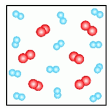
Hydrogen
Hy
H
Hr
Hn
Iron
Ir
In
Fe
FE
Potassium
P
K
Pt
k

What is the picture displayed?
atom
element
compound
Which of the following cannot be broken down into something simpler?
A compound
An element
A mixture


a stretched hair tie

When gasoline is burned in a car engine, ________ energy is converted into _________ energy.
thermal, chemical
chemical, potential
mechanical, chemical
chemical, mechanical

A drawn bow possesses mechanical energy in the form of _______________. After the arrow is released, the energy is transformed into _________________.
gravitational energy; elastic energy
elastic energy; kinetic energy
gravitational energy; kinetic energy

What happens to the energy when you kick a soccer ball?
energy is created
energy is destroyed
energy is transferred to the ball
energy is transferred to your foot
If I drop a book on the floor, how is sound produced?
motion energy transfers to sound energy
electrical energy transfers to sound energy
sound energy transfers to motion energy
light energy transfers to sound energy
True or False. Energy cannot be created or destroyed, rather it is transformed from one energy type to another.
True
False

Identify the energy transfer
chemical to kinetic
solar to electrical
thermal to light
electrical to light
Fire is an example of what two energies?
Electrical and Sound
Mechanical and Sound
Light and Thermal
Chemical and Elastical
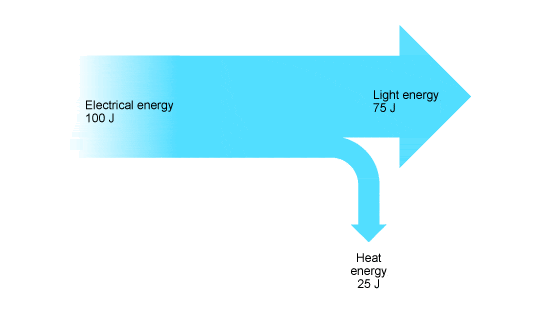
What is this diagram called?
Stankey Diagram
Sankey Diagram
Sankay Diagram
Samkay Diagram
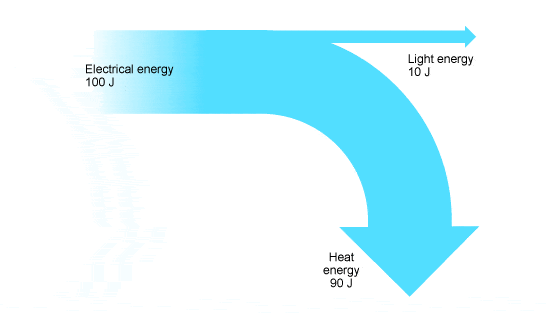


Which bulb is the most efficient?
Filament bulb
LED light
CFL lamp
A washing machine uses 250J of electrical energy to produce 125J of useful energy. How efficient is it?
5%
50%
55%
100%
An iPhone charger coverts 75J of electricty in to 50J of charge and 25J of thermal energy. How efficient is the charger?
10%
100%
33%
67%

Total energy = 350J
Useful energy = 70J
Workout the efficiency of this iphoneX.
efficiency = total energy inuseful energy ×100%
100%
80%
40%
20%

Total energy = 34000J
Useful energy = 340J
Workout the efficiency of this vintage VW Beetle.
efficiency = total energy inuseful energy ×100%
100%
10%
40%
20%

This car needs 8600J of energy to power it. If 5000J is changed into useful energy, how much energy is wasted?
13600J
3600J
5000J
8600J
A car transfers 100 J of chemical energy in order to gain 50 J of kinetic energy. The efficiency of the car is
20%
0.5%
50%
200%
Is being brittle a property for:
Metals
Non Metals
Good conductor of heat
Metal
Non Metal
Iron is a good conductor, malleable and magnetic. What type of element is Iron?
Metal
Non Metal
Metalloid
Pretty
Elizabeth was examining elements and their physical properties. She described an element in her science journal as having no shine, an insulator and very brittle. Would this element be a metal, non metal, or metalloid?
metal
non metal
metalloid
John was observing the physical properties of elements in order to classify them as either a metal, non metal or metalloid. The first element was dull, brittle and did not conduct heat. What would its classification be?
metal
non metal
metalloid
What does malleable mean?
Can be made into a shape
Brittle
Ductile
Shiny
What two things cause iron to rust?
Air and Oxygen
Water and Carbon Dioxide
Oxygen and Water
Carbon Dioxide and Air
Name the metal which is in liquid state.
Iron
Mercury
Zinc
Aluminium


Which of the following is an accurate model of how the Sun, Earth, and Moon move?
Sun and moon orbit Earth
Earth and moon orbit Sun
Earth orbits the Sun and the moon orbits Earth
Earth and sun orbit moon
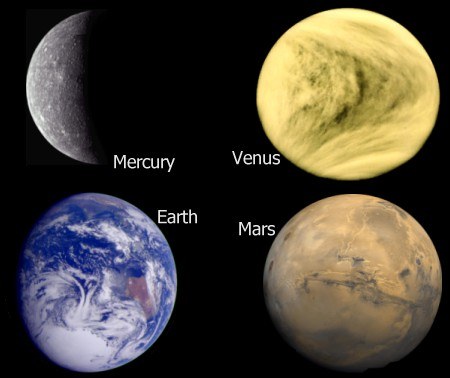

Which planet is NOT one of the
"Gas Giants"?
Uranus
Venus
Neptune
Saturn

What is the largest planet in
our solar system?
Neptune
Jupiter
Uranus
Mars

This table shows the rotation period and revolution period for 6 planets, and Earth’s moon, all relative to Earth’s periods. Which 2 planets have shorter days than Earth?
Jupiter and Saturn
Venus and Mercury
Mars and Jupiter
Saturn and Moon

a small rocky body orbiting the sun, ranging from the size of a small house to dust particles
nebula
terrestrial planets
collision
asteroids

the astronomical model in which the Earth and planets revolve around the Sun at the center of the Solar System.
Aristarchus
accretion
nebula
heliocentric system

What is the name of this planet?
EARTH
MERCURY
MARS
VENUS

This planet has rings.
SATURN
MERCURY
MARS
VENUS

The biggest planet is...
JUPITER
EARTH
MARS
VENUS

This planet is also called "The Red Planet"
JUPITER
EARTH
MARS
VENUS


Which planet is the smallest?
Jupiter
Neptune
Mercury
Pluto
Which planet is the largest?
Jupiter
Saturn
Neptune
Pluto
Which planet is farthest from the sun?
Pluto
Saturn
Uranus
Neptune
This is the only planet with liquid water on it (so far as we know)
Mercury
Earth
Mars
Pluto
How many moons does Earth have?
1
0
2
23
What are the two types of Digestion?
Chemical digestion & Mechanical digestion
Mechanical digestion & Muscular Digestion
Chemical digestion & Muscular digestion
Dermal digestion & Muscular digestion

Which part of the Digestive system push the food towards the stomach?
Oesophagus
Pharynx
Small Intestine
Mouth Cavity

Which organ absorbs water and in the last stage of the digestive process?
Liver
Small intestine
Pancreas
Large intestine

Bile is a chemical that helps break down
Proteins
Carbohydrates
Glucose
Fats

What acid does the stomach produce?
Nitric acid
Phosphoric acid
Acetic acid
Hydrochloric acid
None
moves food from the mouth to the stomach
esophagus
small intestine
large intestine
pancreas
absorbs water
small intestine
stomach
villi
large intestine
absorbs nutrients
stomach
small intestine
large intestine
liver
produces enzymes that break down food
liver
pancreas
gall bladder
stomach
waves of muscular contractions that move food through the digestive tract.
digestion
absorption
peristalsis
villi
Which organ produces bile that breaks down food?
pancreas
liver
gall bladder
stomach
Which organ stores bile?
gall bladder
villi
pancreas
liver
Amylase in saliva changes starch into...
sugar
waste
stomach acid
chyme
Which organ of the digestive system physically breaks down food by the squeezing and churning of muscular contractions?
mouth
stomach
esophagus
small intestine
Digestion begins here, where food is broken into smaller pieces before entering the esophagus.
large intestine
stomach
small intestine
mouth
The breakdown of starch (carbohydrates) begins in the...
small intestine
stomach
large intestine
mouth
Amylase is an enzyme found in the ___________ and begins breaking down which food molecule?
mouth; fats
stomach; fats
stomach; carbohydrates
mouth; carbohydrates
The (a) is where nutrients are absorbed into the bloodstream.
Where does digestion begin?
Our teeth
Our stomach
The esophogus
Small intestines
Chewing is an example of what type of digestion?
Dental
Fragmentary
Chemical
Mechanical
If you wanted to find the glands that produce salivary amylase, where would you look?
In your mouth
In your throat
In your intestines
In your stomach
Place the following events in sequence: A) Food enters your large intestines
B) Food enters your small intestines
C) Food enters your esophagus
A, B, C
C, B, A
C, A, B
B, A, C
Define the term ingestion
The movement of nutrients from the digestive system into the blood
The removal of undigested food from the body
The breaking down of large insoluble molecules into small soluble molecules
The taking in of nutrients.
Define the term digestion
The movement of nutrients from the digestive system into the blood
The removal of undigested food from the body
The breaking down of large insoluble molecules into small soluble molecules
The taking in of nutrients.
Define the term egestion
The movement of nutrients from the digestive system into the blood
The removal of undigested food from the body
The breaking down of large insoluble molecules into small soluble molecules
The taking in of nutrients.

Which term describes the movement of food down the oesophagus by a wave of muscular contraction
Diffusion
Peristalsis
Chyme
Bolus
What is absorbed into the blood from the large intestine?
Digested nutrients
Fibre
Water
Chyme
What does the liver produce for the digestive system?
Enzymes
Bile
Bolus
Chyme
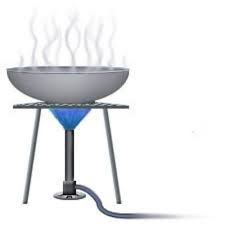
Name the separation technique shown in the diagram.
evaporation
distillation
filtration
Which method is usually used to separate coloured substances from each other?
Simple distillation
Evaporation
Chromatography
If you wanted to make pure drinking water from sea water, what process would you use?
Filtration
Distillation
Evaporation
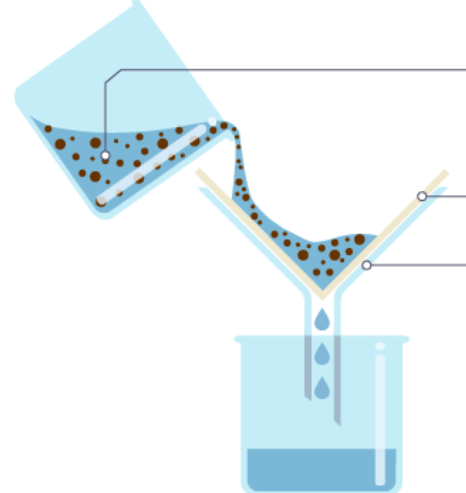
Which method is this a picture of?
Filtration
Evaporation
Distillation
Chromatography
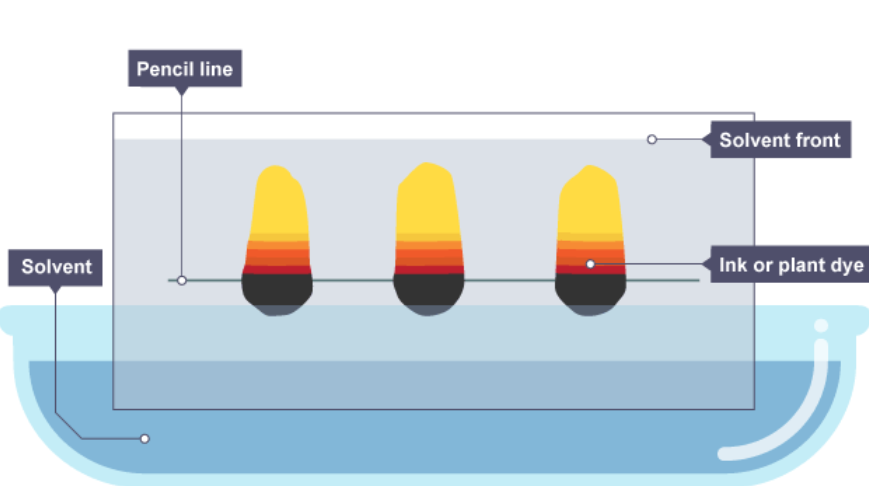
Which method is this a picture of?
Filtration
Evaporation
Distillation
Chromatography

Ethanol and water have different boiling point. What would be the suitable separation technique for a mixture of both substances?
Distillation
Chromatography paper
Sieving
Milk is...
an element
a compound
a mixture

Elements
are made of two or more types of atoms bonded together
are made of one type of atom
are made of two or more types of molecules
are always individual atoms
Which of the following are examples of ELEMENTS? Choose all that are correct.
Oxygen (O)
Water
(H2O)
Flourine
(F)
Lemonade
Sulfur Dioxide (SO2)
Compounds
are made of two or more types of atoms chemically bonded together
are made of one type of atom
are found on the periodic table
can be separated into their individual parts through physical means
Which of the following are examples of compounds? Check all that apply.
Salt
(NaCl)
Salt Water
(NaCl and H2O)
Sugar
(C6H12O6)
Carbon Dioxide
(CO2)
The bonds of compounds can be broken easily because they are not chemically bonded.
True
False
When substances combine chemically...
they form a mixture and their properties change
they form a compound and their properties change
they form a mixture where their properties stay the same
the form a compound where their properties stay the same
Which of the following are examples of Mixtures?
The atmosphere
(N + O + Ar + H2O...)
Carbon Dioxide (CO2)
Oxygen
(O2)
Lemonade
(sugar, lemon juice, water)
Anything on the Periodic Table
Mixtures
are made of two different types of atoms chemically bonded together
Are only liquids
Cannot be separated
Can be separated using physical properties
Which of the following are examples of a Pure Substance?
Water
(H2O)
Helium
(He)
Orange Juice
(oranges, water)
Uranium
(Ur)
Sugar
(C6H12O6)
______ do not retain their original properties
Mixtures
Compounds
Both A & B
None of these
Aurum is the Latin name for .......
Silver
Gold
Bronze
None of these
Where are all elements found?
the water table
the periodic table
the element chart
earth's crust and oceans
Why are elements considered pure substances?
because they cannot be broken down any further
because they don't contain pollution
because they combine to produce chemicals
because they never mix with other elements
What is the element symbol for Arsenic?
Ar
Ae
An
As
A compound is composed of two or more elements chemically combined together.
True
False
Which of the following is an example of a compound?
Al
Co
NH3
Mg
Which of the following is an example of an compound?
NaCl
Fr
Zn
I
Select all of the elements present in this compound of Carbon Dioxide CO2 . Select all that apply.
Cobalt
Carbon
Oxygen
Calcium
Select all the elements present in this compound of baking soda NaHCO3 . Select all that apply.
Sodium
Cobalt
Carbon
Oxygen
Hydrogen
Which is the correct symbol for the element Bismuth?
bi
Bi
bI
BI
Which is the correct symbol for the element Iron?
Fe
fe
Ir
In

