
 Worksheets
Chemistry Sample Items
Total questions: 28
Worksheet time: 17mins
What is the molarity of a solution that contains 2 moles of solute dissolved in 0.5 liters of solution? (SC.912.P.8.9) Molarity = Litersmoles
0.5 M
1.0 M
4.0 M
8.0 M
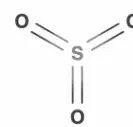
What is the name of the following compound based on the Lewis-Dot structure? (SC.912.P.8.7)
sulfur oxide
sulfur trioxide
monosulfur oxide
monosulfide trioxidea
What are the resulting product(s) formed when magnesium (Mg) metal reacts with copper (II) sulfate (CuSO4) in a single replacement (displacement) reaction?
Cu2SO4 + Mg
MgSO4 + Cu
What is the total number of atoms found in one formula unit of aluminum phosphate (AlPO4)? (SC.912.P.8.7)
6
7
8
12
What is the electron configuration for an atom of nitrogen in its ground state? (SC.912.P.8.4)
1s2 2s2 3s3
1s2 2s2 2p3
1s2 2s2 3p2
1s2 2s2 3s2 4s2
What would happen to the energy of an electromagnetic wave if the frequency of the wave were to be cut in half?
The energy of the wave would reduce by a factor of 2.
The energy of the wave would reduce by a factor of 4.
The energy of the wave would increase by a factor of 2.
The energy of the wave would increase by a factor of 4.
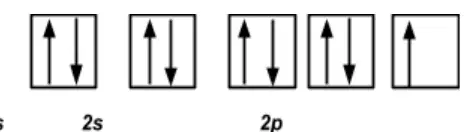
A neutral fluorine atom has nine electrons. Which of the following is the correct orbital diagram for an atom of fluorine in the ground state? (SC.912.P.8.4)
[Image: Orbital diagram with 1s, 2s, and 2p orbitals filled according to Hund's rule]
[Image: Orbital diagram with 1s, 2s, and 2p orbitals not filled according to Hund's rule]
Which of the following correctly names the ionic compound Mg3(PO4)2? (SC.912.P.8.7)
magnesium phosphate
magnesium phosphide
magnesium phosphorus
magnesium phosphorus tetroxide
The reaction below between methane (CH4) and oxygen (O2) producing carbon dioxide (CO2) and water (H2O) can be classified as which type of chemical reaction? (SC.912.P.8.8)
synthesis
combustion
decomposition
single replacement
Which set of coefficients will correctly balance the following chemical reaction? (SC.912.P.8.9) Fe + HCl → FeCl2 + H2
1, 2, 1, 2
2, 1, 2, 1
1, 2, 1, 1
2, 1, 1, 1
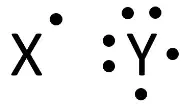
What is the correct empirical formula from the following theoretical Lewis-Dot structures of unknown elements X and Y? (SC.912.P.8.7)
XY₆
X₆Y
X₂Y
XY₂
Which of the following choices correctly ranks the atomic radius in order from smallest to largest? (SC.912.P.8.5)
He, Mg, K
Mg, K, He
K, Mg, He
K, He, Mg
A sample of 20.0 g of sodium hydroxide (NaOH) reacts in the chemical reaction below. How many moles of copper (II) hydroxide (Cu(OH)₂) can be formed by this reaction?
0.25 moles
0.5 moles
1.0 moles
1.5 moles
A student precipitates 212.0 g lead (II) iodide (PbI₂) in the reaction below. Upon careful calculation, the student determines obtaining a 92.0% yield. What was the theoretical yield of lead (II) iodide that should have been recovered? (SC.912.P.8.9) percent yield = (actual yield / theoretical yield) x 100
(a)
The following reaction is at equilibrium. Which of the statements below is true? (SC.912.13) PCl3 + Cl2 ⇌ PCl5
The concentration of Cl2 is zero.
All concentrations remain constant.
The concentration of PCl3 decreases.
The concentration of PCl5 increases.
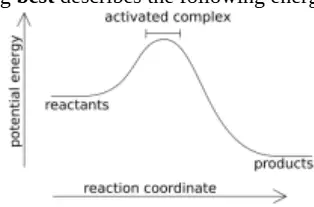
Which of the following best describes the following energy diagram? (SC.912.P.10.7)
ΔH = 45.7 KJ; exothermic
ΔH = 45.7 KJ; endothermic
ΔH = – 45.7 KJ; exothermic
ΔH = – 45.7 KJ; endothermic
Using the following activity series of metals, which of the listed metal ions would be replaced if combined with copper metal in a single replacement reaction? (SC.912.P.8.8)
Lead
Platinum
Cadmium
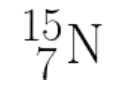
How many neutrons are in an isotope of a nitrogen-15 atom?
7
8
14
15
Identify the Bronsted-Lowry base in the following chemical reaction: (SC.912.P.8.11)
NH3
H2O
NH4+
OH−
20. Using the heating curve below, identify the region where a change of state occurs.
Region AB
Region BC
Region CD
Region DE
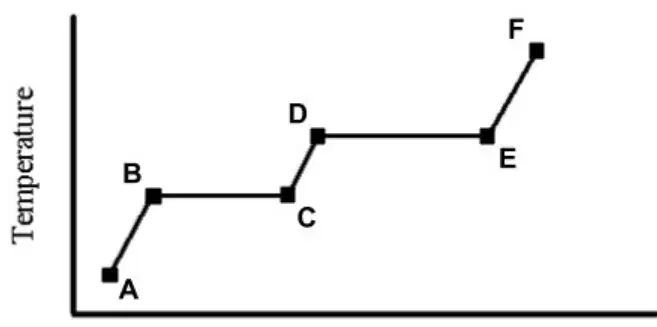
Refer to the graph showing Temperature vs Time. Which segment shows a constant temperature?
between points A and B
between points B and C
between points C and D
between points E and F
If 100.0 g of iron metal at a temperature of 100 °C is dropped into a beaker containing 1.000 kg of water at 25.0 °C, the system will reach a state of thermal equilibrium where all temperatures are equal. What best describes the flow of energy in the system?
Heat energy flows from the water into the iron.
Cold energy flows from the water into the iron.
Heat energy flows from the iron into the water.
Cold energy flows from the iron into the water.
Which of the following list of elements contains only metalloids?
Na, Fe, Sn
F, Xe, H
Si, Br, Cu
Si, As, Sb
A balloon has a pressure of 2.0 atm when the temperature is 303K. Which statement best describes what happens to the gas particles in the balloon when the temperature decreases to 273K? P1/T1 = P2/T2 P = Pressure in atmospheres T = Temperature in Kelvin
The gas particles increase in kinetic energy, as the pressure decreases to 1.8 atm.
The gas particles decrease in kinetic energy, as the pressure decreases to 1.8 atm.
The gas particles increase in kinetic energy, as the pressure increases to 2.2 atm.
The gas particles decrease in kinetic energy, as the pressure decreases to 2.2 atm.
Which of the following substances is the most basic?
The specific heat of copper is 0.385 J/g °C. How many joules of energy are needed to warm 6.0 grams of copper from 12.5 °C to 32.0 °C?
29 J
45 J
74 J
924 J
Which of the following separation methods would be used to separate large, insoluble particles (such as sand) from water?
filtration
distillation
chromatography
fractional distillation
Which of the following changes will increase the rate of a chemical reaction?
lower the temperature
add a catalyst to the reaction
decrease the concentration of products
decrease the concentration of reactants

