
Font size
 Worksheets
Gallopade American Revolution
Total questions: 54
Worksheet time: 41mins
Who is considered the finest poet in the land?
Phyllis Wheatley
Benjamin Franklin
Samuel Adams
Thomas Jefferson
What year did the United States issue the Declaration of Independence?
1775
1776
1777
1778
What year did the Revolutionary War begin?
1775
1780
1942
1812
How many American colonies were a part of the Revolution?
8
13
50
7
Who was the first President of the United States?
Paul Revere
Andrew Jackson
George Washington
Abraham Lincoln
Which European country became a major ally to the United States during the Revolutionary War?
Russia
France
Italy
Sweden
Who were the patriots?
Loyalists who supported British rule in the American colonies.
Native American tribes who allied with the British during the war.
American colonists who supported and fought for independence from Great Britain.
British soldiers who fought against the American colonists.

How did Abigail Adams help her country?
By being John Adams' wife.
By giving her husband advice and standing up for women's rights.
By letting her husband be away from home without complaining.
By writing her husband nice letters.
Which detail shows that Deborah Sampson was a brave soldier?
"She was wounded more than once. She hid some wounds, afraid that doctors would find out she was a woman."
"One day Deborah got really sick. She had a high fever."
"Deborah put her own clothes back on and went home."
"Robert Shurtleff, got an honorable discharge from the army."
She carried water to soldiers in a pitcher. That's probably how she got the nickname.
Mary Ludwig Hays
Mercy Otis Warren
Molly Pitcher
Abigail Adams
Both of these women were First Ladies or the wives of men who would later become presidents of the United States
Phillis Wheatley
Mercy Otis Warren
Martha Washington
Abigail Adams
She took over for her husband at the cannon and worked there all day during a Revolutionary War battle.
Margaret Cochran Corbin
Mary Ludwig Hays
Molly Pitcher
Martha Washington
This free African American wrote inspirational poetry.
Mercy Otis Warren
Mary Ludwig Hays
Abigail Adams
Phillis Wheatley
She had to disguise herself as a man to join the Continental Army.
Mary Ludwig Hayes
Margaret Cochran Corbit
Deborah Samson
Phillis Wheatley
She wrote her husband letters and talked with him about women's rights.
Margaret Cochran Corbin
Martha Washington
Abigail Adams
Phillis Wheatley
When and why did the French agree to alliance with the Patriots?
After the Battle of Charleston; the French knew the war was almost over and wanted to fight on the winning side
After the Battle of Long Island; the French didn't want the Dutch to gain influence over the new country
After the Battle of Saratoga; the French saw that the Americans had a chance to defeat Great Britain
After the Battle of Princeton; the French saw that George Washington was a good leader
Which of the following marked the official end of the American Revolution?
The Battle of Cowpens
The Battle of Yorktown
Signing of the Treaty of Paris
Cornwall's surrender to Washington
Why did the British army set up camp at Yorktown, Virginia?
They planned to surrender there
They thought it would be hard for the American army to attack.
They thought it would be a good place for British supply ships to land.
They thought it would stop French supply ships from helping Americans.
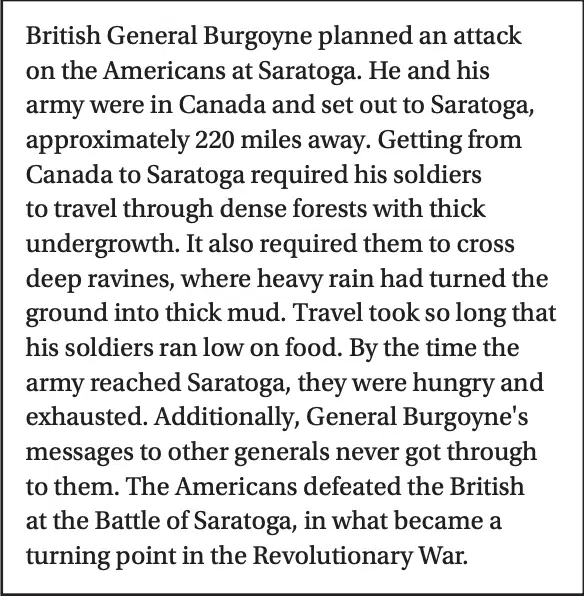
Which factor most caused the British to suffer such an unexpected defeat?
The British army was weak and inexperienced.
The British general was not familiar with the local geography.
The British general was too confident and did not ask for support.
Traveling 220 miles was an unreasonable expectation of an army on foot.
Which battle was the turning point in the Revolutionary War?
Battle of Breed’s Hill
Battle of Saratoga
Battle of Valley Forge
Battle of Yorktown
Why did George Washington spend the winter at Valley Forge?
to prepare and train the colonial militia
to hide from the British after a major loss
to rest after a major victory in a battle there
to write the peace treaty after the war was over
Select the choices that describe Abigail Adams.
sold into slavery
supported the American Revolution
wrote poems and plays supporting American independence
her letters are some of the earliest known writings about women’s rights
important advisor to her husband; she told him to “remember the ladies” when forming America’s new government
Select the choices that describe Phillis Wheatley.
sold into slavery
supported the American Revolution
wrote poems and plays supporting American independence
her letters are some of the earliest known writings about women’s rights
important advisor to her husband; she told him to “remember the ladies” when forming America’s new government
Select the choice that describes BOTH Abigail Adams and Phillis Wheatley.
sold into slavery
supported the American Revolution
wrote poems and plays supporting American independence
her letters are some of the earliest known writings about women’s rights
important advisor to her husband; she told him to “remember the ladies” when forming America’s new government
Choose whether the statement describes the Battle of Princeton, Battle of Trenton, or both.
The Continental Army won the battle.
Battle of Princeton
Battle of Trenton
Both
Choose whether the statement describes the Battle of Princeton, Battle of Trenton, or both.
The battle was fought against General Cornwallis and his troops.
Battle of Princeton
Battle of Trenton
Both
Choose whether the statement describes the Battle of Princeton, Battle of Trenton, or both.
The battle was fought against Hessian soldiers from Germany after the Continental Army crossed the Delaware River.
Battle of Princeton
Battle of Trenton
Both
Choose the event the statement describes.
(Siege of Charlestown, Siege of Savannah, or Both)
The battle was fought in 1779
Siege of Charlestown
Siege of Savannah
Both
Choose the event the statement describes.
(Siege of Charlestown, Siege of Savannah, or Both)
The British army blockaded any paths out of Charlestown
Siege of Charlestown
Siege of Savannah
Both
Choose the event the statement describes.
(Siege of Charlestown, Siege of Savannah, or Both)
The British troops won the battle
Siege of Charlestown
Siege of Savannah
Both
Choose the event the statement describes.
(Siege of Charlestown, Siege of Savannah, or Both)
French and American troops fought together against British troops
Siege of Charlestown
Siege of Savannah
Both
Choose the event the statement describes.
(Siege of Charlestown, Siege of Savannah, or Both)
There was heavy fog that made it hard for the troops to see
Siege of Charlestown
Siege of Savannah
Both
Choose the event the statement describes.
(Siege of Charlestown, Siege of Savannah, or Both)
There were about 5,000 American troops lost in the battle
Siege of Charlestown
Siege of Savannah
Both
Identify which significant individual in the American Revolution each phrase describes.
(James Armistead, Paul Revere, or George Washington)
appointed commander-in-chief of the American Continental Army
James Armistead
Paul Revere
George Washington
Identify which significant individual in the American Revolution each phrase describes.
(James Armistead, Paul Revere, or George Washington)
born into slavery
James Armistead
Paul Revere
George Washington
Identify which significant individual in the American Revolution each phrase describes.
(James Armistead, Paul Revere, or George Washington)
fought as a spy on the American side of the Revolution
James Armistead
Paul Revere
George Washington
Identify which significant individual in the American Revolution each phrase describes.
(James Armistead, Paul Revere, or George Washington)
joined Boston’s network of guards that watched for signs of British activity
James Armistead
Paul Revere
George Washington
Identify which significant individual in the American Revolution each phrase describes.
(James Armistead, Paul Revere, or George Washington)
Lord Cornwallis of England surrendered to him at the Battle of Yorktown
James Armistead
Paul Revere
George Washington
Identify which significant individual in the American Revolution each phrase describes.
(James Armistead, Paul Revere, or George Washington)
warned residents of Lexington and Concord that the British were coming
James Armistead
Paul Revere
George Washington
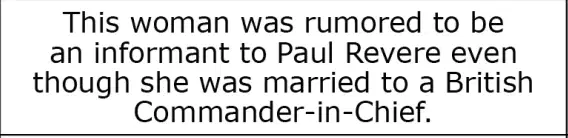
Margaret Gage
Molly Ludwig Hays
Deborah Sampson
Mercy Otis Warren
Martha Washington
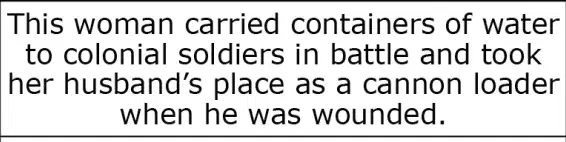
Margaret Gage
Molly Ludwig Hays
Deborah Sampson
Mercy Otis Warren
Martha Washington

Margaret Gage
Molly Ludwig Hays
Deborah Sampson
Mercy Otis Warren
Martha Washington
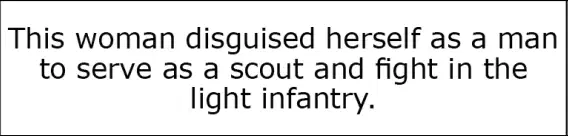
Margaret Gage
Molly Ludwig Hays
Deborah Sampson
Mercy Otis Warren
Martha Washington
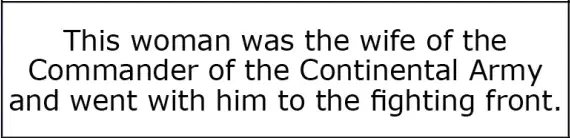
Margaret Gage
Molly Ludwig Hays
Deborah Sampson
Mercy Otis Warren
Martha Washington
Battles of Lexington and Concord occurred in which U.S. state?
New York
Pennsylvania
Georgia
Massachusetts
Battle of Saratoga occurred in which U.S. state?
Florida
New York
Virginia
New Jersey
Battle of Yorktown occurred in which U.S. state?
New York
Pennsylvania
Massachusetts
Virginia
Which DESCRIBES the battle of Lexington & Concord?
British forced to retreat back to Boston
first battle of Revolutionary War showed untrained colonists could fight against the British soldiers
colonists ran low on ammunition and were forced to retreat but the British suffered many casualties
showed the British that the Revolutionary War was going to be tougher than they might have expected
Which DESCRIBES the battle of Bunker Hill?
British forced to retreat back to Boston
first battle of Revolutionary War showed untrained colonists could fight against the British soldiers
colonists ran low on ammunition and were forced to retreat but the British suffered many casualties
showed the British that the Revolutionary War was going to be tougher than they might have expected
Which tells the IMPORTANCE of the battle of Lexington & Concord?
British forced to retreat back to Boston
first battle of Revolutionary War showed untrained colonists could fight against the British soldiers
colonists ran low on ammunition and were forced to retreat but the British suffered many casualties
showed the British that the Revolutionary War was going to be tougher than they might have expected
Which tells the IMPORTANCE of the battle of Bunker Hill?
British forced to retreat back to Boston
first battle of Revolutionary War showed untrained colonists could fight against the British soldiers
colonists ran low on ammunition and were forced to retreat but the British suffered many casualties
showed the British that the Revolutionary War was going to be tougher than they might have expected

