wayground logo

Free Printable Worksheets

Font size

S
M
L
XL
Worksheets

Astronomy Test Review

Total questions: 30

Worksheet time: 15mins
Name
Class
Date
1.
Which of the following is in the correct order from smallest to largest?
a)
Planet --> Universe --> Solar System--> Moon --> Galaxy
b)
Moon --> Planet --> Solar System --> Galaxy --> Universe
c)
Moon --> Planet --> Galaxy --> Universe --> Solar System
d)
Galaxy --> Solar System --> Moon --> Planet --> Universe
2.
What galaxy do we live in?
a)
Andromeda
b)
Western
c)
Milky Way
d)
Watery Way
3.
What force keep's Earth in it's orbit around the Sun?
a)
Friction
b)
Electrostatic
c)
Gravity
d)
Heat
4.
In comparison to other stars, the Sun is
a)
Very large, and very hot
b)
Very small, and very cool
c)
Very large, but not very hot
d)
Average size, Average Temperature
5.
Earth is a ___________ planet, because it is __________________________________.
a)
(Terrestrial) (Large, Gaseous ,and Low Density)
b)
(Jovian) (Large, Gaseous ,and Low Density)
c)
(Terrestrial) (Small, Rocky and Dense)
d)
(Jovian) (Small, Rocky and Dense)
6.
The inner and outer planets are separated by the
a)
Sun
b)
Oort Cloud
c)
Kuiper Belt
d)
Asteroid Belt
7.
Why are we able to see the moon from Earth?
a)
The moon reflects the sun's light
b)
The moon is a star, and it is luminous
c)
The moon reflects the light from the planets
d)
The moon is an asteroid, and it is luminous
8.
Approximately how long does it take from the moon to complete all of the lunar phases?
a)
24 hours
b)
27 and 1/3 days
c)
29 and 1/2 days
d)
7 days
9.
Tides are caused by
a)
All of the planet's aligning
b)
The Sun's rotation
c)
The moon's gravitational pull
d)
The Earth's tilt
10.
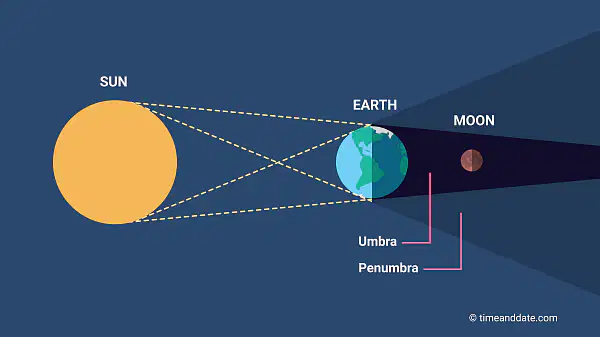
In the image below, the Sun, Earth and Moon are all lined up perfectly so that the moon falls in the Earth's shadow. The event shown below is a
a)
Solar Eclipse
b)
Lunar Eclipse
c)
Low Tide
d)
Terrestrial Eclipse
11.
A lunar eclipse can only occur during which moon phase?
a)
New
b)
First Quarter
c)
Waxing crescent
d)
Full
12.
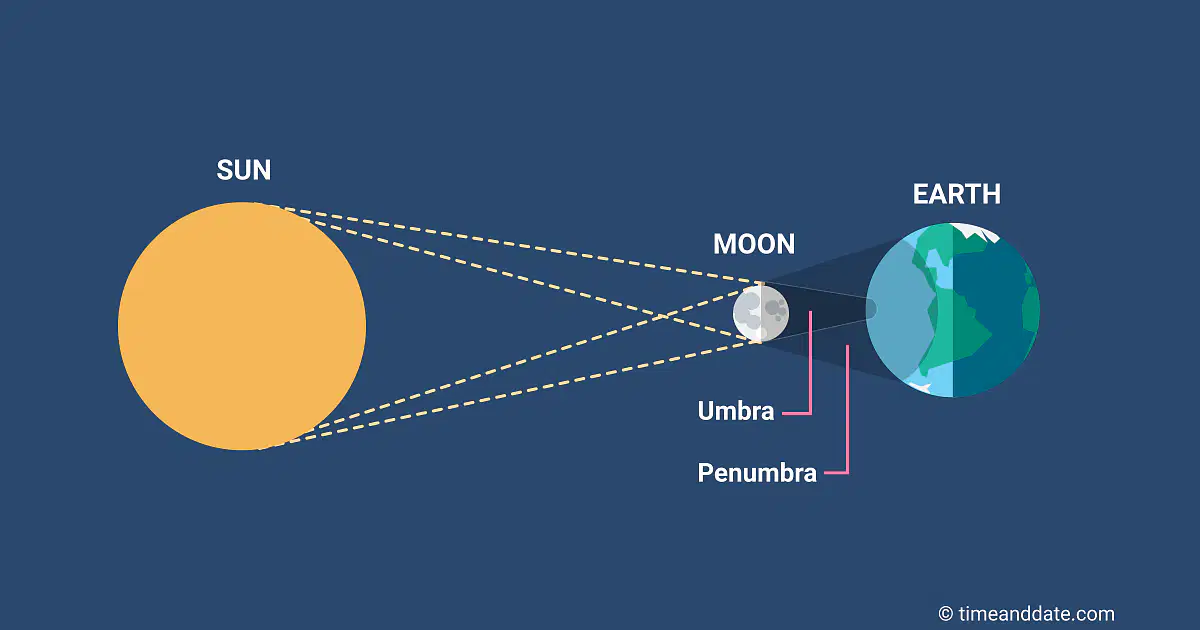
In the image below, the Sun, Earth and Moon are all lined up perfectly so that the moon falls in the Earth's shadow. The event shown below is a
a)
Lunar Eclipse
b)
Tidal Wave
c)
Solar Eclipse
d)
Solar Flare
13.
A solar eclipse can only happen during which moon phase?
a)
Full
b)
Gibbous
c)
Quarter
d)
New
14.
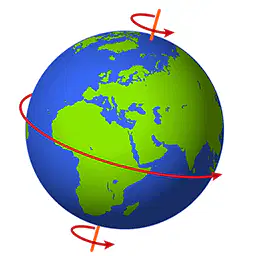
The picture below shows the Earth spinning on it's axis. This motion is called
a)
Revolution, and it takes 365 and 1/4 days
b)
Rotation, and it takes 24 hours
c)
Revolution, and it takes 24 hours
d)
Rotation, and it takes 365 and 1/4 days
15.
The picture below shows the Earth traveling in it's orbit around the Sun. This motion is called
a)
Revolution, and it takes 365 and 1/4 days
b)
Rotation, and it takes 24 hours
c)
Revolution, and it takes 24 hours
d)
Rotation, and it takes 365 and 1/4 days
16.
Select the TWO factors that cause the seasons:
a)
The tilt of the Earth's Axis
b)
The Earth's revolution around the Sun
c)
The rotation of the Sun
d)
The revolution of the moon
e)
The distance the Earth is from the Sun
17.

The asteroid belt is between what two planets?

a)

Earth and Mars

b)

Mars and Jupiter

c)

Venus and Mars

d)

Jupiter and Saturn

18.

When one year is complete, a planet has done which of the following?

a)

Made one complete rotation (spin) on its axis

b)

Made one complete revolution (orbit) around the Sun.

19.

A bright object with a tail, moving slowly across the sky is most likely a _________.

a)

asteroid

b)

comet

c)

meteor

d)

UFO

20.
Which season is taking place in the Northern Hemisphere in Position 1?
a)
Winter
b)
Spring
c)
Summer
d)
Fall
21.

What does "waxing" mean?

a)

Getting bigger

b)

Getting smaller

22.

One rotation on Earth's axis takes...

a)

24 minutes

b)

365 1/4 hours

c)

365 days

d)

24 hours

23.

Gravitational pull depends on...

a)

if the object is solid or gaseous

b)

weight

c)

mass and distance

d)

if an object has arms.

24.

We experience day and night because -

a)

the Earth revolves around the sun.

b)

the Earth rotates on its axis.

c)

the sun revolves around the Earth.

d)

The moon comes out at night.

25.

What type of eclipse is this?

a)

lunar

b)

solar

c)

neap

d)

waxing

26.

how long does it take the Moon to go through all of its moon phases?

a)

one year

b)

one day

c)

8 days

d)

one month

27.

Which planet has the greatest gravitational pull because of its large mass?

a)

Mercury

b)

Earth

c)

Jupiter

d)

Neptune

28.

Pluto is now classified as a

a)

Planet

b)

Comet

c)

Dwarf Planet

d)

Asteroid

29.
If tides alternate from high to low and there are two of each type of tide a day, about how many hours will generally be between each different tide?
a)
2 hours
b)
6 hours
c)
12 hours
d)
24 hours
30.

What determines the color of a star?

a)

Size

b)

Temperature

c)

Composition

d)

They are all the same color