
NEW
Font size
 Worksheets
Physical Science - Physics Review #1
Total questions: 50
Worksheet time: 25mins
The variable plotted on the horizontal or x-axis is called the ____.
dependent variable
independent variable
variable with the largest range
In a graph showing speed of a car over time, speed is the ____.
dependent variable
independent variable
variable with the largest range
A single point on a distance-time graph tells the ____.
instantaneous speed
average speed
constant speed
Motion is a change in ____.
time
speed
position
3 m/s north is an example of a(n) ____.
speed
velocity
position
A merry-go-round horse moves at a constant speed but at a changing ____.
velocity
balanced force
inertia
Acceleration is rate of change of ____.
position
time
velocity
A horizontal line on a velocity/time graph shows ____ acceleration.
positive
negative
zero
When a car’s acceleration is negative, what is happening to the car’s motion?
The car is slowing down.
The car is speeding up.
The car is traveling at constant speed.

The graph above describes the motion of a cyclist. The graph illustrates that the acceleration of the cyclist
is constant.
decreases.
increases.

The graph above describes the motion of a cyclist. During the interval shown, the cyclist is
slowing down.
speeding up.
traveling at the same speed.
How far does a car go if it travels at 30 m/s for 25 seconds?
750 m.
1.2 m.
55 m.
If an object has constant velocity, then it
has a negative acceleration.
has zero acceleration.
has positive acceleration.
Inertia varies depending on ____.
force
mass
velocity
A 15-N force and a 45-N force act on an object in opposite directions. What is the net force on the object?
15 N
30 N
45 N
A 5-N force and a 30-N force act in the same direction on an object. What is the net force on the object?
35 N
30 N
5 N
If the force of gravity suddenly stopped acting on the planets, they would
spiral slowly towards the sun.
continue to orbit the sun.
move in straight lines tangent to their orbits.
Compared to its weight on Earth, a 10-kg object on the moon will weigh
the same.
less.
more.
Compared to its mass on Earth, the mass of a 10-kg object on the moon is
the same.
more.
less.
Accelerations are produced by
unbalanced forces.
velocities.
accelerations.
A girl pulls on a 10-kg wagon with a constant force of 20 N. What is the wagon's acceleration?
0.5 m/s²
2 m/s²
10 m/s²
How much force is needed to accelerate a 4.0-kg physics book to an acceleration of 2.0 m/s²?
0.5 N
0 N
8.0 N
An unfortunate bug splatters against the windshield of a moving car. Compared to the force of the car on the bug, the force of the bug on the car is
larger.
the same.
smaller.
An unfortunate bug splatters against the windshield of a moving car. Compared to the deceleration of the car, the deceleration of the bug is
larger.
the same.
smaller.
A feather will fall through the air more slowly than a brick because of ____.
air resistance
gravity
inertia
Without air resistance, objects fall at constant
speed.
velocity.
acceleration.
If a freely falling object were somehow equipped with a speedometer, its speed reading would increase each second by
about 5 m/s.
about 10 m/s.
about 15 m/s.
A freely falling object starts from rest. After falling for 6 seconds, it will have a speed of about
6 m/s.
30 m/s.
60 m/s.
Without air resistance, when an object is in free fall, its
velocity increases.
acceleration increases.
Without air resistance, a penny and a feather that are dropped from the same height at the same time will ____.
fall at different rates
fall at the same rate
float
When an object moves in a circular path, it accelerates toward the center of the circle as a result of ____.
centripetal force
frictional force
gravitational force
For any object, the greater the force that's applied to it, the greater its ____ will be.
acceleration
gravity
inertia
As you get farther from the center of Earth, your weight will ____.
decrease
increase
remain the same
The mass of a lamb that weighs 110 N is about
1 kg.
11 kg.
110 kg.
How much does a 3.0-kg bag of bolts weigh?
0.3 N
30 N
13 N
If the mass of Earth increased, with no change in radius, your weight would ____.
stay the same
decrease
increase also
If the radius of Earth decreased, with no change in mass, your weight would ____.
not change
increase
decrease
If you were to weigh yourself in an elevator that is accelerating upward, compared to your ordinary weight you would weigh ____.
more
less
the same
A ball is thrown straight up in the air. At the top of its path, its acceleration is
0 m/s²
10 m/s²
5 m/s²
If gravity did NOT affect the path of a horizontally thrown ball, the ball would ____.
travel horizontally
fall straight down
follow a curved path
What is the direction of the force that acts on clothes in the spin cycle of a washing machine?
inward
down
outward
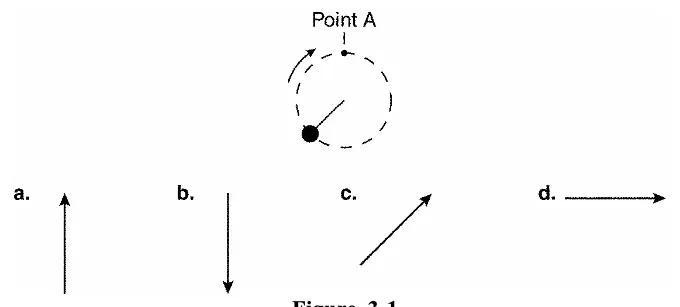
A ball attached to a string is being swung in a clockwise circular path as shown in Figure 3-1. Assume the string breaks at point A. In which direction will the ball be traveling an instant later?
direction b
direction c
direction d
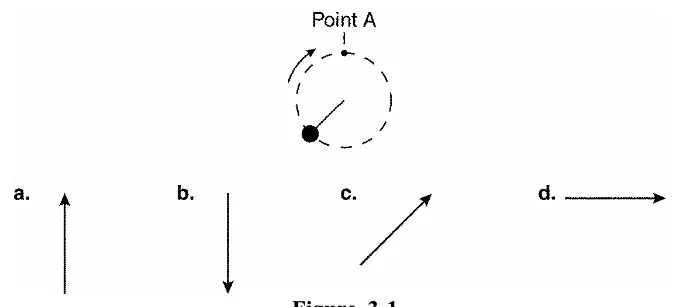
A ball attached to a string is being swung in a clockwise circular path as shown in Figure 3-1. In which direction will the acceleration on the ball be when the ball passes point A?
direction a
direction b
direction c
A real car moving at 10 km/h has more momentum than a toy car moving at the same speed because the real car ___
generates less friction
has greater mass
has less mass
Which has more momentum, a large truck moving at 30 miles per hour or a small truck moving at 30 miles per hour?
Both have the same momentum.
The small truck
The large truck
The reason padded dashboards are used in cars is that they
decrease the time of impact in a collision.
increase the force of impact in a collision.
increase the time of impact in a collision.
A 5.0-kg chunk of putty moving at 10.0 m/s collides with and sticks to a 7.0-kg bowling ball that is initially at rest. The bowling ball with its putty passenger will then be set in motion with a momentum of
50.0 kgm/s.
more than 50.0 kgm/s.
2.0 kgm/s.
A 2-kg ball is thrown at 3 m/s. What is the ball's momentum?
2 kgm/s
3 kgm/s
6 kgm/s
In order to catch a ball, a baseball player moves his or her hand backward in the direction of the ball's motion. Doing this reduces the force of impact on the player's hand principally because
the time of impact is decreased.
the time of impact is increased.
the velocity of the hand is reduced.
An unfortunate bug splatters on the windshield of a moving car. Compared to the car, the change in momentum for the bug is
more than the car.
less than the car.
the same as the car.

