
 Worksheets
Wireless Communication and Networking Quiz
Total questions: 86
Worksheet time: 43mins
When looking at the wireless spectrum, what happens to the frequency and wavelength when going from radio waves to microwaves, to infrared, to ultraviolet, to x-rays, to gamma-rays?
The frequency increases while the wavelength decreases.
The frequency decreases while the wavelength increases.
Both frequency and wavelength increase.
Both frequency and wavelength decrease.
How many channels are available for 802.11 (Wi-Fi) in Japan?
11
13
14
16
In the United States, how many channels are typically available for an 802.11 wireless network operating in the 2.4 GHz band?
9
10
11
12
How many channels does a standard Bluetooth connection utilize?
37
79
40
22
How many channels does the Zigbee protocol typically utilize in the 2.4GHz band?
11
14
16
20
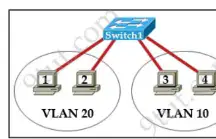
On a corporate network, hosts on the same VLAN can communicate with each other, but they are unable to communicate with hosts on different VLANs. What is needed to allow communication between the VLANs?
A router with subinterfaces configured on the physical interface that is connected to the switch
A switch with a trunk link that is configured between the switches
A hub connecting all VLANs
A repeater for each VLAN
On a corporate network, hosts on the same VLAN can communicate with each other, even if they are in different buildings on different switches. What is needed to allow communication between the same VLAN hosts?
A router with subinterfaces
A hub connecting all VLANs
A repeater for each VLAN
A switch with a trunk link that is configured between the switches
Which of the following statements is TRUE regarding the 802.1Q standard for VLANs?
802.1Q allows for the creation of multiple broadcast domains on a single physical network segment by tagging frames with VLAN IDs.
802.1Q is used for wireless network configurations.
802.1Q is a standard for IP address allocation.
802.1Q is a protocol for network security.
When we created VLANs in the lab, we assigned a VLAN number (such as 3 or 99) to the switch’s:
IP Addresses
Ports/Interfaces
Subnets
Routers
How many bits are required to represent a virtual local area network identifier in an ethernet frame?
8 bits
10 bits
12 bits
16 bits
In _____, switch ports can’t be deleted or edited but can be used.
VLAN 0
VLAN 1
VLAN 10
VLAN 100
A VLAN can span ____ switches?
Single
Multiple
No
Two
VLAN lets you easily _____ your network.
Segment
Expand
Slow down
Disconnect
When setting the subnet 200.12.1.0/24 with a packet tracer, you would set the router gateway to be:
200.12.0.1
200.12.1.1
200.12.1.254
200.12.2.1
When setting the subnet 200.12.1.0/24 using DHCP, the DHCP server would be set to listen to port:
53
80
67
21
When setting the subnet 200.12.1.0/24 using DHCP, If the DHCP is not configured correctly, hosts are assigned addresses from this range instead:
192.168.0.0/16
10.0.0.0/8
169.254.0.0/16
172.16.0.0/12
A DHCP helper, also known as a DHCP relay agent, is needed when setting a server across routers because:
It allows the server to assign different IP address ranges to different subnets.
DHCP discovery packets are broadcast and cannot normally reach a server on a different subnet without the helper forwarding them.
It provides additional security by encrypting DHCP packets.
It reduces the overall network traffic by filtering DHCP requests.
The top layer in the Networking Internet Stack is the:
The application layer
The transport layer
The network layer
The data link layer
The layer where we assign port numbers to a network process is the:
The application layer
The transport layer
The network layer
The link layer
The layer where we assign host IP addresses of the source and destination to the datagram is the:
The application layer
The transport layer
The network layer
The link layer
Using bits, the difference between IPv.4 and IPv.6 in terms of size:
IPv.4 uses 16 bits while IPv.6 uses 32
IPv.4 uses 32 bits while IPv.6 uses 128
IPv.4 uses 64 bits while IPv.6 uses 128
IPv.4 uses 128 bits while IPv.6 uses 256
Which of the following is not a major difference between wired and wireless networks:
Speed of data transmission
Physical medium of transmission
IP address assignment
Security protocols
A base station in a wireless network is simply considered:
A network layer device
A link layer device
A transport layer device
An application layer device
A temperature sensor that is drawing power from an AC outlet is used to measure heat at a cellular tower and transmits the reading over a Wi-Fi radio frequency. This would be an example of:
A mobile and wireless device
A wired and mobile device
A wireless but not mobile device
A wired and stationary device
The latest 802.11 Wi-Fi can reach a theoretical transmission rate that is:
Less than 10 Mbps
Between 10 and 50 Mbps
Between 50 and 100 Mbps
More than 100 Mbps
802.11ax and 802.11n use
CSMA/CD and CSMA/CD
CSMA/CA and CSMA/CD
CSMA/CD and CSMA/CA
CSMA/CA and CSMA/CA
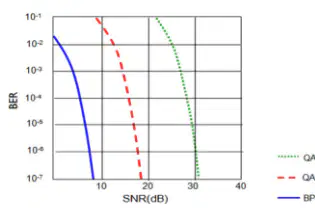
Given the above BER-SNR diagram. To get a Bit Error Rate of one in 1000 with an SNR close to 27 dB, you would select:
QAM 256
QAM 16
QAM 64
BPSK
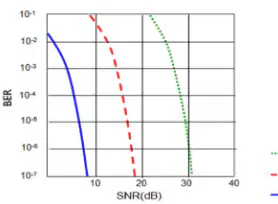
Given the above BER-SNR diagram. If you are using QAM-256, to reduce the error rate (BER) while keeping the data rate constant, you would:
Decrease SNR
Increase SNR
Use QAM 16
Use BPSK
In the 802.11 protocol, the AP sends beacon frames that include its
SSID and the MAC address
IP Address and the MAC Address
SSID and the IP Address
Frequency and the SSID
In 802.11 protocol, when the host broadcasts a probe frame for the surrounding APs, the method is called:
Passive Scanning
Active Listening
Active Scanning
Passive Listening
In 802.11 protocol, the use of RTS and CTS control frames is to overcome:
Signal Interference
Bandwidth Limitation
Frequency Overlap
Hidden Terminal Problem
802.11 does not implement collision detection because:
It uses a different frequency for each device.
Even if it does, it will not detect all collision due to hidden terminal problem.
It is hard to measure the received signal and compare to sent signal at the adapter.
It relies on wired connections to avoid collisions.
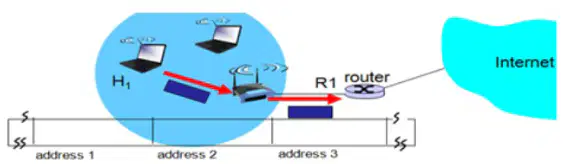
In the above diagram regarding 802.11, Address one (remember that the format has destination, source, others) would be that of:
The IP address of the router
The MAC address of H1
The MAC address of the Internet
The MAC address of AP

In the above diagram regarding 802.11, Address two (remember that the format has destination, source, others) would be that of:
The IP address of the Internet
The MAC address of the router
The MAC address of H1
The MAC address of AP

In the above diagram regarding 802.11, Address three would be that of:
The IP address of H1
The MAC address of R1
The MAC address of the Internet
The MAC address of AP
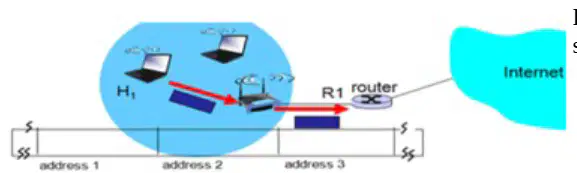
In the above diagram regarding 802.11, H1 can switch from BBS1 to BBS2 without changing its IP address:
Because the two BBSs are in different subnets
Because the two BBSs are within the same subnet
Because H1 has a static IP address
Because the router assigns a new IP address

The closest bps range for 802.15 (Bluetooth) among the following is:
10 Mbps
54 Mbps
100 Mbps
1 Gbps
The aspect of security where only the sender and the intended receiver should “understand” message content is called:
Confidentiality
Integrity
Availability
Access Control
The aspect of security where the sender and the receiver want to confirm the identity of each other is called:
Authentication
Authorization
Encryption
Non-repudiation
One of the famous unlicensed frequency bands is the ISM band, which stands for:
Information, Security, and Management
Industrial, Scientific, and Medical
Internet, Satellite, and Mobile
Integrated, Secure, and Managed
Which of the following are three services expected from the link layer in networking?
Flow control, medium access control, and error detection and correction
Medium access control, packet forwarding, and routing
Address resolution, error detection, and encryption
Flow control, routing, and data compression
Which of the following are three broad classes of Media Access Control (MAC) protocols?
Channel Partitioning, Random Access, and Token Passing
Flow Control, Error Detection, and Network Addressing
Encryption, Decryption, and Authentication
Routing, Switching, and Bridging
In the Ethernet frame, which three fields are always present besides the payload?
Source Address, Destination Address, and CRC
Source Address, Protocol Type, and CRC
Destination Address, Protocol Type, and CRC
Source Address, Destination Address, and Protocol Type
A Wi-Fi Access Point (AP) is considered a layer ________________ networking device (counting from the bottom).
1 (Physical Layer)
2 (Data Link Layer)
3 (Network Layer)
4 (Transport Layer)
What are three significant differences between wired and wireless networks regarding the signal communicated?
Interference, Attenuation, and Medium Access Control
Interference, Fading, and Attenuation
Medium Access Control, Signal Strength, and Latency
Signal Strength, Latency, and Fading
802.11a has a bps rate of:
6 Mbps
11 Mbps
54 Mbps
600 Mbps
802.11n has roughly a ______________ bps rate of around:
54 Mbps
100 Mbps
300 Mbps
600 Mbps
802.11a and 802.11n use:
CSMA/CD and CSMA/CA, respectively
CSMA/CA and CSMA/CD, respectively
CSMA/CA and CSMA/CA, respectively
CSMA/CD and CSMA/CD, respectively
CDMA stands for ________________ and is a form of ________________ when regarding the link layer.
Code Division Multiple Access, channel access method
Carrier Division Multiple Access, channel access method
Code Division Multiple Access, data link method
Carrier Division Multiple Access, data link method
A power ratio of 200 implies an SNR of:
20 dB
23 dB
26 dB
30 dB
Which of the following is the formula for calculating Signal-to-Noise Ratio (SNR) in decibels (dB)?
SNR = 20 log10 (Psignal / Pnoise)
SNR = 10 log10 (Psignal / Pnoise)
SNR = 10 log10 (Pnoise / Psignal)
SNR = 20 log10 (Pnoise / Psignal)
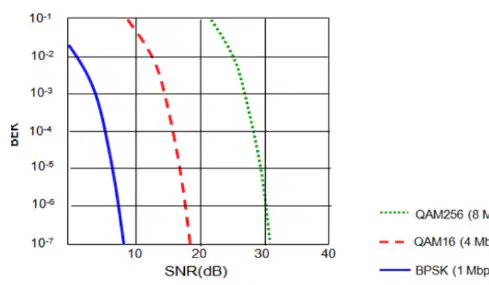
Given a BER-SNR diagram, BER, which characterizes the communication channel digitally, stands for:
Bit Energy Rate
Bandwidth Efficiency Ratio
Binary Error Ratio
Bit Error Rate
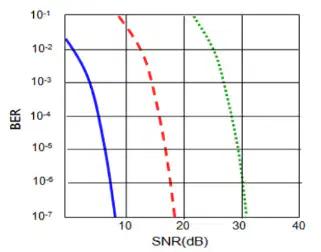
Given the above BER-SNR diagram. To get a BER of one in 10000000 with an SNR close to 18 dB, you would select:
QAM 256
QAM 16
BPSK
QAM 64
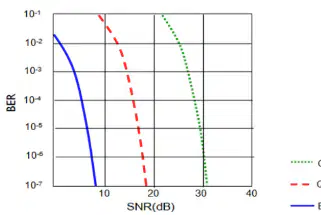
Given the above BER-SNR diagram. If you are using BPSK, your BER at 5 dB would be:
1 in 1,000
1 in 100,000
1 in 10,000
1 in 1,000,000
In wireless networks, the term BSS, also known as "cell," stands for:
Basic Service Set
Broadcast Signal System
Base Station Sector
Binary Signal Set
The two modes used in wireless networks are:
Cellular Mode and Satellite Mode
Bluetooth Mode and Infrared Mode
Infrastructure Mode and Ad Hoc Mode
Wi-Fi Mode and ZigBee Mode
What are the three 2.4 GHz non-overlapping channels usually used to optimize the bandwidth distribution by limiting competing frequencies?
2, 4, 6
1, 6, 11
3, 7, 10
5, 9, 13
In wireless networks, the term MANET stands for:
Mobile Access Network
Managed Ad Hoc Network
Mobile Ad Hoc Network
Multi-Access Network
Calculate the bandwidth (BW) of wireless technology with a frequency range of 5.1 to 5.8 GHz.
600 MHz
700 MHz
800 MHz
900 MHz
What is the number of channels in the Wi-Fi 802.11a/n/ac (American System)?
11
13
24
30
What is the number of channels in the Wi-Fi 802.11b/g (American System)?
9
11
13
15
What is the number of channels in the ANT+ technologies?
78
50
100
120
What is the primary reason we use wireless protocols other than Wi-Fi, such as Bluetooth (BT), ZigBee, and Z-Wave?
Higher data transfer rates
Lower power consumption and longer battery life
Greater range
Better security
Which two of the following are security risks associated with Bluetooth devices?
Bluejacking and Bluebugging
Phishing and Spoofing
Hacking and Sniffing
Eavesdropping and Man-in-the-Middle
Which network topology is commonly used in ZigBee?
Star topology
Ring topology
Mesh topology
Bus topology
In which of the following areas is ZigBee commonly used?
Industrial automation
Home automation
Military communication
Space exploration
Which network topology is used in Z-Wave?
Star topology
Bus topology
Mesh topology
Ring topology
In which of the following areas is Z-Wave commonly used?
Industrial automation
Automotive systems
Home automation
Medical devices
Which wireless technology is primarily used in sports and fitness applications?
Bluetooth
Wi-Fi
ANT+
NFC
Which wireless technology is primarily used in measuring proximity to the device?
Bluetooth
IR (Infrared)
Wi-Fi
ZigBee
Which wireless technology belongs to a group of technologies called automatic identification and data collection (AIDC)?
Bluetooth
RFID (Radio Frequency Identification)
Wi-Fi
NFC
Which wireless technology is an IPv6-based, low-power mesh networking technology for Internet of Things (IoT) products?
ZigBee
Bluetooth
Wi-Fi
Thread
Which application protocol was created to solve the interoperability challenge of IoT vendors by providing a universal open-source solution for smart home devices to communicate with each other, regardless of the manufacturer?
ZigBee
Bluetooth
Matter
Wi-Fi
In the 802.11 protocol, the AP sends beacon frames that include its
IP address
SSID and the MAC address
Channel number
Frequency band
In 802.11 protocol, when the host broadcasts a probe frame for the surrounding APs, the method is called.
Scanning
Probing
Broadcasting
Polling
What does the RTS short control frame used for reserving access to the channel stand for?
Reverse To Send
Request To Send
Reserve To Send
Ready To Send
What does the CTS short control frame used for reserving access to the channel stand for?
Confirm To Send
Clear To Send
Continue To Send
Connect To Send
The use of the RTS and CTS frames to reserve access to the wireless channel can improve performance by mitigating:
Multiple MAC addresses problem
Signal interference problem
The hidden station problem
Frequency overlap problem
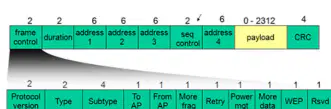
In the 802.11 frame structure, the ________ flag field is used for security (encryption).
WEP flag field
ACK flag field
Retry flag field
Power Management flag field
During the 802.11 association handshake protocol, the wireless host gets assigned an IP address.
True
False
Logical partitioning of a switch can create virtual local area networks.
True
False
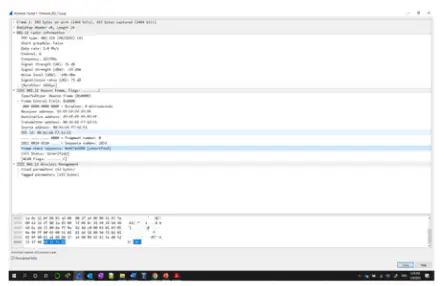
Answer the following questions about the packet from an 802.11 capture trace. The AP from which the frame is captured is an:
802.11a
802.11b
802.11g
802.11n
Answer the following questions about the packet from an 802.11 capture trace. What is the size of the MAC address of the AP?
32 bits
48 bits
64 bits
128 bits
Answer the following questions about the packet from an 802.11 capture trace. What is the destination address the AP uses to reach its clients?
00:16:b6:f7:1d:50
00:16:b6:f7:1d:51
00:16:b6:f7:1d:52
00:16:b6:f7:1d:53
Answer the following questions about the packet from an 802.11 capture trace. What is the frequency used for the AP?
2400 MHz
2420 MHz
2437 MHz
2450 MHz
Answer the following questions about the packet from an 802.11 capture trace. What is the channel used for the AP?
1
6
11
14

